Museums and galleries
Connect collections research, documentary comparison and exhibition development. Keep object identities, source roles, rights and unresolved questions inspectable.
← Research Tools and Experiments · Research
Working prototype · Observatory · Version 2.1
A research workbench for museums, galleries, curators and individual researchers. Bring artworks, artifacts, sources and encounters into one inquiry. Preserve the evidence behind an account, compare conflicting descriptions and make a curatorial decision open to revision.
Developed by Dorian Vale; maintained by Museum of One. Documentation revised 21 October 2026.
Evidence status: the guide documents implemented research workflows. Its records are constructed examples; no empirical validation, museum pilot or participant findings are claimed.
This public page explains the working prototype and how to use it. Screenshots show the actual local interface with original schematic images and entirely constructed documentation records. Research takes place in the separately run local application.
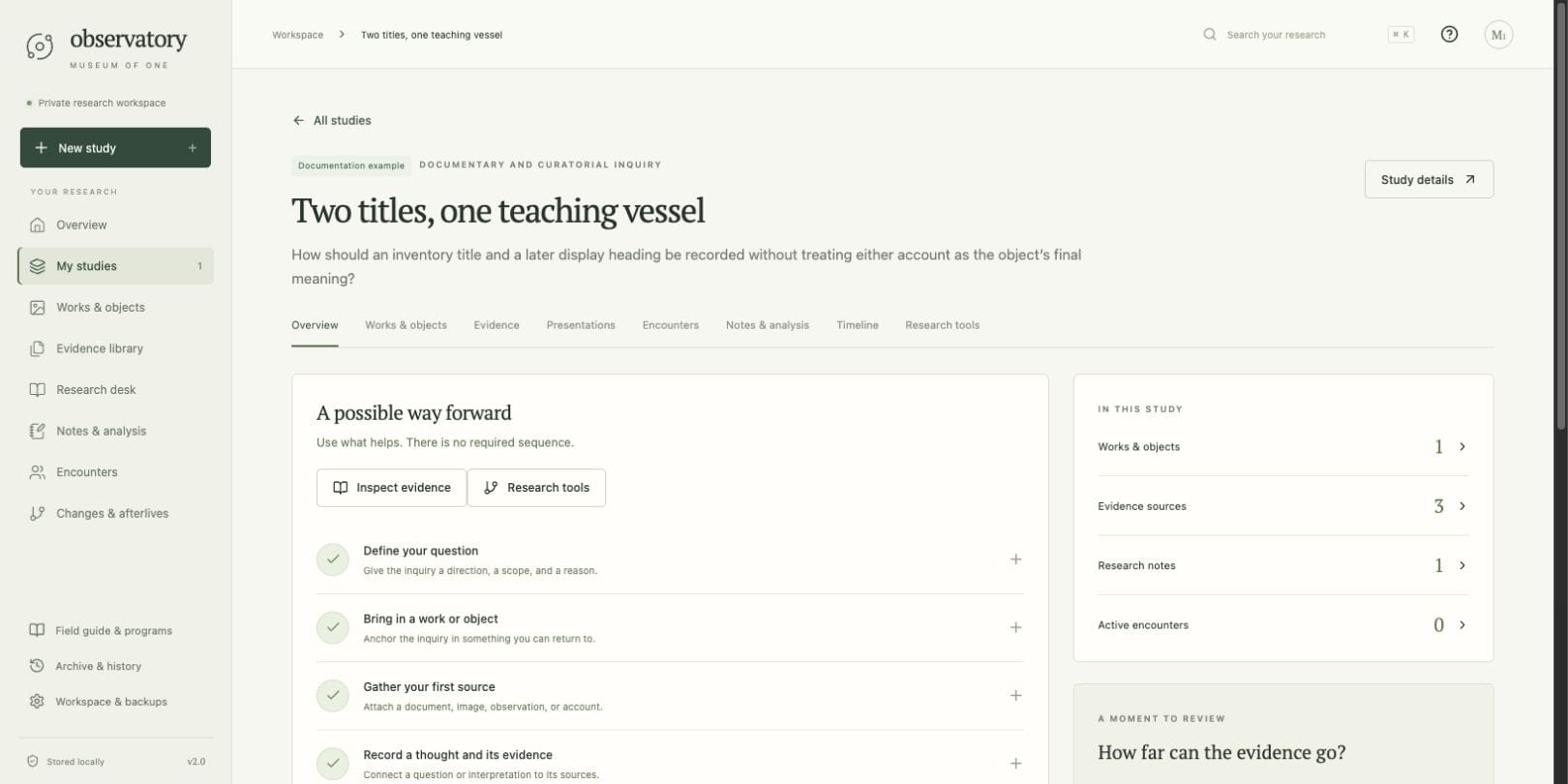
New in Observatory 2.1 · Guided workflows
Begin with a question. The guided workflow brings the next useful action into view, from gathering works and sources to following evidence and preparing an output.
Choose a starting route, then adapt it to the research. Keep the steps you need for object histories, curatorial decisions, exhibition conditions, encounters, documentary work or another inquiry. Open the relevant research tool from a step and return to the guide when you are ready.
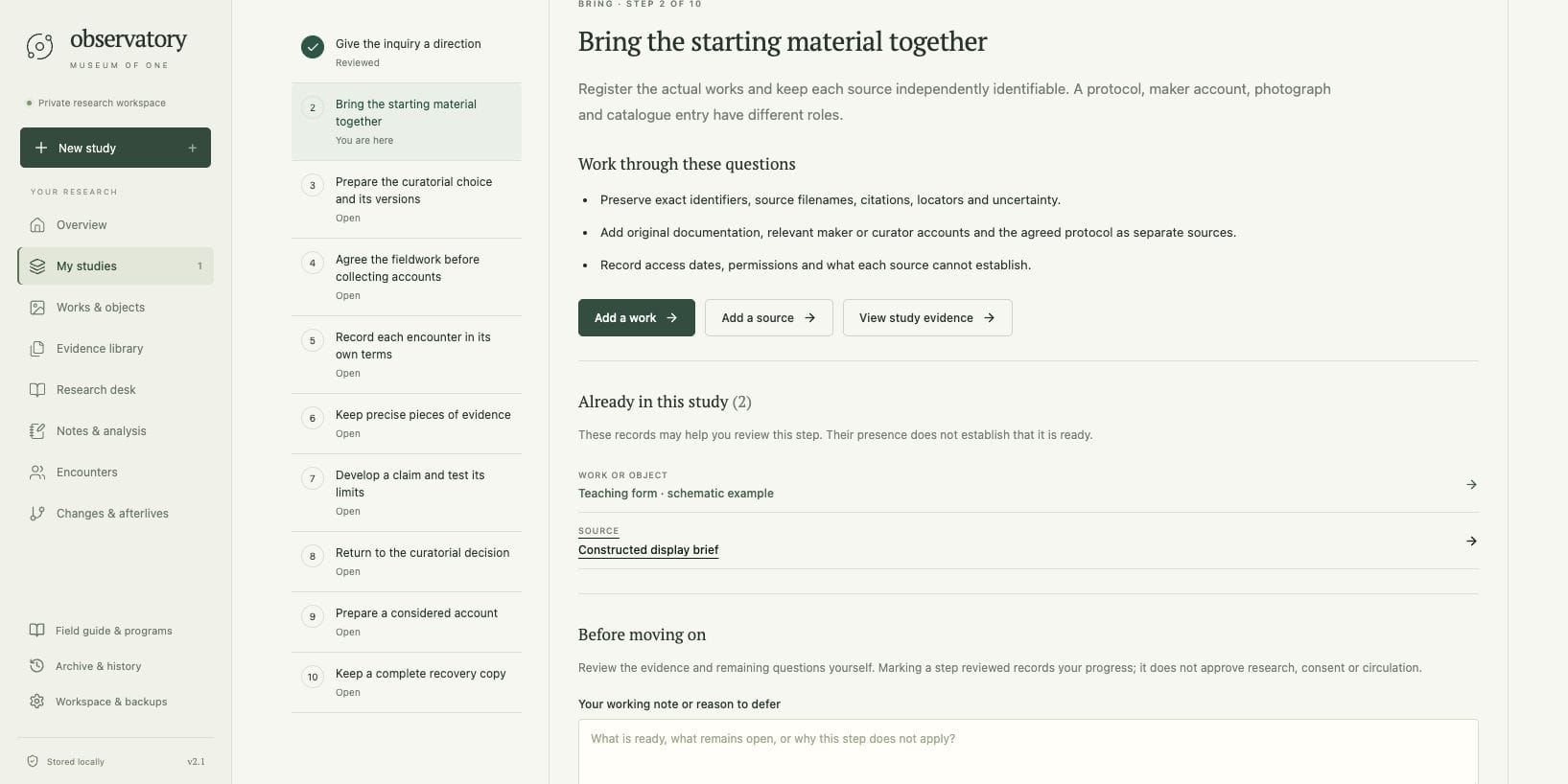
Save a working note, mark a step reviewed, or defer it with a reason. Return later with your progress and notes intact.
Enlarge image ⤢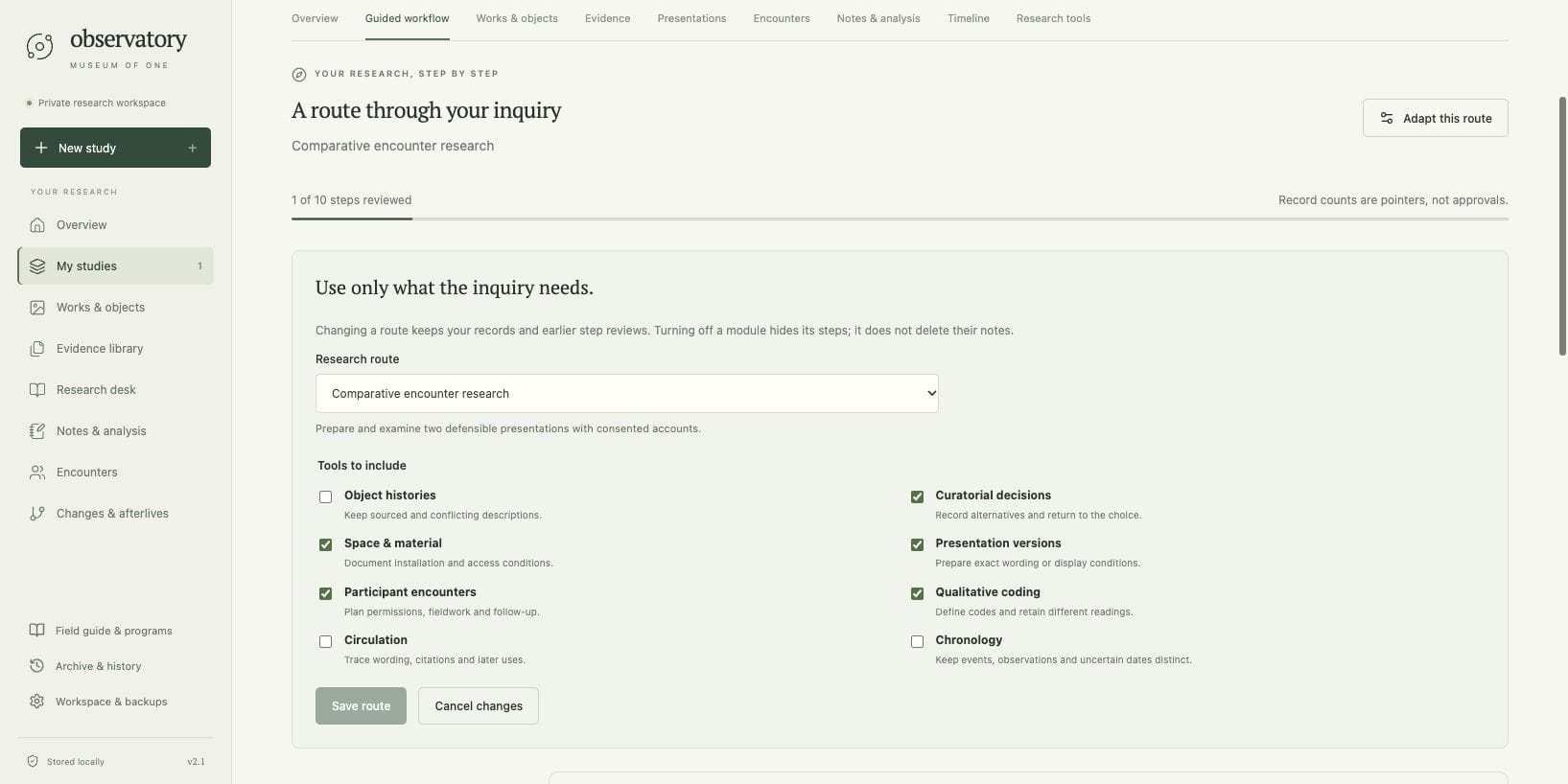
Change the starting route and optional modules as the inquiry develops. Hidden steps retain their saved notes and reviews.
Enlarge image ⤢Start here: choose New study → Guide me step by step, or open an existing study and select Guided workflow. Use Adapt this route to choose what the inquiry needs.
Workflow notes remain private and are excluded from research outputs. Reviewing a step records your progress; it does not establish consent, permissions or the validity of a finding. These screenshots contain fictional demonstration records and no participant findings.
For museums, galleries and curators
For teams and researchers who need to explain how an account, object record or exhibition decision was reached and retain the evidence and uncertainty behind it.
Ask a question. Bring things together. Follow the evidence. Start from the work and the situation, with room for several accounts to remain in view.
Connect collections research, documentary comparison and exhibition development. Keep object identities, source roles, rights and unresolved questions inspectable.
Retain an installation’s conditions, the alternatives considered and the reasons for a decision. Revisit the account when a source, situation or attribution changes.
Bring qualitative readings, properly consented encounter records and documentary evidence into the same inquiry without treating their different roles as interchangeable.
Start with one uncertainty or decision your team is already discussing. These are proposed uses, illustrated by the working interface and constructed records.
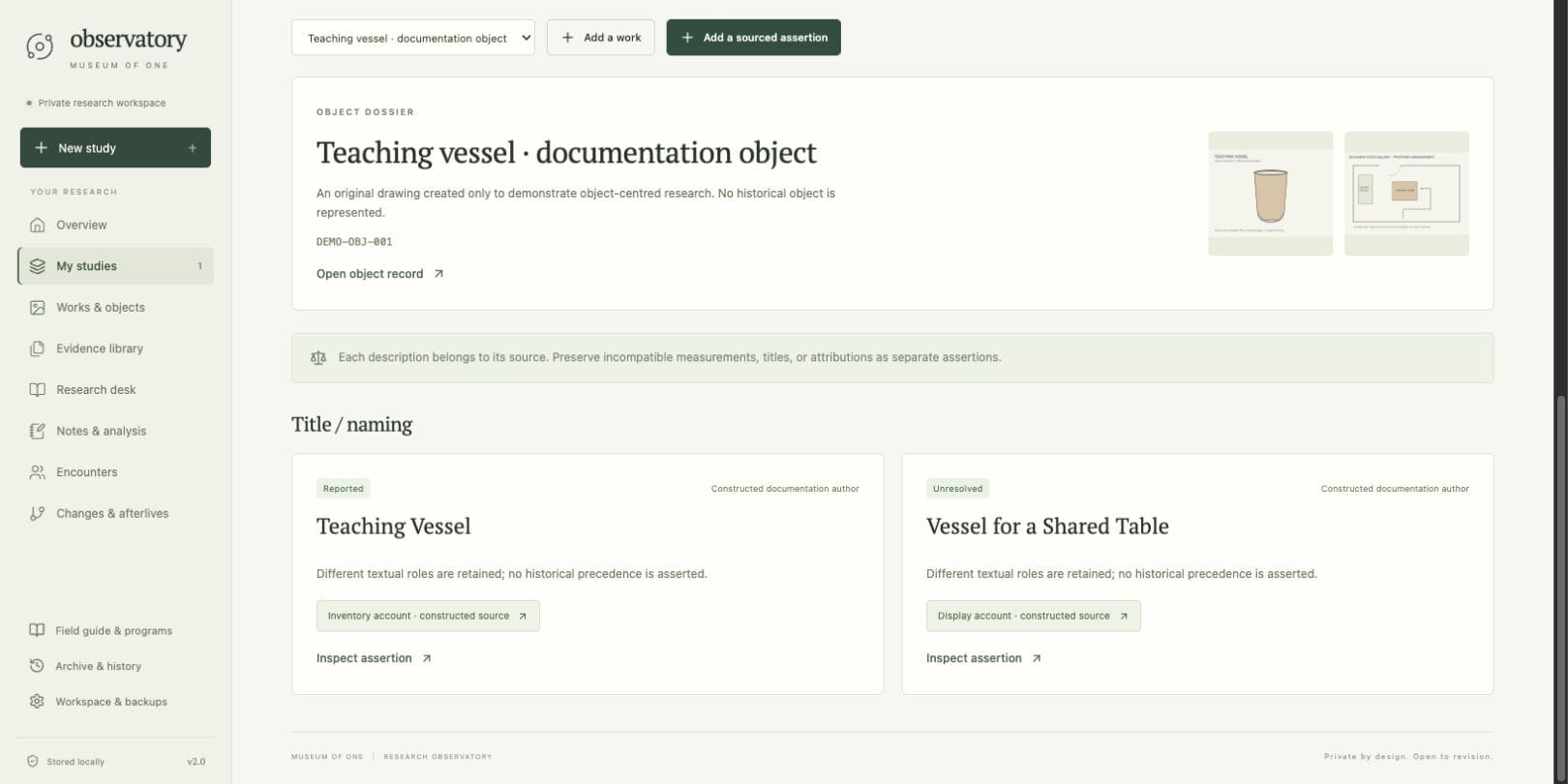
Proposed museum workflow · interface illustration
Which description belongs to which source?
Retain an old title, a later title and their provenance without silently overwriting either.
Retain an old title, a later title and their provenance without silently overwriting either. Compare the original identifiers, dates and wording before deciding whether a catalogue change is warranted.
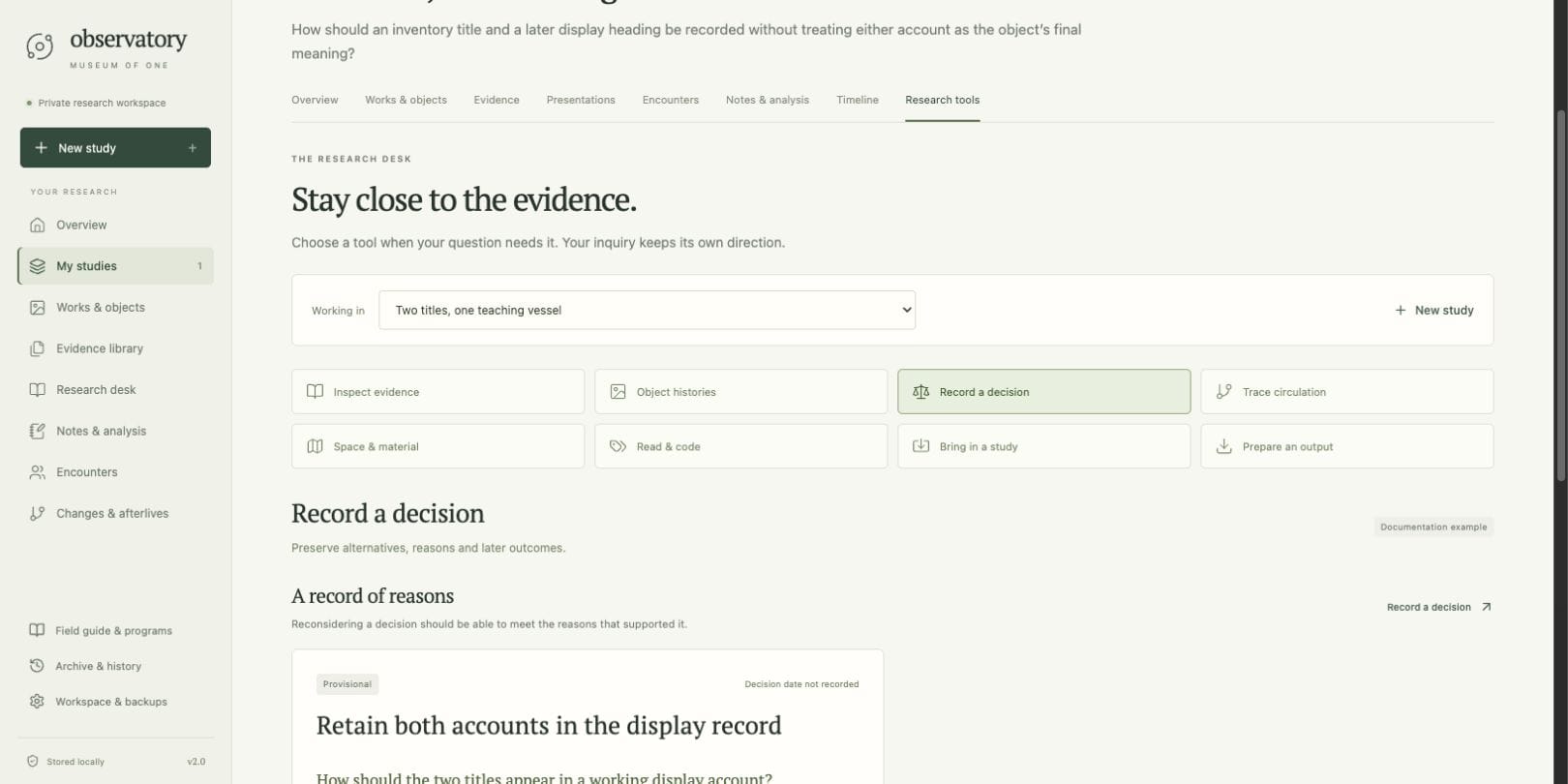
Proposed museum workflow · interface illustration
Why was this arrangement or wording chosen?
Record alternatives and responsible voices alongside the evidence.
Record alternatives and responsible voices alongside the evidence. State what the decision can establish and what a later review would need to reconsider it.
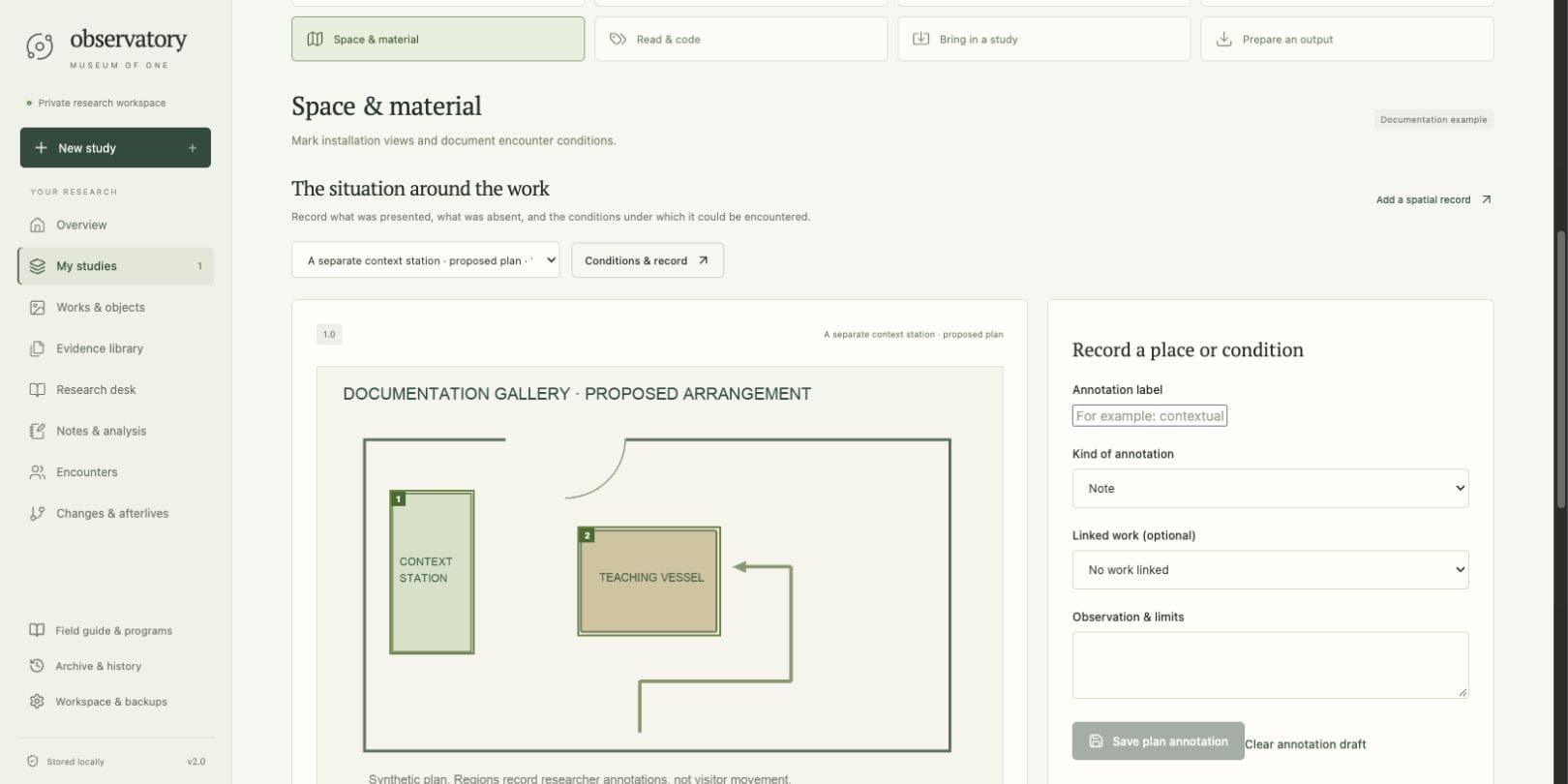
Proposed museum workflow · interface illustration
What was available to be encountered?
Retain plans or installation photographs with versioned spatial records.
Retain plans or installation photographs with versioned spatial records. Record omission, sequence, sightlines and access; investigate any claim about a visitor effect through a separate study.
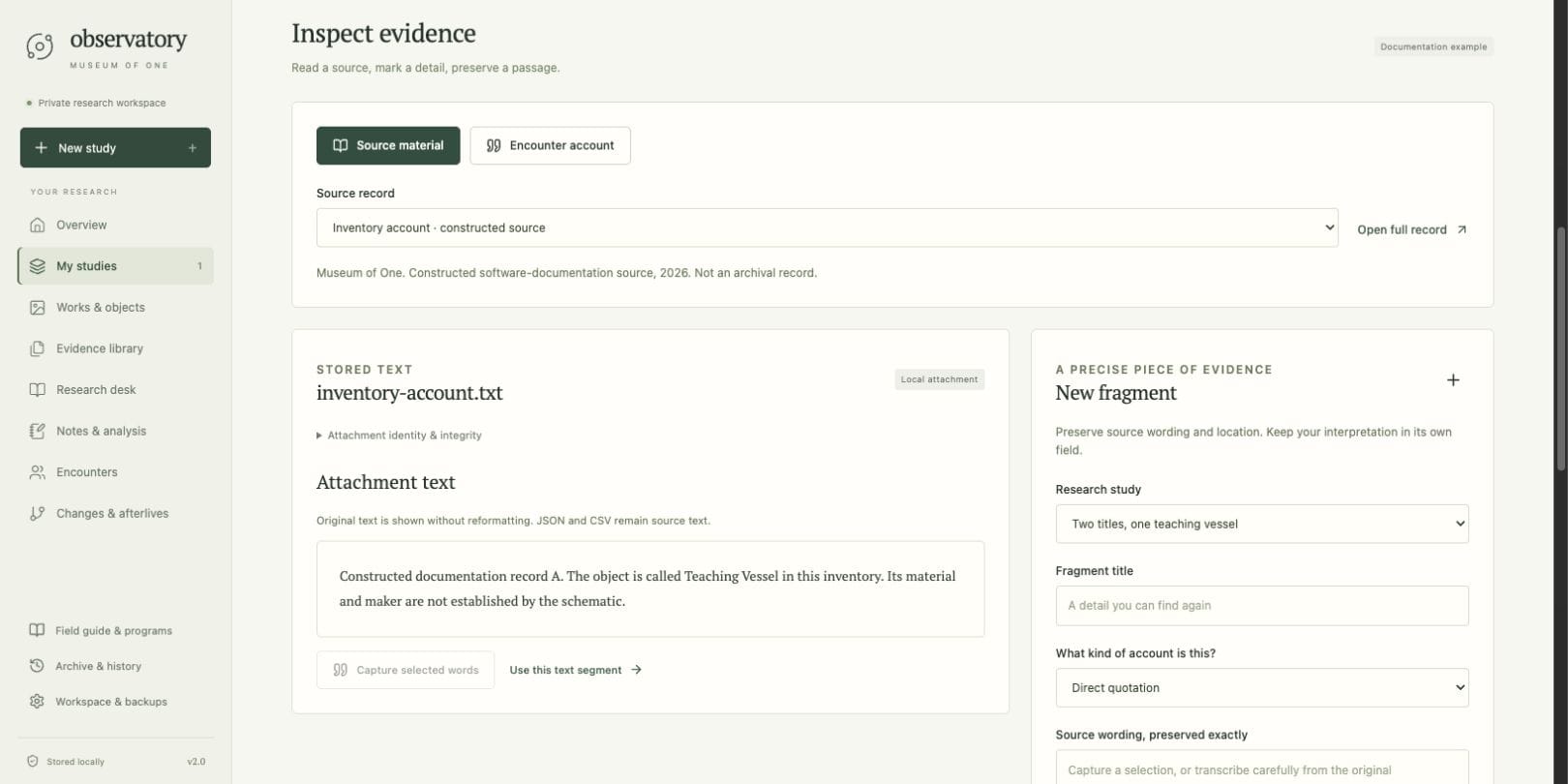
Proposed museum workflow · interface illustration
What changes when the source is re-read?
Capture the exact passage and its locator.
Capture the exact passage and its locator. Keep source wording, translation, paraphrase and researcher inference distinguishable; connect the correction to supporting and contrary evidence.
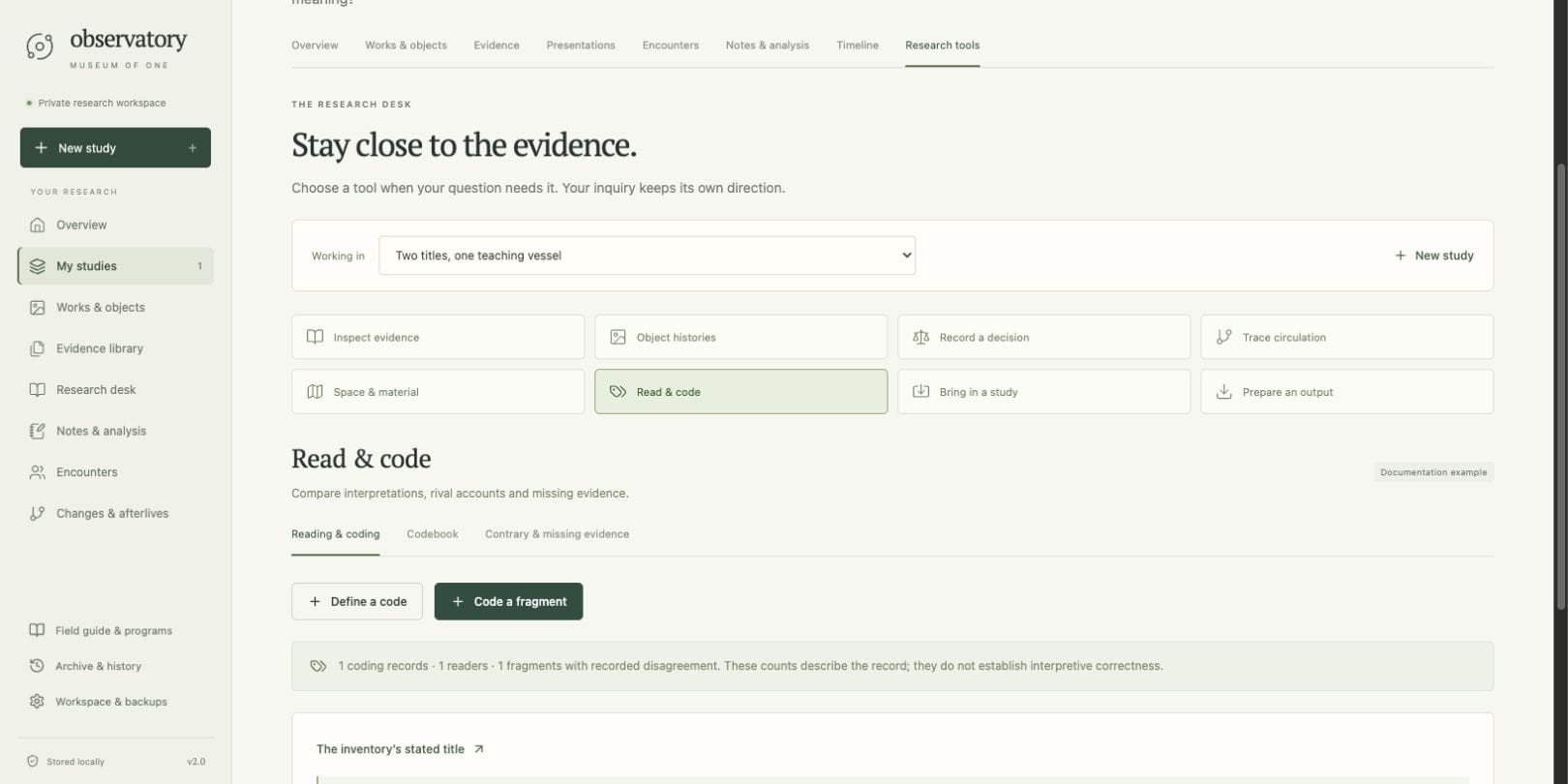
Proposed museum workflow · interface illustration
Where do readers agree, disagree or hesitate?
Define a coding scheme appropriate to the inquiry, preserve independent reading records, and examine negative cases.
Define a coding scheme appropriate to the inquiry, preserve independent reading records, and examine negative cases. The software does not automatically adjudicate disagreement or calculate a validated measure of meaning.
Proposed museum workflow · interface illustration
How does an account move between settings?
Record source-to-source and passage-to-passage relationships with their evidence.
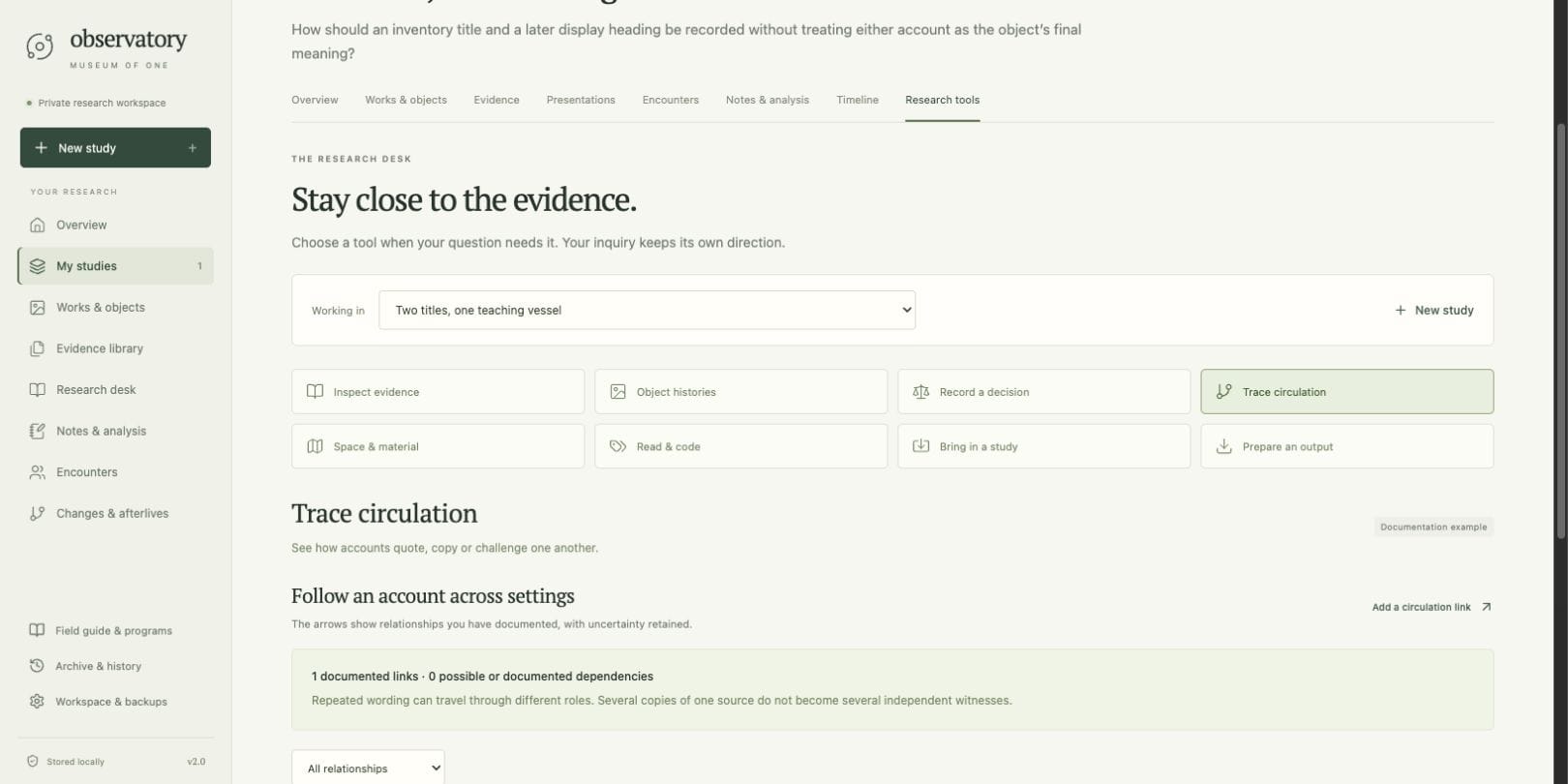
Record source-to-source and passage-to-passage relationships with their evidence. Preserve uncertainty about translation, influence and independence rather than treating every repeated phrase as a new witness.
This prototype supports research documentation and analysis. It is not a collections-management replacement, provenance certification, visitor-tracking system or automatic finding generator. Its usefulness in particular museum settings must be investigated, not assumed.
Inside the working prototype
Fifteen actual application views across four stages. All records are constructed for documentation; the images depict no historical collection or real exhibition.
Begin with a question, a research direction, the scope and a next step. A study keeps the evidence together without prescribing one method.
Enlarge image ⤢Keep object images, exact identifiers and competing sourced descriptions together. The two titles here have different documentary roles.
Enlarge image ⤢Annotate a plan or installation view and retain selection, omission, sequence, placement and access conditions. Regions are researcher annotations, not visitor movement.
Enlarge image ⤢Inspect a local attachment, preserve exact wording and record a locator. Your observation or interpretation has its own field.
Enlarge image ⤢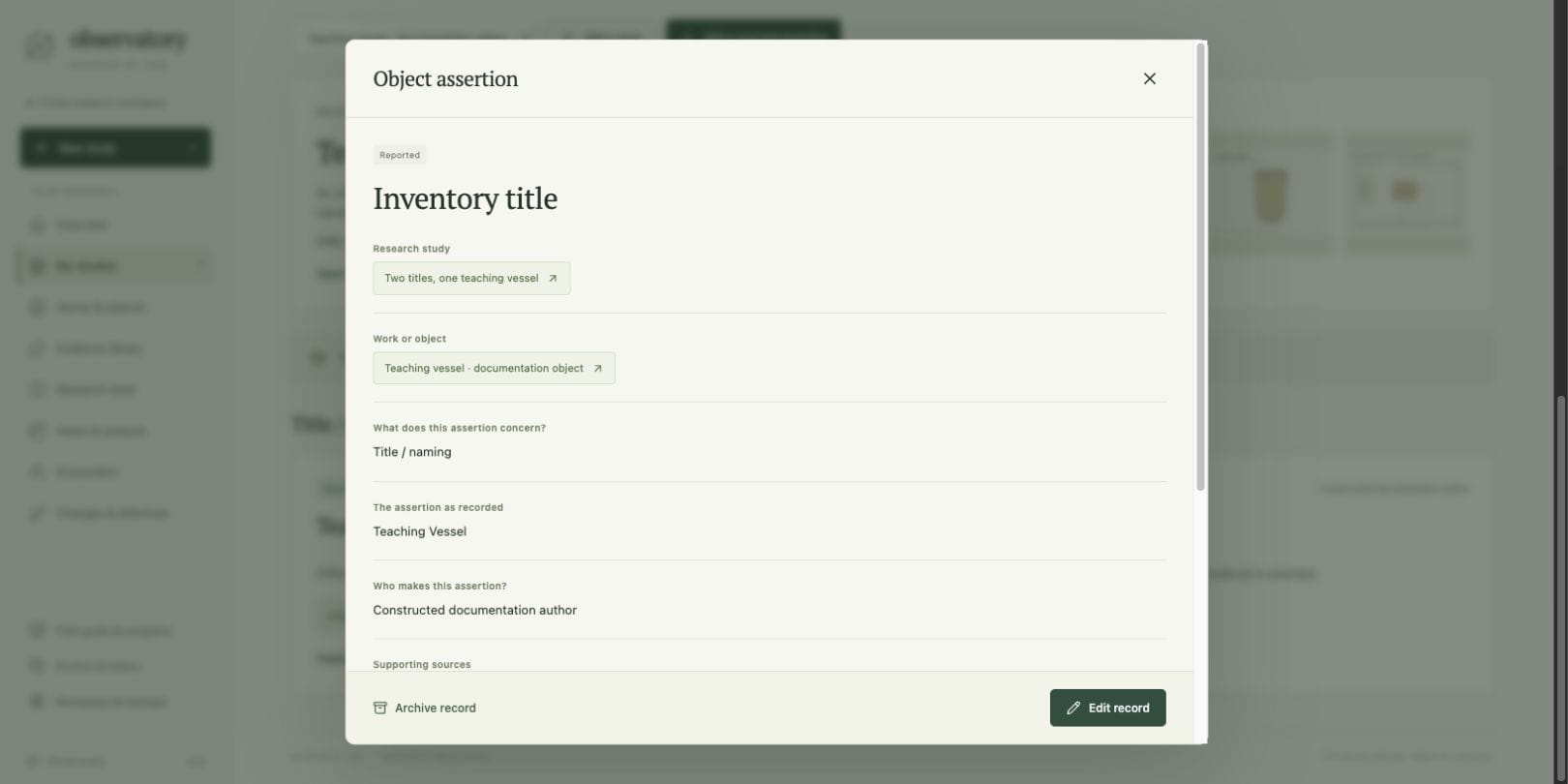
Record who makes an attribution or description, its supporting sources and its unresolved standing. A source record does not establish the truth of its assertion.
Enlarge image ⤢Retain alternatives, evidence, responsible voices, disagreement, the chosen course and later outcomes. Revisit the decision when its evidence changes.
Enlarge image ⤢Describe documented relationships between particular sources or passages. Repetition does not by itself establish independent corroboration or copying.
Enlarge image ⤢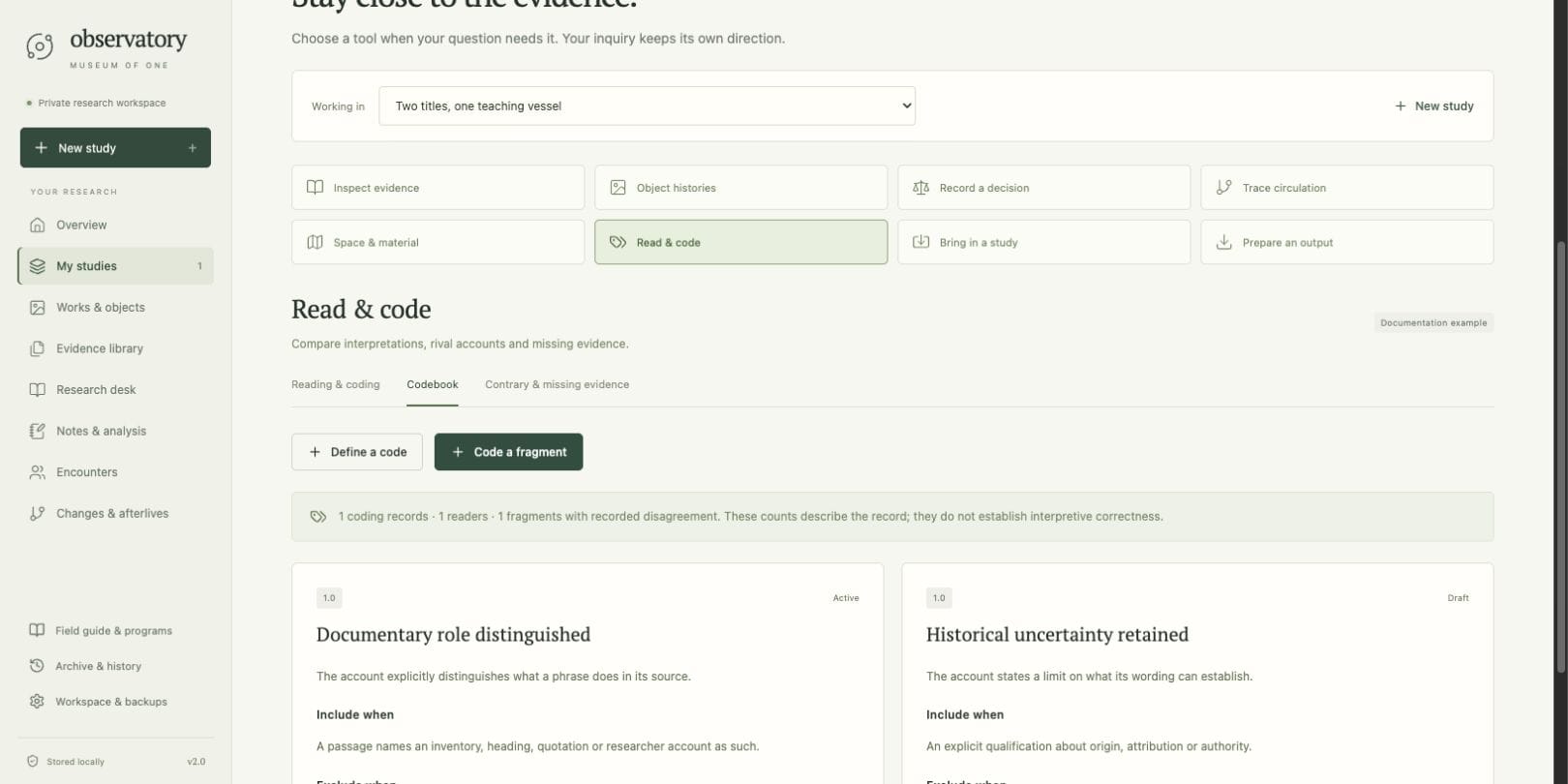
Keep code definitions, inclusion and exclusion criteria and versions available for scrutiny. Changing an applied definition requires a new version.
Enlarge image ⤢Attach a named reading and analytical pass to a precise fragment. Counts describe recorded work; they do not establish interpretive correctness.
Enlarge image ⤢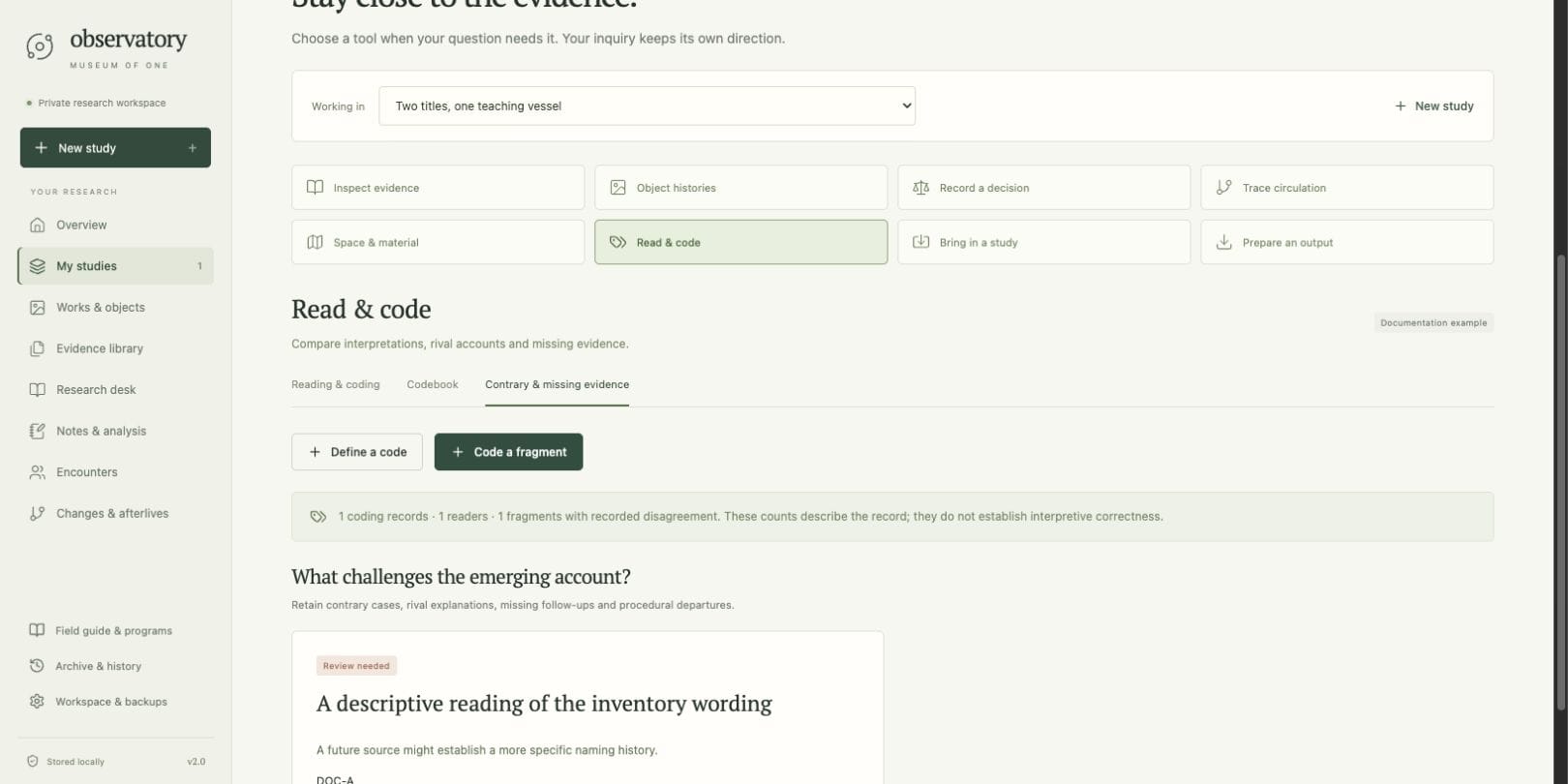
Keep negative cases, rival explanations, disagreement and missing follow-ups visible instead of smoothing them into a single conclusion.
Enlarge image ⤢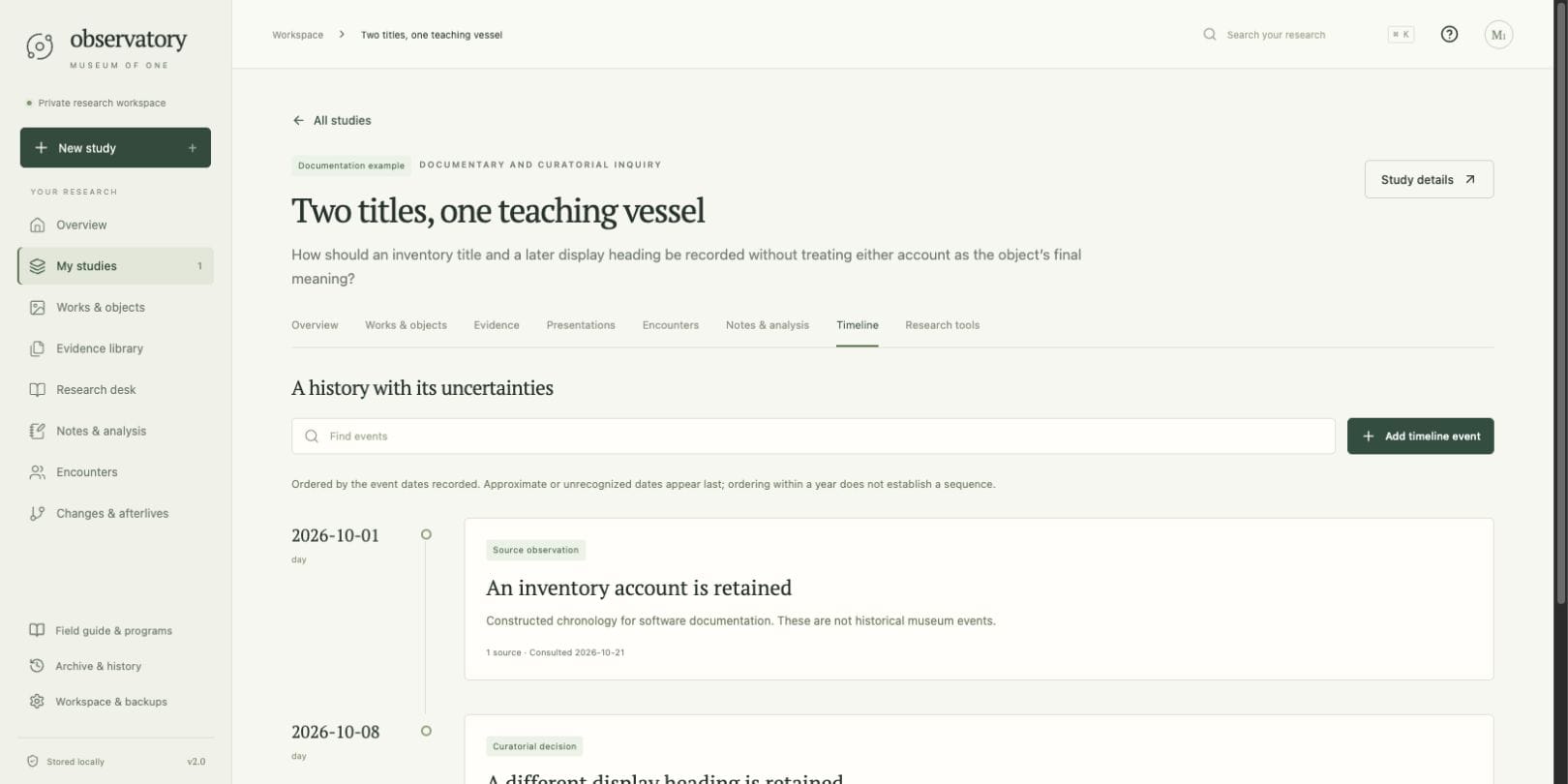
Distinguish an event date from the date its source was consulted. The dates shown here are invented demonstration values.
Enlarge image ⤢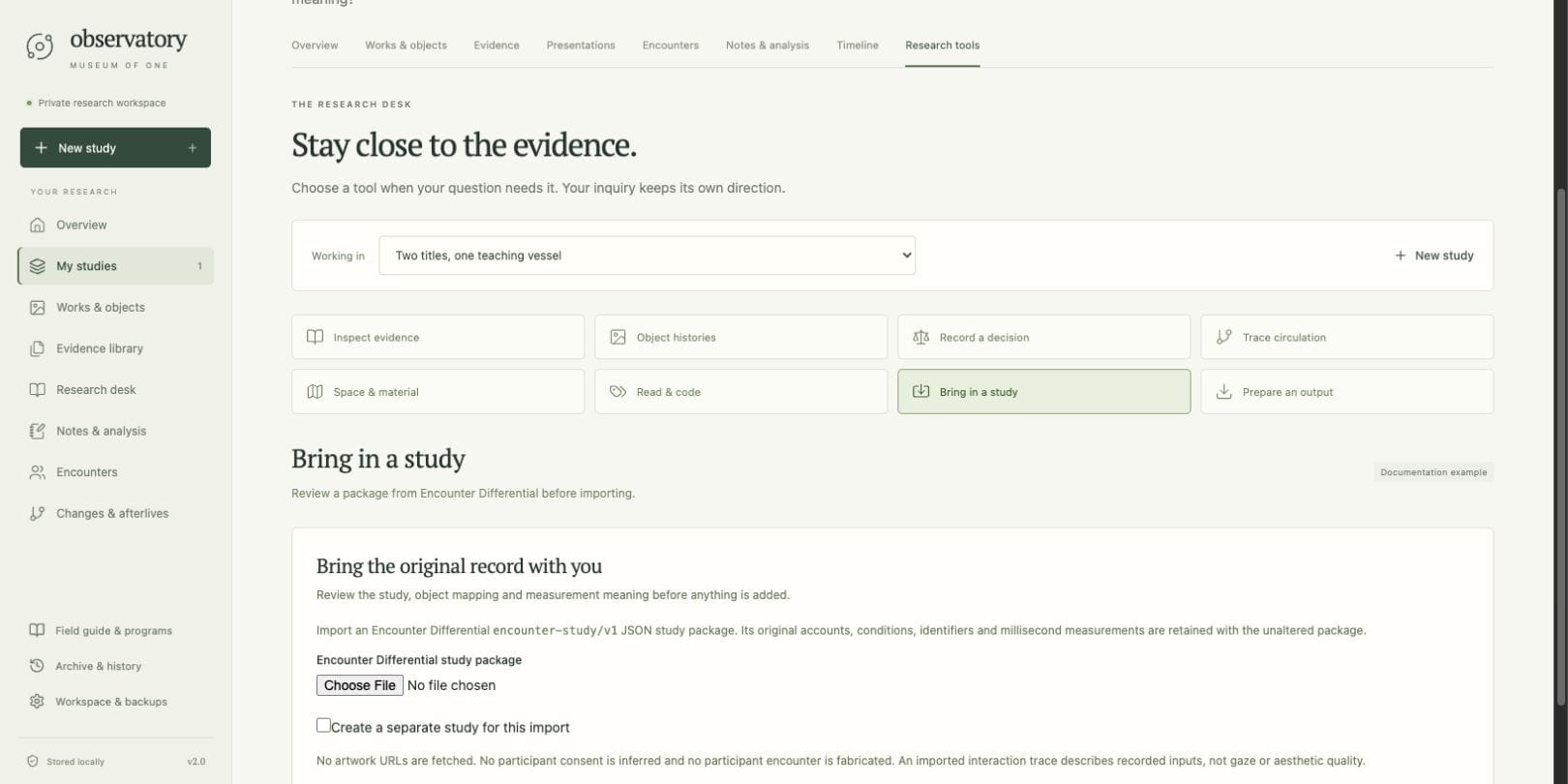
Preview a supported Encounter Differential study, original identifiers, conditions, artwork mapping and millisecond measurements before adding it. No consent or participant encounter is inferred.
Enlarge image ⤢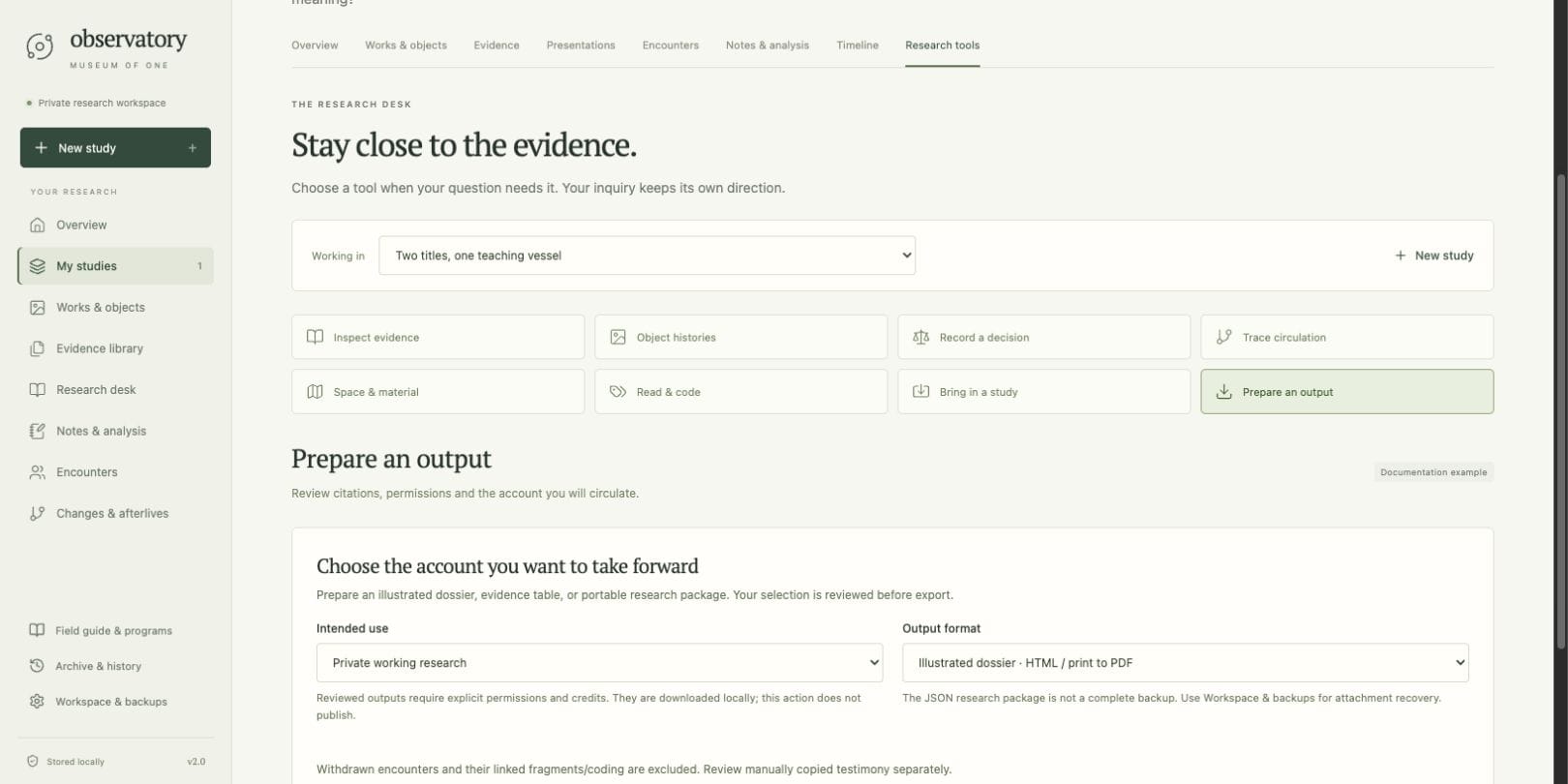
Select a private or reviewed output, format and included records. A research package and a complete private backup serve different purposes.
Enlarge image ⤢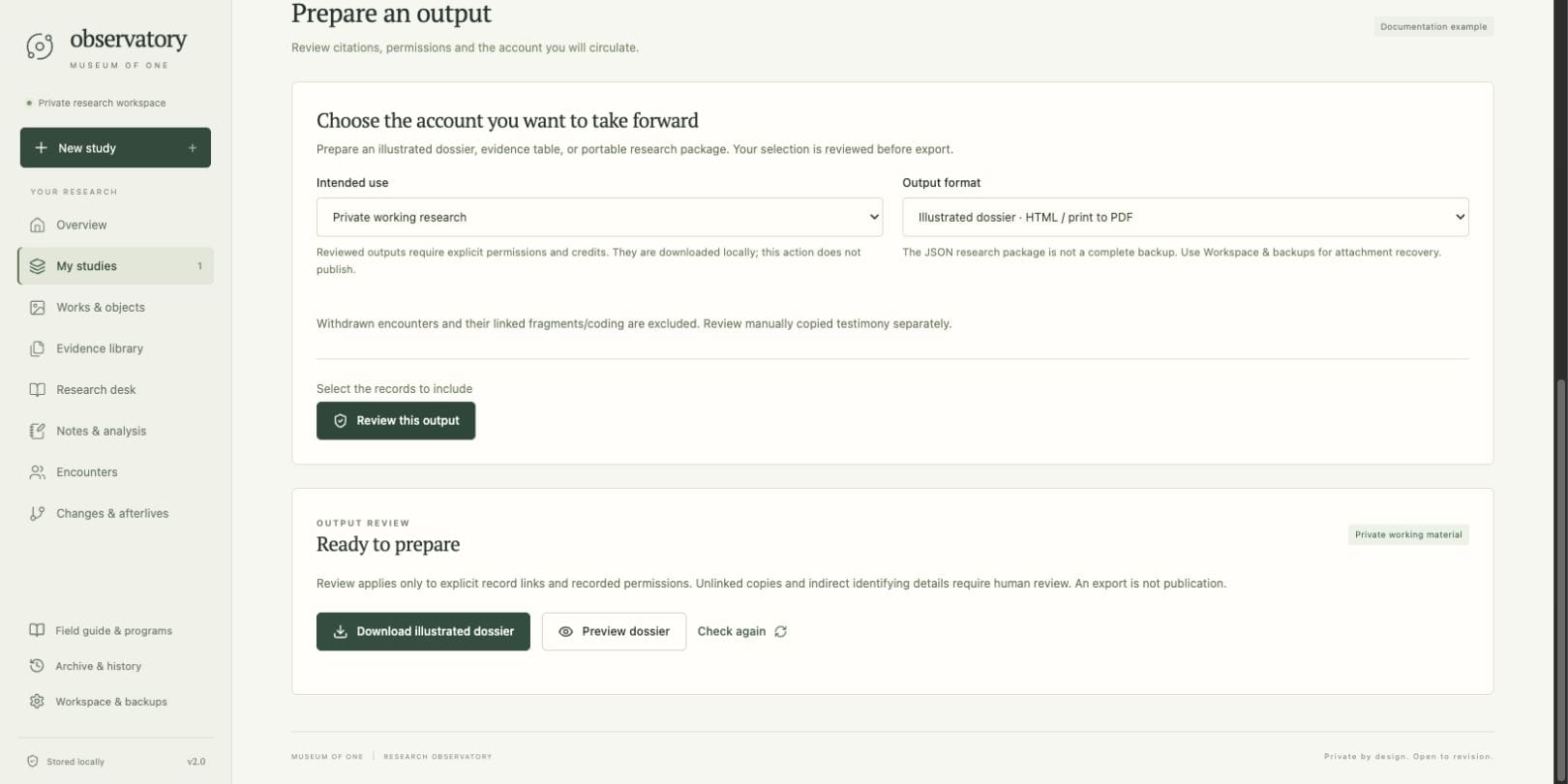
Check explicit links, credits and recorded permissions before export. Human review remains necessary for copied text and indirect identifying details.
Enlarge image ⤢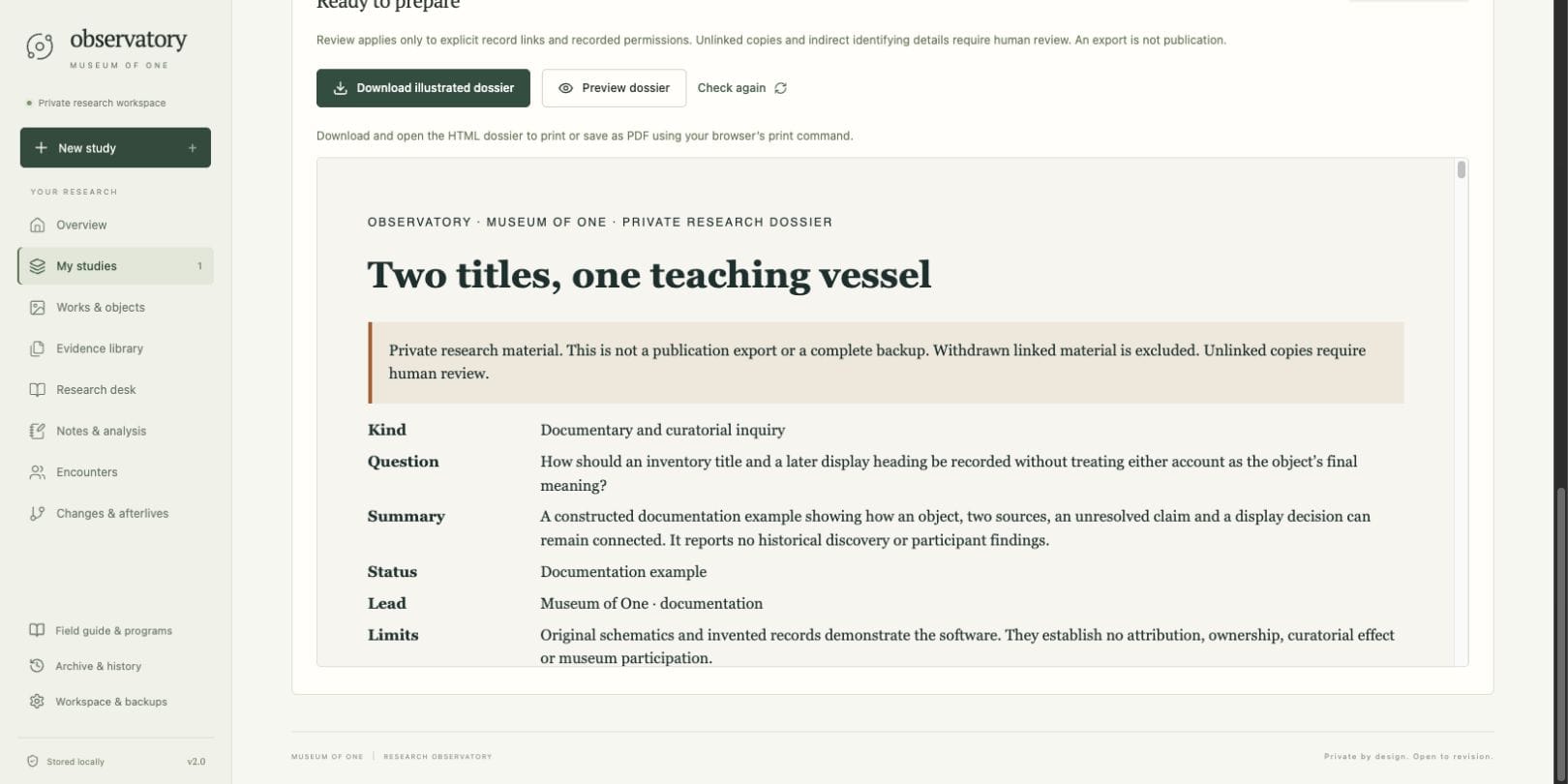
Preview an illustrated HTML dossier with citations, fragments, qualifications and links. Download it locally and use the browser print command when a PDF is needed.
Enlarge image ⤢Actual screens explain the instrument; they are not evidence of a curatorial effect. Read image and record provenance →
In post-interpretive research, an account remains answerable to the work, its material situation, the source and the conditions of encounter. The workspace helps distinguish these records while preserving their connections. It does not prescribe one diagnostic vocabulary for every inquiry.
Research question: How should an inventory title and a later display heading be recorded without treating either account as the object’s final meaning?
Constructed demonstration. The vessel is an original schematic; the two texts, dates and decision were written for software documentation. They are not archival evidence or participant testimony.
| Material | Recorded account | What it can establish here |
|---|---|---|
| Object DEMO-OBJ-001 | Teaching vessel · original schematic | A stable demonstration object and its illustration; no historical identity. |
| Constructed inventory, paragraph 1 | “The object is called Teaching Vessel in this inventory.” | The stated role of wording inside one invented document. |
| Constructed display record, paragraph 1 | “The display heading reads Vessel for a Shared Table.” | A different curatorial heading; no original historical name is inferred. |
Procedure: retain both sources and exact fragments; record two sourced title assertions; compare their roles; write a provisional claim and decision with contrary possibilities. No participant data are needed for this documentary example.
Review and stopping rule: stop when each wording can be traced to its source and the decision’s limits are explicit. In a real study, further archival material, stakeholder accounts or an installation comparison could require revision.
| Research record | Illustrative decision | Qualification retained |
|---|---|---|
| Sourced assertions | Preserve both titles separately. | Neither is silently promoted into an original historical title. |
| Analytical reading | Distinguish documentary role from historical identity. | A future source could support a more specific naming history. |
| Curatorial decision | Retain both wordings with their source roles. | Provisional; no physical exhibition or visitor effect has been tested. |
Choose New study. Write the question you can presently ask; select a research direction and state the scope, limits and next step. Leave Guide me step by step selected to begin a guided workflow, then adapt the route as needed.
Research design can change. Record the change and its reasons. Decide what evidence would challenge your proposed account before searching only for support.
Add a work or object, a source, an image, a document or a first observation. Preserve existing identifiers exactly and attach only material you are entitled to use.
Add a citation, locator, dates, source independence and limits. Keep separate records where accounts conflict. The tool is not a live museum catalogue or a rights authority.
Open Research tools → Inspect evidence. Check the source, capture exact wording or an image region and save a fragment. Put your reading in the note field.
PDF page anchors use file order, which may differ from printed page labels. Check extracted text against the rendered page. For scanned pages, use a checked transcription or image-region fragment.
Use Object histories for sourced assertions, Trace circulation for relationships, and Notes & analysis for a claim with supporting and contrary evidence.
A source relationship requires evidence. Separate a reported description from your endorsement of it, and preserve incompatible dates, titles and attributions.
Where relevant, add versioned presentations, actual encounters and a spatial record. Record participation and observation consent separately.
A study record is not consent. Use Space & material to annotate an actual plan or installation view; do not interpret its rectangles as recorded visitor behaviour.
Define codes, attach readings to precise fragments, retain disagreement and examine contrary or missing evidence.
Identify the reader and analytical pass. Do not overwrite an applied code definition to improve apparent agreement. Add a new version and explain the difference.
Record the alternatives, choice, evidence, responsible voices, disagreement, uncertainty and any later outcome.
State a review condition: a missing source, revised attribution, further account or practical installation check. A completed form does not validate a curatorial conclusion.
Choose Prepare an output. Select the intended use, format and records, review the selection, then download. Use Workspace & backups for a complete private recovery copy.
Reviewed circulation requires explicit recorded permissions and credits. It does not publish. A research JSON export is not a full backup; private backups include attachments and history and require protected storage.
This is the public guide. The working application runs locally on your computer from its source code. Request the repository or a copy of the tool from Museum of One.
No. Begin with your own question and select the research direction that fits it. Documentary, object-centred, exhibition, translation, encounter and mixed-method inquiries can use different parts of the workspace.
Ask a question. Bring things together. Follow the evidence. A working question and one source are enough to begin; use the additional tools only when your inquiry needs them.
PDF, PNG, JPEG, WebP, TXT, CSV and JSON, up to 25 MB per file. PDFs render locally. Extracted text needs checking, and image-only pages have no automatic OCR.
Yes. Add separate sourced assertions, retain each original identifier, and record the uncertainty or conflict. Do not merge accounts merely to make the record look complete.
A fragment retains exact source wording and an anchor. Notes, language, translation and translator are recorded separately. Check permission and credit before circulating either wording.
No. A plan region is a researcher annotation. Sightlines, routes and access notes describe a documented or proposed situation; a visitor-effect claim needs its own evidence.
No. It helps preserve the connection between an account, its evidence and its limits. Observation, testimony, inference and curatorial interpretation must remain distinguishable.
The importer previews one supported encounter-study/v1 JSON record. It retains original identifiers and millisecond measurements. Archive wrappers, legacy sessions and unknown schema versions are not accepted; no artwork URL is fetched and no consent is inferred.
This version is a single-user local workspace. Named reading records can document different readers, but there is no multiuser account system, live collaboration or cloud sync.
No. It prepares a locally downloaded selection after checks against recorded permissions, credits and links. Human review of the context and any separately copied or identifying text remains necessary.
Withdrawn encounters and explicitly linked evidence derivatives are excluded from research outputs. Private records and audit history remain in complete backups. Withdrawal and archiving are not permanent erasure; review separately copied material manually.
Use Workspace & backups to download a complete JSON backup with attachments and history. Keep a dated copy on protected storage. Restore previews links, checksums and identifier conflicts before merging compatible records.
The public record documents a working prototype and its constructed example. It reports no completed museum pilot, participant findings or empirical validation. Facilitated usability and museum-transfer studies remain a research task.
The screenshots were captured from the working local Research Desk v2 interface and the Observatory 2.1 guided workflow on 21 October 2026, using separate documentation workspaces. The teaching vessel and gallery plan are original schematic drawings created for this guide. All object descriptions, source texts, coded readings, chronology and decisions shown are explicitly constructed.
No private study PDFs, scholarly correspondence, actual participant records or institutional collection images are reproduced. The display illustrates software procedures; it reports no museum finding. Select any image to inspect its full-size capture.
This is a single-user local application with no cloud sync, public publishing, AI analysis or unattended collection. Local storage is not encryption or a multiuser authorization system. Backups can contain restricted material and must be stored accordingly.
Recorded rights, consent and clearance document decisions; they do not establish legal permission or ethics approval. Explicitly linked withdrawn material is excluded from research exports, but separately copied text needs manual review. Archiving and withdrawal preserve records; permanent erasure is not implemented.
File checksums and revision history help inspect integrity. They do not prove source accuracy, historical causation, interpretive correctness, empirical validity or institutional wrongdoing.
Vale, Dorian. Post-Interpretive Curatorial/Museum Research — Observatory. Version 2.1, working prototype. Museum of One. Public documentation revised 21 October 2026. Canonical tool guide.
Software version and documentation revision are separate records. Cite the version and retrieval date of the copy actually used. The research programme remains in development; no persistent identifier or peer-reviewed validation is asserted here.
Research programme → · Encounter Differential → · Museum of One research programmes →
← All research tools and experiments · Request research access ↑