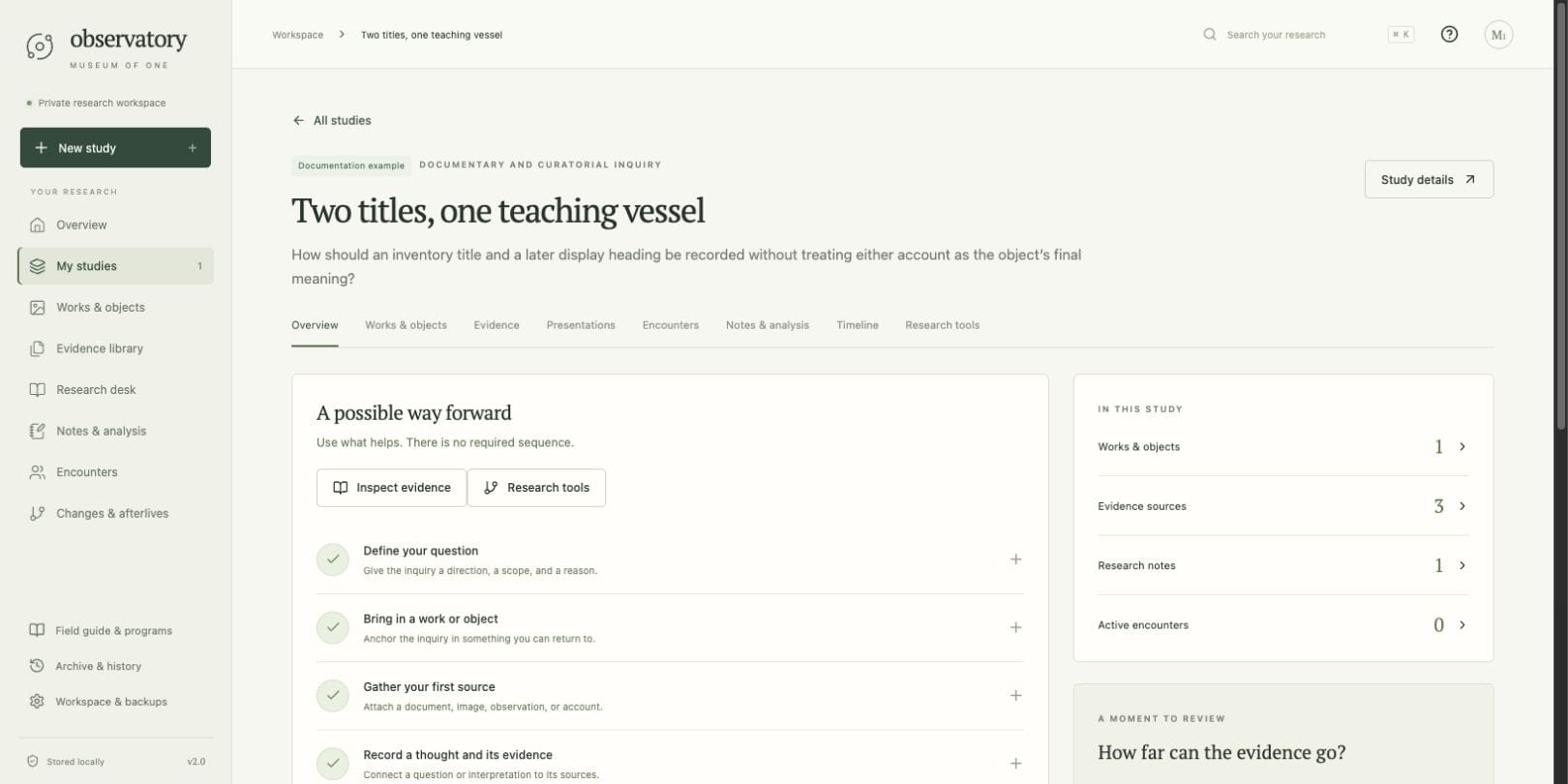
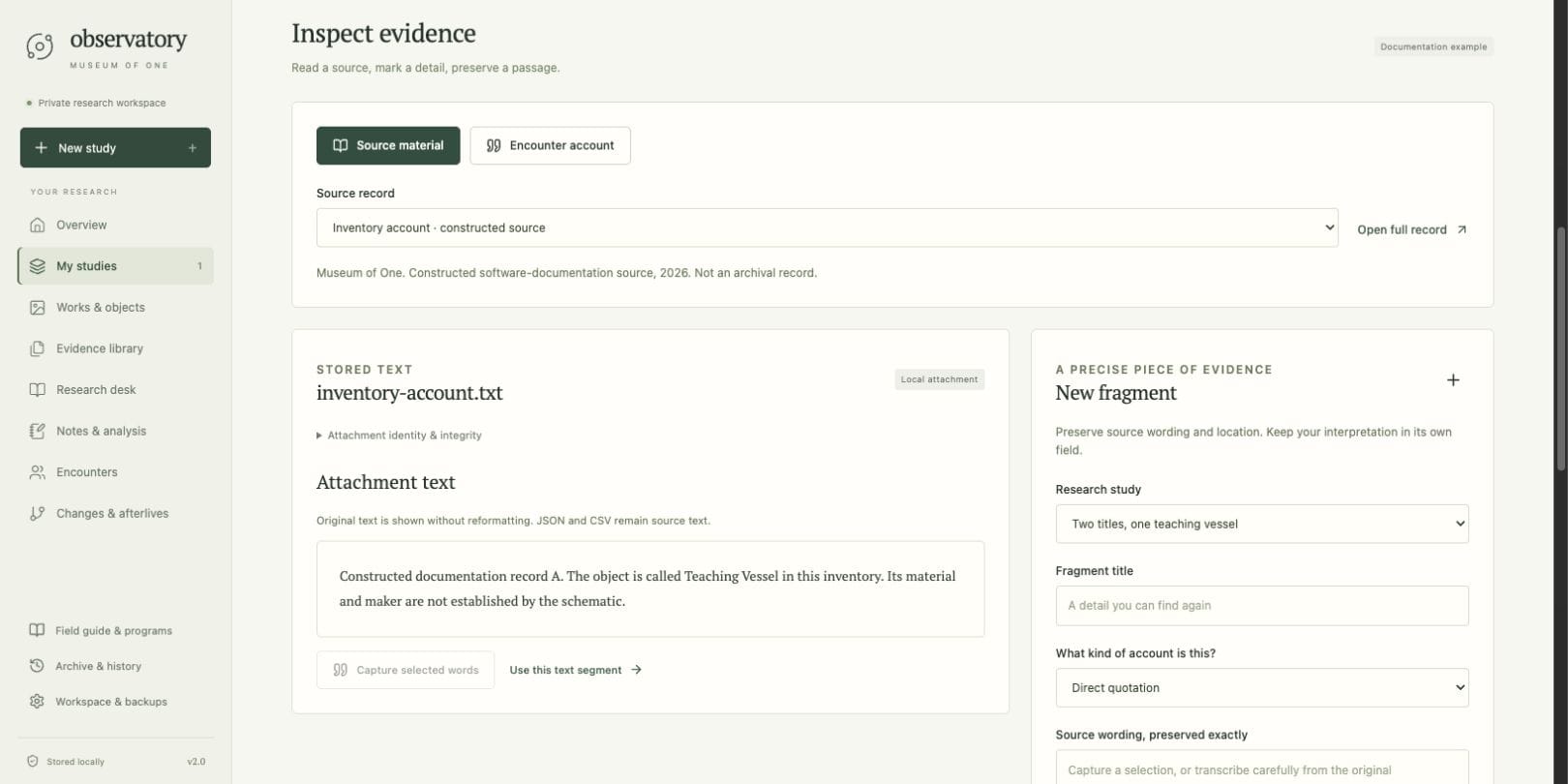
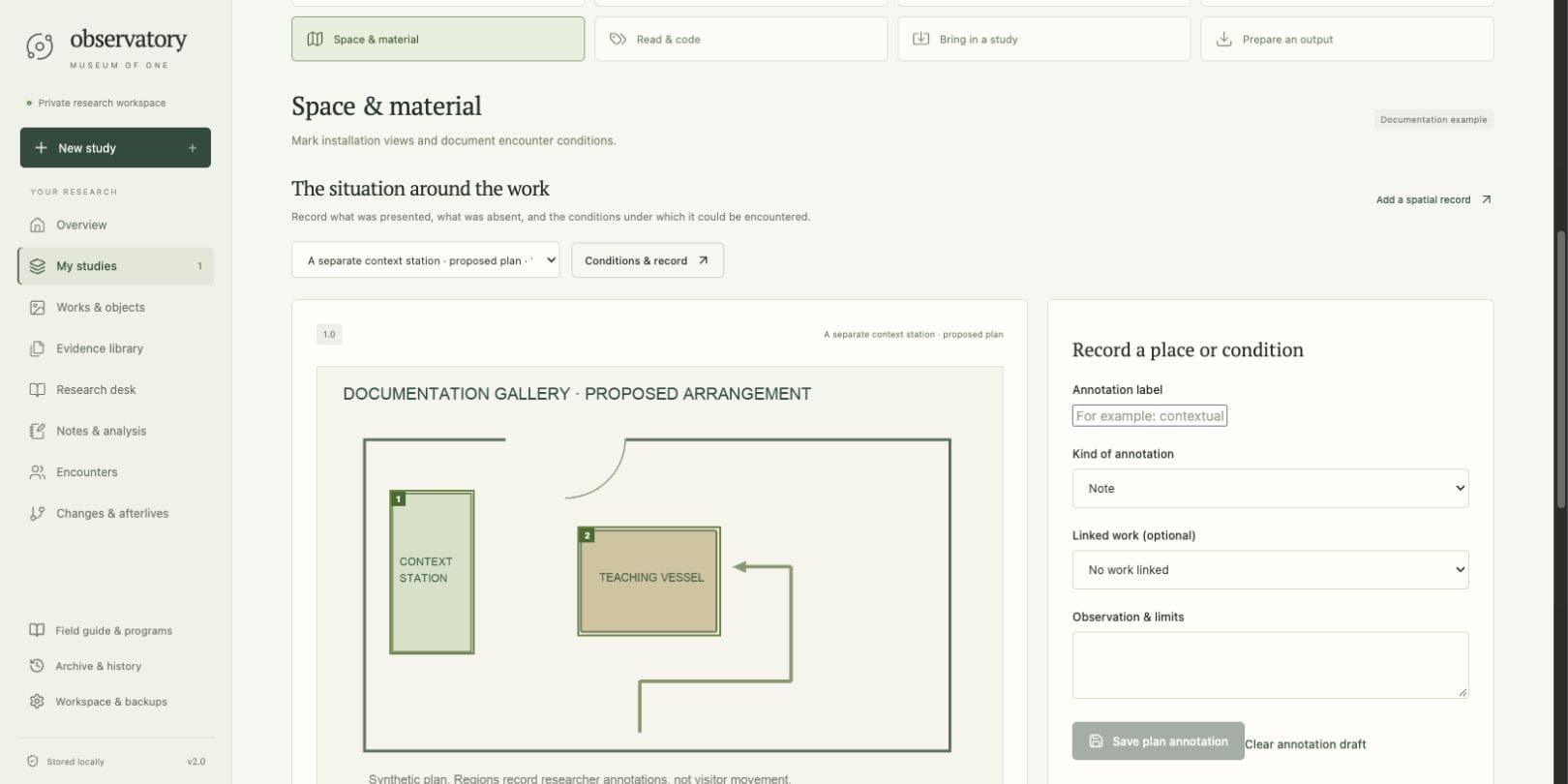
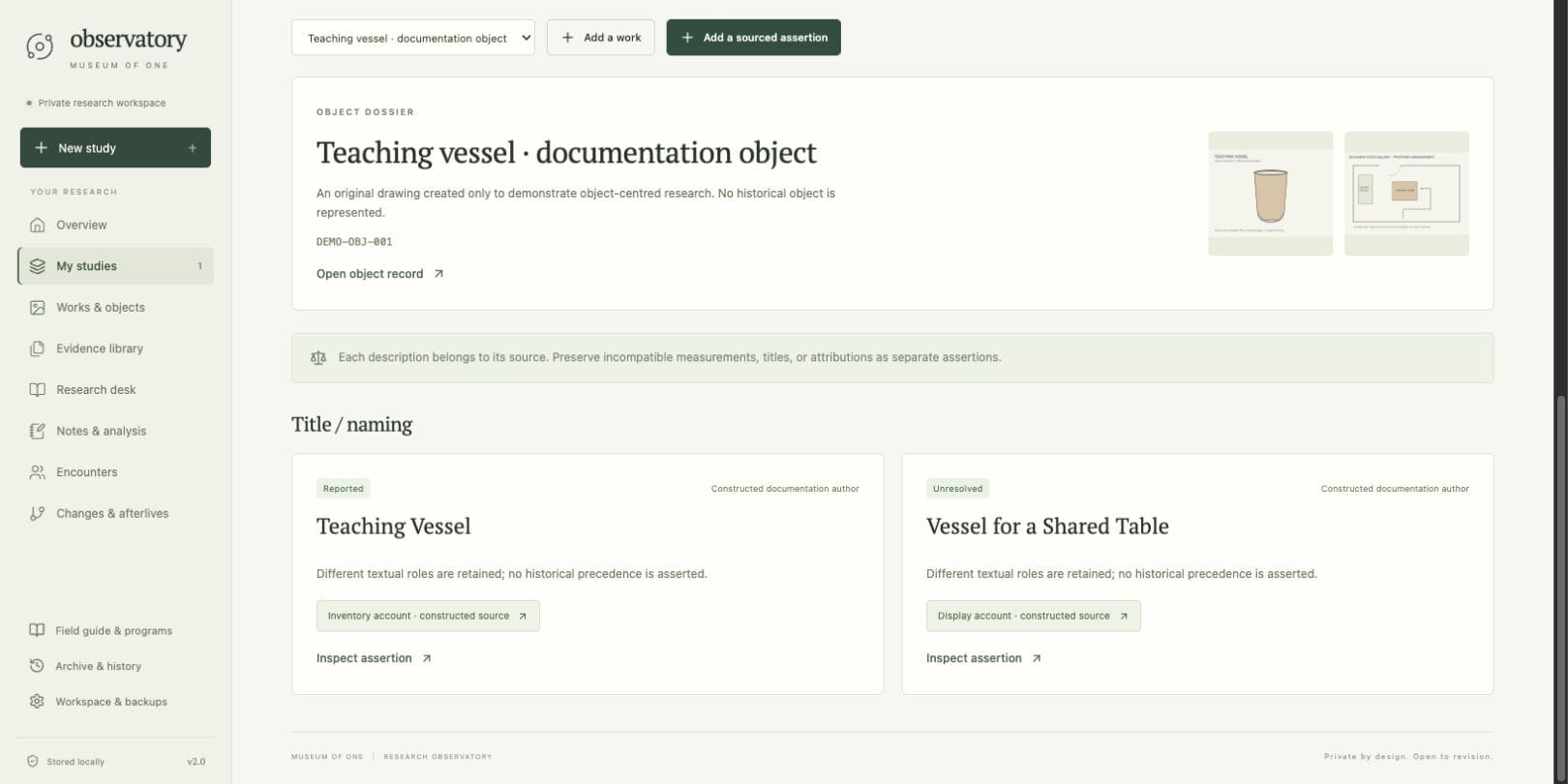
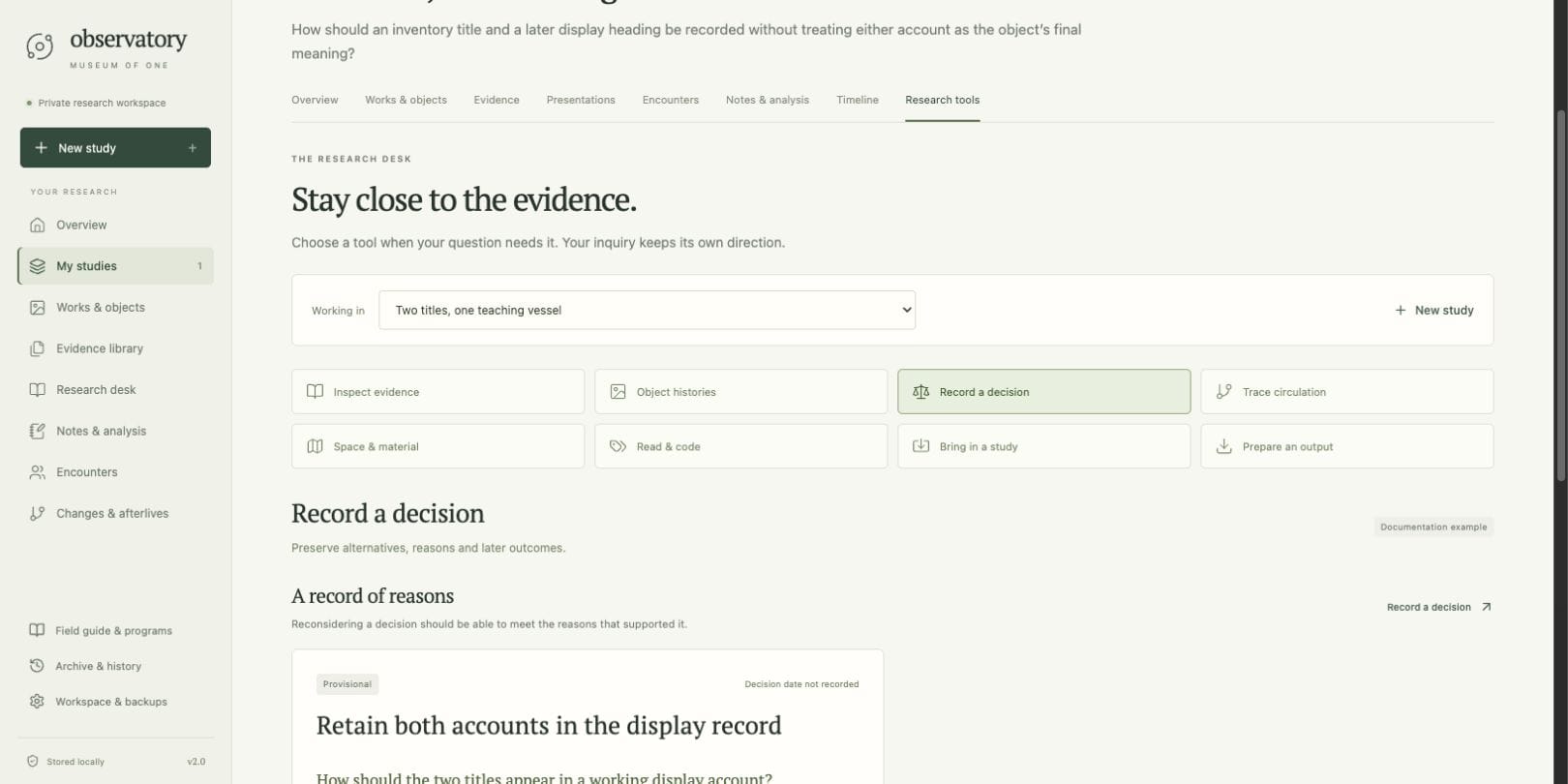
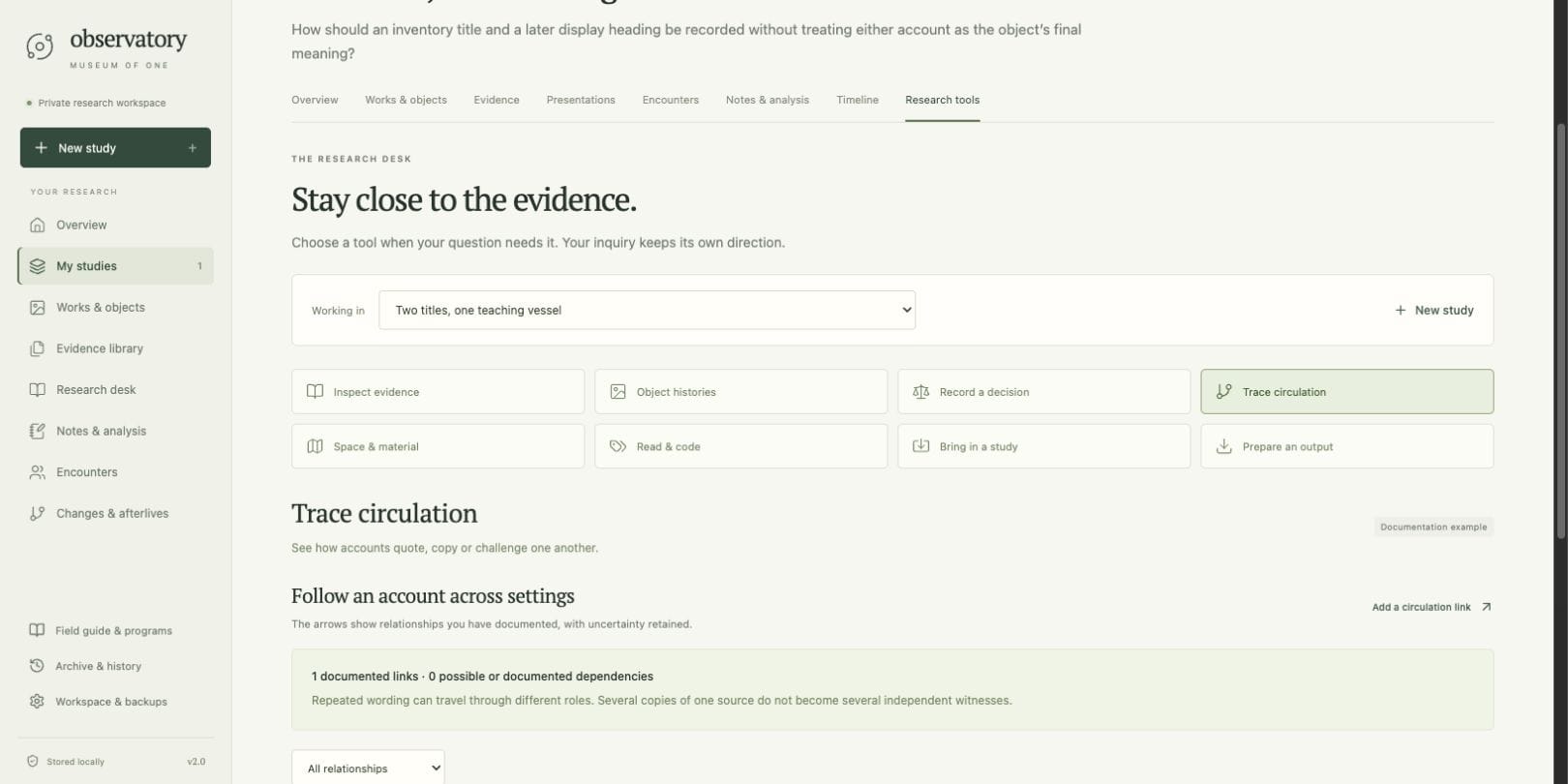
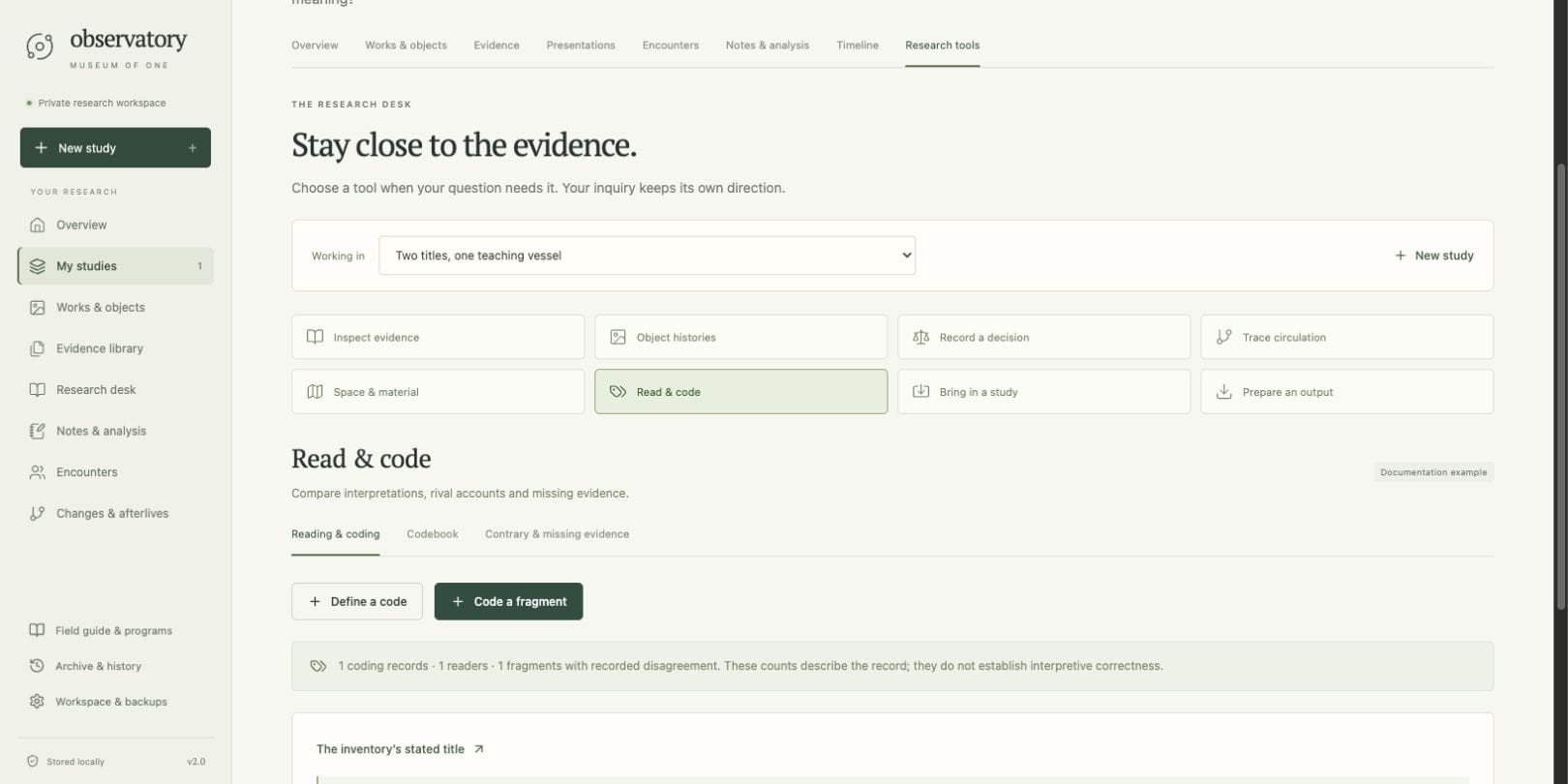
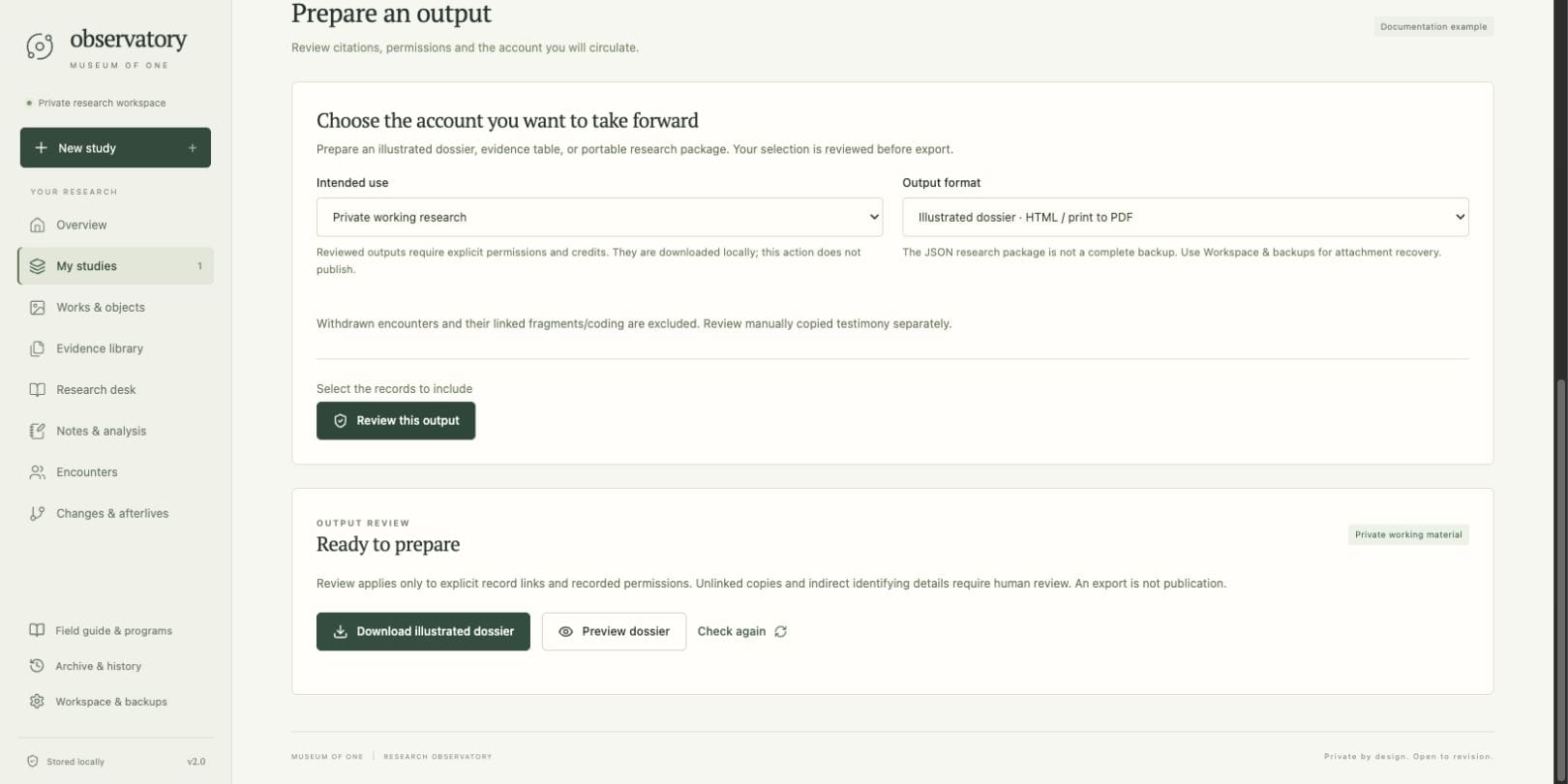
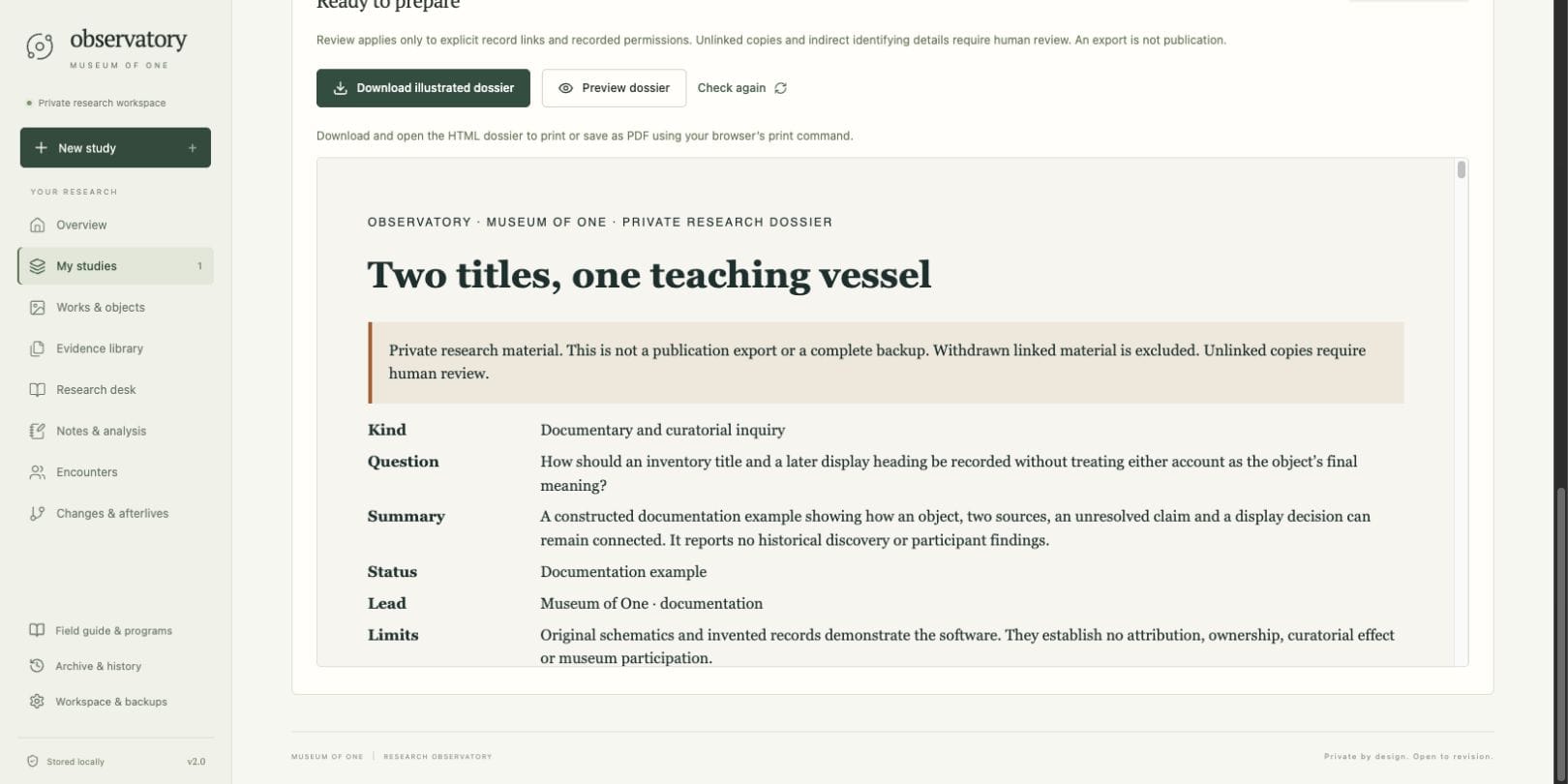
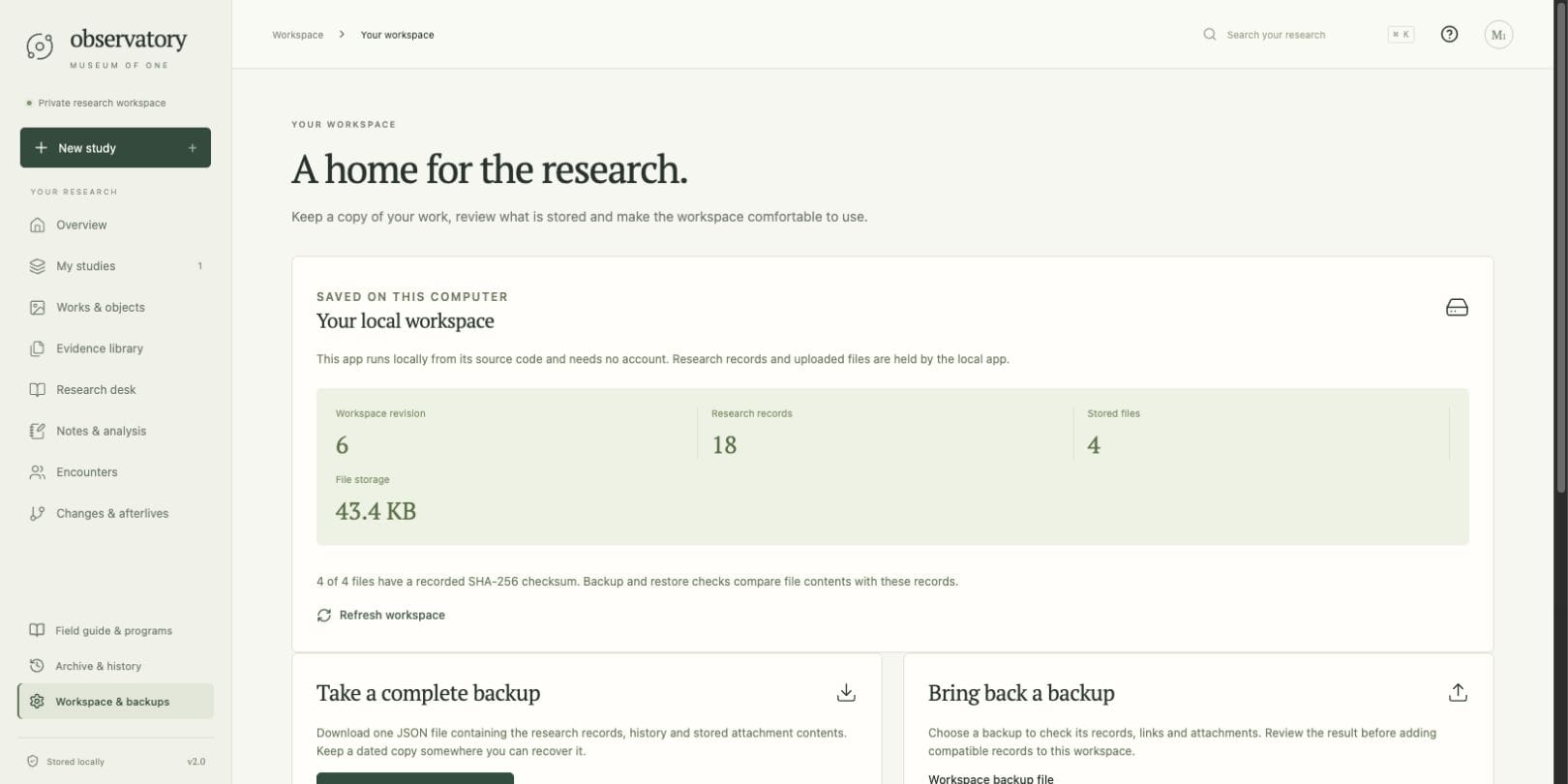
Actual interface views with constructed documentation records. No historical discovery, participant findings or institutional pilot. Select a panel to inspect the workflow.
Evidence, material situations and curatorial answerability · Museum of One
Research question
How can museum and curatorial research preserve the relationship between works, artifacts, sources, situated encounters and revisable claims across different kinds of inquiry?
Research rationale
A curatorial account often joins several forms of evidence: an object’s material presence, documentary descriptions, an installation, a participant’s words and a researcher’s inference. This programme investigates how a practical research workspace can make those connections inspectable while retaining their differences, disagreements and limits. The instrument is itself an object of research: the adequacy of its record structures and its usefulness in museum work remain open questions.
Questions within the inquiry
01 / RESEARCH QUESTION
Object and source
How can incompatible descriptions remain visible without dissolving the object into its records?
Read the full research question
Which relationships between objects, images, identifiers and sourced assertions help a researcher preserve conflict, attribution and uncertainty without silently normalizing the record?
02 / RESEARCH QUESTION
Documentary roles
What changes when the same wording moves between an inventory, a display and a later account?
Read the full research question
How can exact fragments and typed source relationships support investigation of quotation, translation, correction and circulation without treating repetition as independent corroboration?
03 / RESEARCH QUESTION
Material situation
How should selection, omission, sequence and access enter a curatorial account?
Read the full research question
Which spatial and material records are necessary to describe the conditions of encounter, and what additional evidence is required before claiming an effect on visitors?
04 / RESEARCH QUESTION
Reading and disagreement
Can a shared analytical procedure retain meaningful differences between readers?
Read the full research question
Can versioned definitions and precise evidence anchors support independent readings, while preserving negative cases, rival explanations and disagreement rather than forcing apparent consensus?
05 / RESEARCH QUESTION
Curatorial usefulness
Which records help a museum team make and revisit a decision?
Read the full research question
In facilitated studies of real curatorial tasks, which workflows are understandable, which outputs support reconsideration, and where does record-keeping add unhelpful burden?
Research model / Conceptual workflow
From a working question to a revisable account.
Select a stage to inspect the supporting procedure.
Public examples: Sample records for demonstration purposes. Live research records remain private. These samples are not participant findings or evidence of empirical validation.
Eight connected research tools across source inspection, object histories, curatorial decisions, circulation, spatial records, coding, reviewed import and outputs.
Current public outputs
Inspectable documentation
A constructed documentary study, actual interface screenshots, practical procedures, stated limits and this programme record.
Next research stage
Facilitated evaluation
Source-fidelity checks, independent reading exercises and studies of real museum workflows remain necessary before broader usefulness or transfer claims.
Read the current development record
The working instrument brings studies, works, sources, claims, chronology, presentations and encounters together with exact evidence fragments, competing object assertions, curatorial decisions, source relationships, spatial records and qualitative coding. It offers local recovery backups and reviewed research outputs.
The two supplied example studies helped identify different research needs; they do not define the instrument’s boundaries. New inquiries can begin from a documentary correction, an object, an exhibition history, a translation, an encounter or an open question.
The programme’s public example is separate from private research. Software functionality and integrity checks do not constitute empirical validation, an institutional pilot or a completed research finding.
Methodology
Begin with the research question and the kind of claim it could support. Select the records needed for that inquiry; retain evidence roles, source independence, uncertainty and the history of revision.
01–02 / Bring the inquiry together
Keep the source and the situation available for inspection.
A precise passage and a situated material record answer different questions. Both may be needed; neither supplies the other automatically.
Actual application screen
Inspect the source
Preserve exact wording, a locator and its source role. Check PDF extraction against the rendered page.
Sourced assertions, decisions, source relationships and qualitative readings retain different kinds of responsibility. They can be connected without being collapsed into a single verdict.
Actual application screen
Bring the work into view
Keep object images, exact identifiers and competing sourced descriptions together. The two titles here have different documentary roles.
Describe documented relationships between particular sources or passages. Repetition does not by itself establish independent corroboration or copying.
The staged plan below identifies work to be carried out. The constructed example demonstrates procedures; it does not supply validation data. Report failures, exclusions and unresolved results alongside successful checks.
Stages describe the work and its status, not a completion score. Select a stage for the required evidence.Record integrity: Implemented controls; continuing checks
Exercise exact source anchors, identifier preservation, applied-version protection, withdrawal exclusions, permission-aware output and conflict-checked recovery. These checks concern software behaviour, not truth or museum usefulness.
Source fidelity: Planned systematic evaluation
Compare captured passages, PDF extraction, image regions, translation fields and exported citations against authorized source documents. Report omissions, reading-order problems and inaccessible material.
Reading and disagreement: Planned independent exercise
Ask independent readers to apply a declared coding scheme to the same authorized material. Examine disagreements and negative cases before deciding whether any agreement statistic is appropriate.
Curatorial usability: Planned facilitated study
Observe curators and museum researchers carrying out bounded real tasks. Record completion, confusion, recovery, record burden and the usefulness of outputs without presuming favourable results.
Museum transfer: Planned setting-specific inquiry
Compare what a documentary or screen-based inquiry can establish with evidence from a separately designed physical exhibition or institutional workflow. Make transfer claims only within the tested setting.
Outputs and developments
Current outputs are a working instrument and methodological documentation. No completed empirical study, peer-reviewed validation or institutional adoption is claimed.
A staged plan for source fidelity, independent readings, facilitated usability and setting-specific transfer studies.
Version or documentation record: Research Desk v2; documentation revised 21 October 2026.
Continuing developments
Priorities are to simplify the first research steps, improve source and output inspection, and test the workspace against real curatorial tasks. New features should preserve existing identifiers, evidence anchors and the distinction between private working material and reviewed circulation.
05 / Review and retain
Take forward an account whose evidence can be inspected.
An output preserves a selected account. A backup preserves the workspace for recovery. Their purposes and permission requirements differ.
Actual application screen
Review the output
Check the present selection and recorded permissions before generating a local file.
The following text table states the central relationships shown in the demonstration, without depending on a screenshot. All entries are constructed.
Record
Account retained
Limit
DEMO-OBJ-001
Original schematic teaching vessel
No historical object, maker or ownership claim.
Inventory source, paragraph 1
Teaching Vessel
Invented inventory title; its documentary role is stated.
Display source, paragraph 1
Vessel for a Shared Table
Invented curatorial heading; not an original name.
Provisional decision
Retain both accounts with their source roles.
No actual exhibition change or visitor effect tested.
Citation and version record
Vale, Dorian. Post-Interpretive Curatorial/Museum Research — Observatory. Research Desk v2, working prototype. Museum of One. Public documentation revised 21 October 2026. Canonical software guide.
Cite the software version and retrieval date of the copy used. Documentation revision is a separate date. The PIRR project identifier identifies this research programme; it does not identify a software release or establish validation.
Research context
The programme sits within Museum of One’s work on post-interpretive criticism, phenomenological description, historical answerability and the afterlives of curatorial accounts. It treats the work, its material conditions, documentary mediation and research procedure as related matters that require distinct evidence.
The workspace can support different Museum of One research directions without making each programme adopt one protocol. Documentary correction, intellectual history, translation, witnessing, exhibition studies and comparative encounters may need different questions, sources and review procedures.
Encounter Differential provides a complementary, more bounded instrument for comparative artwork encounters. Its supported study record can be reviewed and imported into Observatory. Imported interaction measures remain instrument records; they do not become gaze, consent or aesthetic judgements.