Relational Archival Investigation: Identity, Chronology, and Historical Judgment in Korean Experimental Art
The published main paper distinguishes the supported 1972/1974 documentary difference from an unwarranted transfer of a separately numbered 1973 work into the same individual chronology. This is Dorian Vale’s research argument, not an institutional record or independent verification of the correct production year.
Selected PDF file page 9 of 16 (printed page 8), section 6: Park Suk-won: a genuine pair and an unwarranted third date.
PDF page 9 · printed page 8
Relational Archival Investigation: Identity, Chronology, and Historical Judgment in Korean Experimental Art, version 1.0, PDF file page 9 of 16; printed page 8.
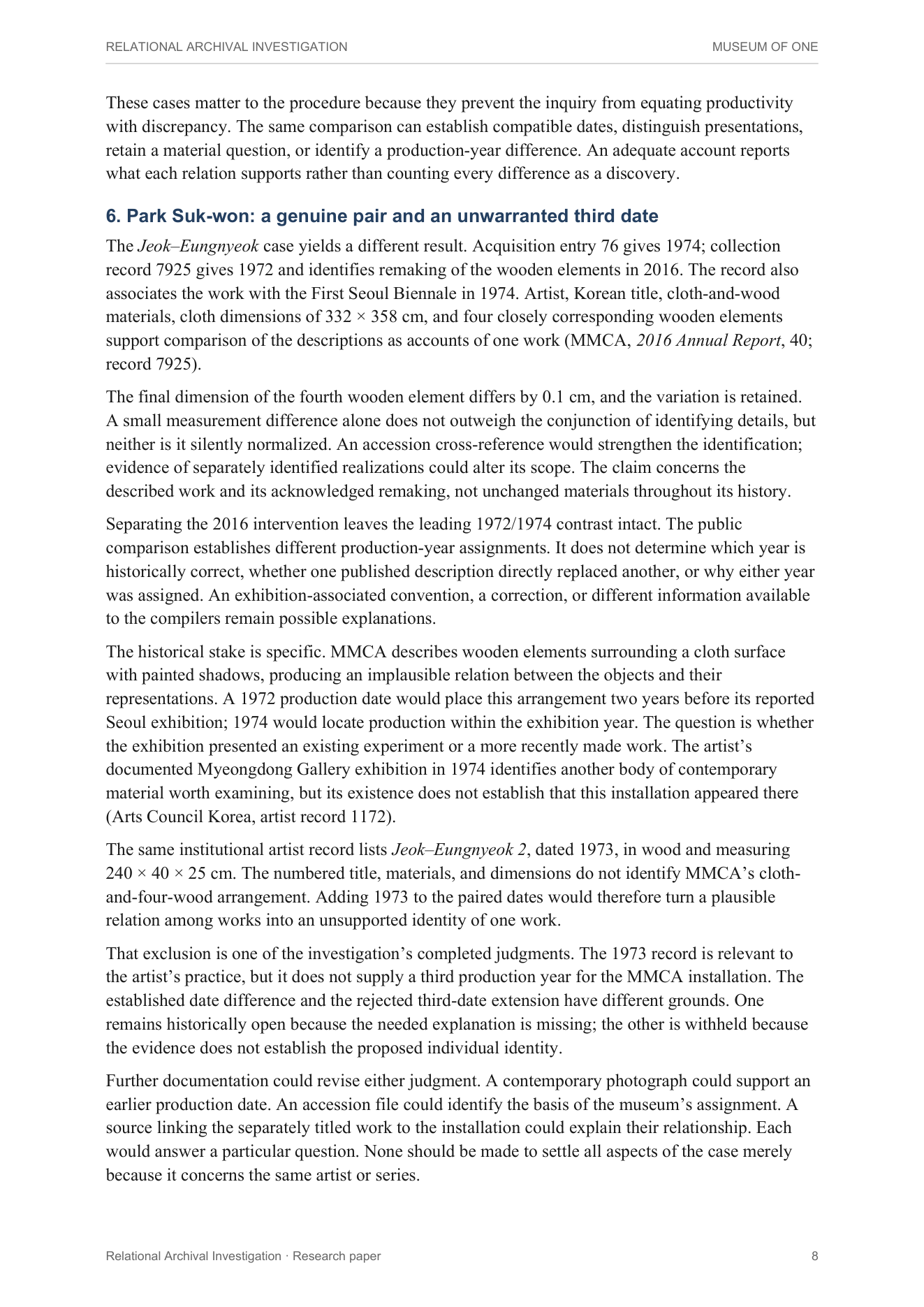
Open this page in the published PDF ↗ · Permanent page link
Published text / transcription
PDF text extraction, checked against the rendered published page · 2026-11-10 · Reviewed extraction; original language retained
This is an extracted text layer of the published research page, not a new transcription of an institutional manuscript. Line breaks and text-layer ordering may differ from the visual page. No new translation has been supplied.
RELATIONAL ARCHIVAL INVESTIGATION
MUSEUM OF ONE
Relational Archival Investigation · Research paper
8
These cases matter to the procedure because they prevent the inquiry from equating productivity
with discrepancy. The same comparison can establish compatible dates, distinguish presentations,
retain a material question, or identify a production-year difference. An adequate account reports
what each relation supports rather than counting every difference as a discovery.
6. Park Suk-won: a genuine pair and an unwarranted third date
The Jeok–Eungnyeok case yields a different result. Acquisition entry 76 gives 1974; collection
record 7925 gives 1972 and identifies remaking of the wooden elements in 2016. The record also
associates the work with the First Seoul Biennale in 1974. Artist, Korean title, cloth-and-wood
materials, cloth dimensions of 332 × 358 cm, and four closely corresponding wooden elements
support comparison of the descriptions as accounts of one work (MMCA, 2016 Annual Report, 40;
record 7925).
The final dimension of the fourth wooden element differs by 0.1 cm, and the variation is retained.
A small measurement difference alone does not outweigh the conjunction of identifying details, but
neither is it silently normalized. An accession cross-reference would strengthen the identification;
evidence of separately identified realizations could alter its scope. The claim concerns the
described work and its acknowledged remaking, not unchanged materials throughout its history.
Separating the 2016 intervention leaves the leading 1972/1974 contrast intact. The public
comparison establishes different production-year assignments. It does not determine which year is
historically correct, whether one published description directly replaced another, or why either year
was assigned. An exhibition-associated convention, a correction, or different information available
to the compilers remain possible explanations.
The historical stake is specific. MMCA describes wooden elements surrounding a cloth surface
with painted shadows, producing an implausible relation between the objects and their
representations. A 1972 production date would place this arrangement two years before its reported
Seoul exhibition; 1974 would locate production within the exhibition year. The question is whether
the exhibition presented an existing experiment or a more recently made work. The artist’s
documented Myeongdong Gallery exhibition in 1974 identifies another body of contemporary
material worth examining, but its existence does not establish that this installation appeared there
(Arts Council Korea, artist record 1172).
The same institutional artist record lists Jeok–Eungnyeok 2, dated 1973, in wood and measuring
240 × 40 × 25 cm. The numbered title, materials, and dimensions do not identify MMCA’s cloth-
and-four-wood arrangement. Adding 1973 to the paired dates would therefore turn a plausible
relation among works into an unsupported identity of one work.
That exclusion is one of the investigation’s completed judgments. The 1973 record is relevant to
the artist’s practice, but it does not supply a third production year for the MMCA installation. The
established date difference and the rejected third-date extension have different grounds. One
remains historically open because the needed explanation is missing; the other is withheld because
the evidence does not establish the proposed individual identity.
Further documentation could revise either judgment. A contemporary photograph could support an
earlier production date. An accession file could identify the basis of the museum’s assignment. A
source linking the separately titled work to the installation could explain their relationship. Each
would answer a particular question. None should be made to settle all aspects of the case merely
because it concerns the same artist or series.
Separating the 2016 intervention
Separating the 2016 intervention leaves the leading 1972/1974 contrast intact. The public comparison establishes different production-year assignments. It does not determine which year is historically correct, whether one published description directly replaced another, or why either year was assigned. An exhibition-associated convention, a correction, or different information available to the compilers remain possible explanations.
The same institutional artist record lists
The same institutional artist record lists Jeok–Eungnyeok 2, dated 1973, in wood and measuring 240 × 40 × 25 cm. The numbered title, materials, and dimensions do not identify MMCA’s cloth- and-four-wood arrangement. Adding 1973 to the paired dates would therefore turn a plausible relation among works into an unsupported identity of one work.
Provenance and verification
IIIF Presentation manifest ↗ · Selected published pages; no image API service.
Cite this research document
Dorian Vale. Relational Archival Investigation: Identity, Chronology, and Historical Judgment in Korean Experimental Art. 9 November 2026 · version 1.0. Museum of One. 10.5281/zenodo.24088563. https://archive.museumofone.art/evidence/rai-main-paper-v1.html.
Source, rights and selection
Author-owned published research pages reproduced under the account holder’s explicit publication instruction. Existing copyright is preserved. Third-party passages retain their attributed sources; this permission does not authorize redistribution of institutional images, manuscripts or private correspondence.
© 2026 Dorian Vale · Museum of One. In Copyright.
Record history
First release of this research presentation: 2026-11-10
2026-11-10 · Museum of One · First public dossier selection from the already published version 1.0 PDF. Original page images, PDF page numbers and publication identity retained; no change to the deposited edition.