01 / Passage
Stay with the wording
Identify what a passage observes, infers and claims. Keep its source available for inspection.
 Digital Archive LibraryMuseum of One / Source-linked catalogue
How can observation, inference, and critical decisions be made available for comparison and revision?
Canonical website source ↗ · All website captures · Original content HTML ↓
Dorian Vale (Credited website author)
This is a stored copy of a public website publication, captured under the website owner’s archive instruction. Original source rights, image credits, citations and third-party exclusions remain applicable. Public access does not grant a new licence. External embeds and unpreserved files are explicitly identified below. Interactive source is retained as an inert HTML download; a live software environment is not guaranteed.
Research model / Conceptual overview
The programme examines how critical writing can be described precisely enough for comparison, disagreement and revision.
Identify what a passage observes, infers and claims. Keep its source available for inspection.
Use stated coding units, definitions and exclusions. Record uncertainty and the reasons for a reading.
Compare accounts and examine reliability. A proposed index does not establish aesthetic truth.
Conceptual guide to the programme, not a validated measurement model or a report of completed research.
Research and experimental methods · Museum of One
This programme examines whether the conduct of critical writing can be described with sufficient precision to support comparison, disagreement, and revision. It connects phenomenological aesthetics with practical questions about what a text observes, what it infers, how forcefully it interprets, and what evidence supports its claims.
pir-prj-pyp5yx3wAvailable public record: Diagnostics Without Possession · Research and diagnostic tools.
Status reviewed: 14 October 2026.
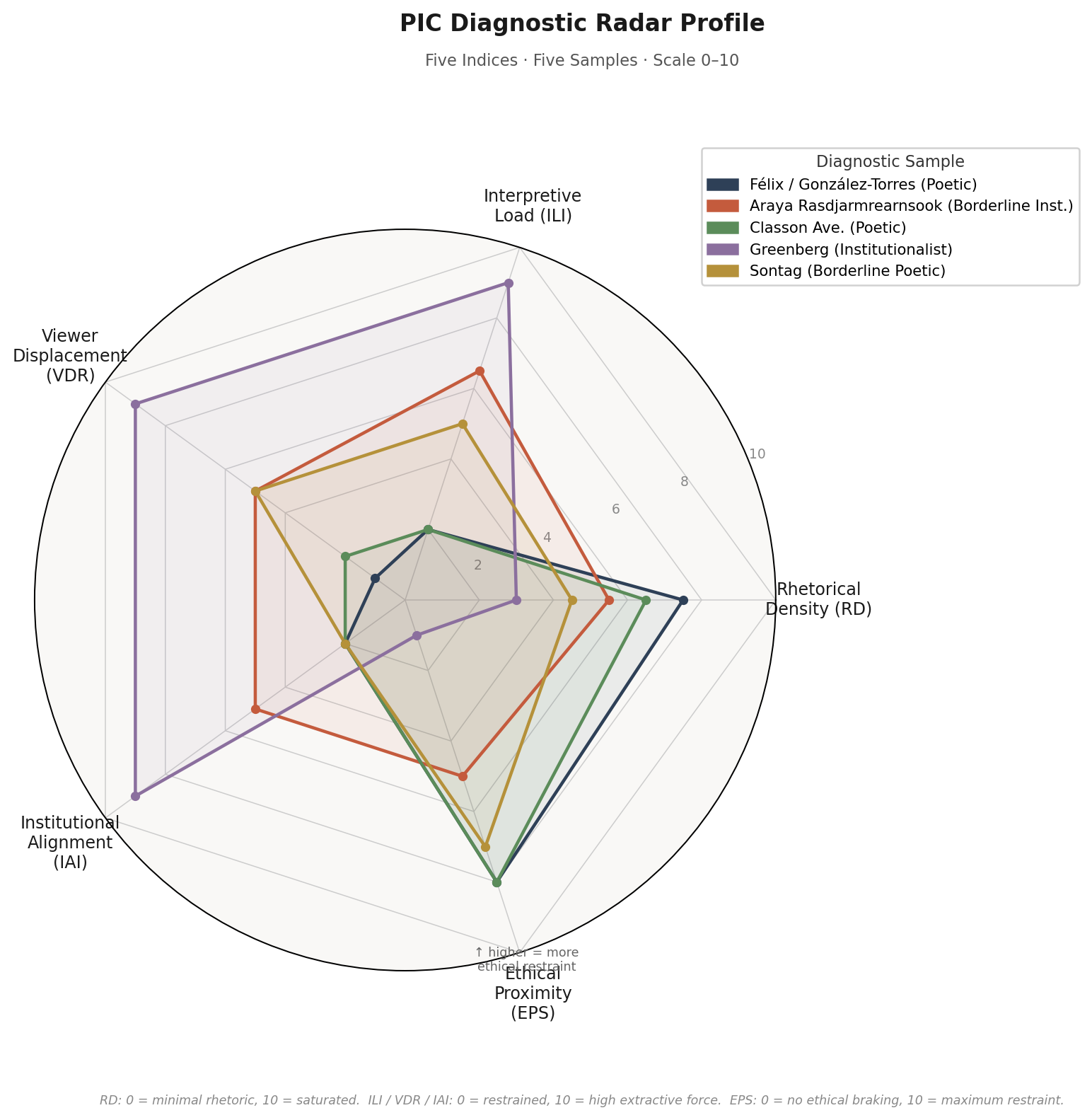
Measuring Proximity, From Husserl's Mathematics to Dufrenne's Aesthetics, and Quantifying Critical Posture develop the published methodological sequence. Diagnostics Without Possession provides an operational reference for coding and inter-rater reliability work. The reading tools show how the proposed distinctions can be applied to critical language.
The published methodological sequence and operational reference are linked below. Their proposed indices and coding rules remain open to scrutiny; publication does not establish a validated measure of artworks or aesthetic truth.
Status: Published methodological essay
Dorian Vale · Site publication date: 9 January 2026
Status: Published methodological essay
Dorian Vale · Site publication date: 10 January 2026
Status: Published diagnostic study
Dorian Vale · Site publication date: 5 February 2026
Status: Published operational manual
Dorian Vale · Site publication date: 9 May 2026
Read the operational reference ↗
Coding, inter-rater reliability work, and comparative reading require examination of the assumptions, exclusions, and limits of the proposed methods. The research and diagnostic tools provide associated resources for inspecting those proposals.
Dates above are the site’s publication dates, not claims about when a later version was released. Version labels follow the linked records.
Preparations for a small comparative study concern a curatorial framing decision, alternative texts, documentation and comparative reading. This is preparatory research, not completed findings or a published output. No case or participant activity is announced here. Public attribution will be added only after it is agreed.
Related development in Witness, Material Presence, and Cultural Memory ↗
The diagnostic indices are proposals for critical inquiry. Their coding rules, assumptions, exclusions, and limits require scrutiny; they do not establish a measurement of aesthetic truth or replace judgment. A useful method must make disagreement more specific and its own decisions easier to examine.
Foundational essays and doctrine supply the vocabulary of restraint, proximity, and critical responsibility. The methodological essays investigate how those concerns can be described through explicit coding rules and diagnostic profiles.
The published corpus study is a single-coder pilot with approximate counts and descriptive comparisons. Independent coding, reliability testing, genre sensitivity, and the limits of quantification remain questions for continuing research.
Study plan: identify a small public corpus, state its genres and exclusions, and prepare a comparison of independent readings under the published coding rules. Preserve the initial judgments, reasons for disagreement, any changes to the rules and the reliability statistics appropriate to the resulting data. Selection of material and agreement on a protocol precede any coding.
The intended output is a bounded methods report and a shareable record of the source passages, coding decisions, disagreements and limits, subject to the sources’ rights. Responsibility for preparing the study rests with Dorian Vale. Recruitment and completed reliability results are not reported in this plan.
The existing preparatory curatorial micro-study retains its own scope. Historical answerability and lasting correction offer documentary questions to examine alongside the methods; their published case studies do not validate the diagnostic indices.
Doctrine, Foundational Essays & Investigations → Research Programmes → Outputs and developments → Publications.
Explore research and diagnostic tools
Transcribed declarations retain their source scope. Identifiers are not promoted to independently verified edition assignments.
Source content SHA-256: 1de50d6896bf685c7b506680fa242779d6a4767989ae4c44f8b47a33a589a054