This is a stored copy of a public website publication, captured under the website owner’s archive instruction. Original source rights, image credits, citations and third-party exclusions remain applicable. Public access does not grant a new licence. External embeds and unpreserved files are explicitly identified below. Interactive source is retained as an inert HTML download; a live software environment is not guaranteed.
New in the working prototype · 21 October 2026
From a research design to a study you can run.
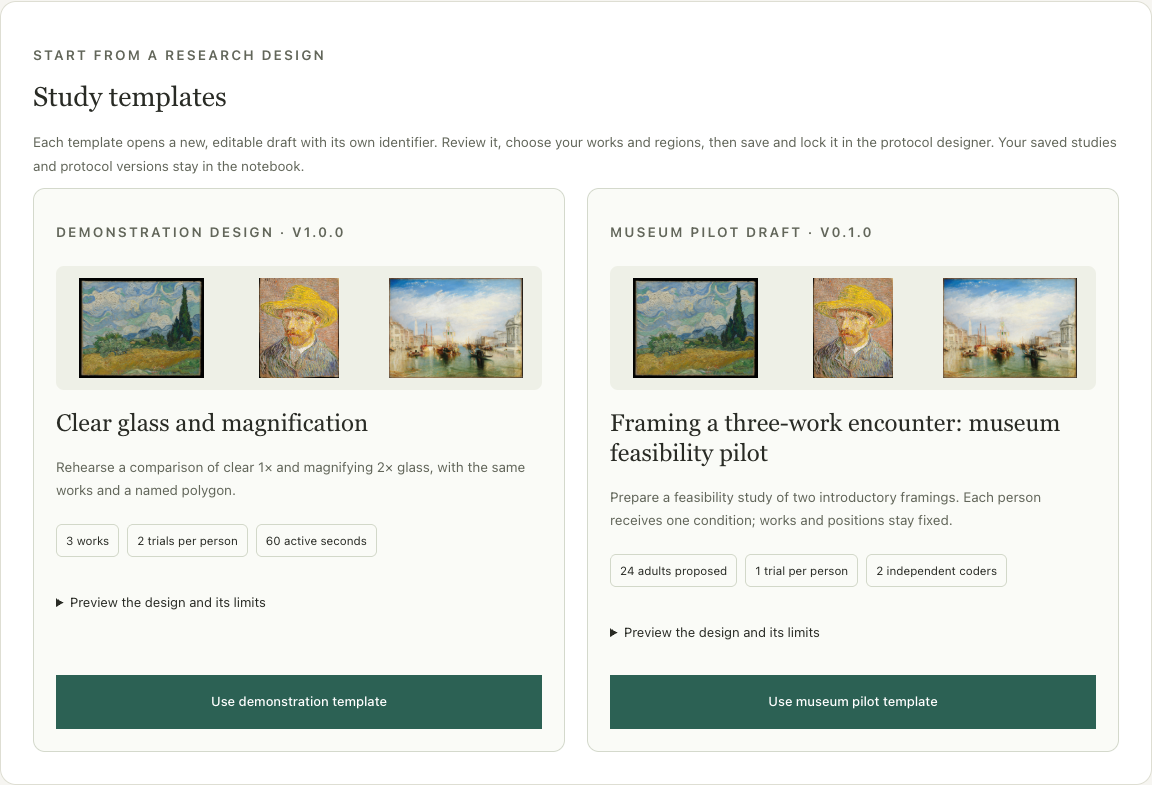
Two built-in templates now connect the published study materials to the local application. Start with a complete design, adapt it to your question, rehearse the procedure and retain the decisions behind the protocol.
01 / Demonstration · template 1.0.0
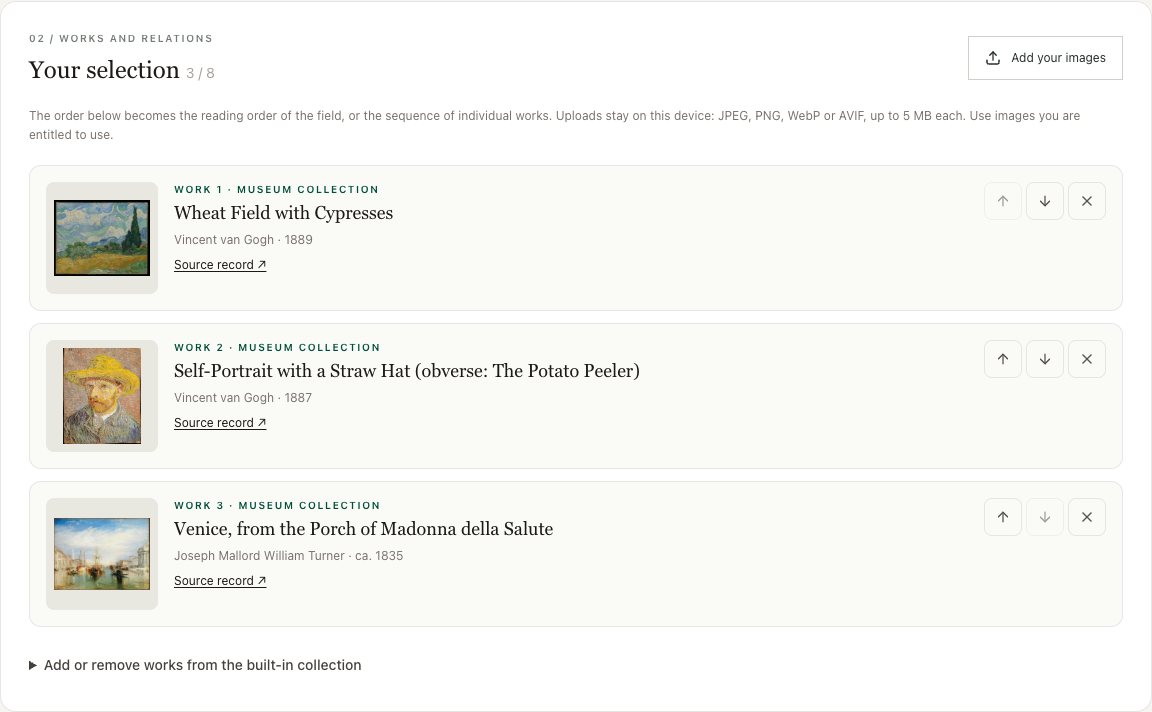
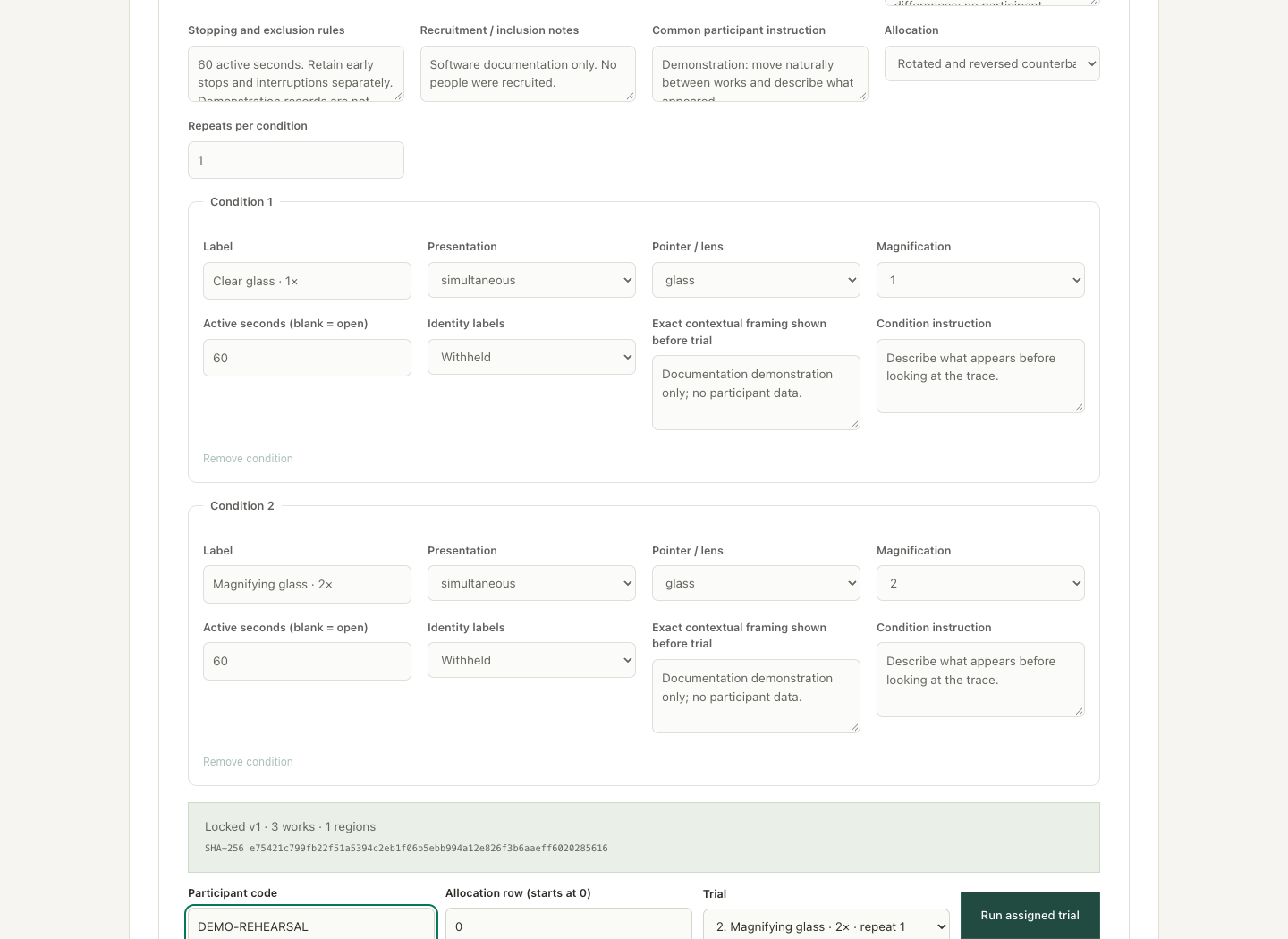
Clear glass and magnification
3 works2 trials per person60 active seconds
Same person→Clear 1×⇄Magnify 2×
Rehearse a within-person comparison with counterbalanced order, bundled artworks and an example region. Opens in practice mode.
02 / Museum pilot · draft template 0.1.0
Compare introductory framing
24 adults proposed1 trial per personFixed works and positions
Each person receives one framing condition ↓
A / Neutral introductionB / Relational introduction
Prepare a feasibility comparison with balanced blocks of four. The draft still needs a host, local review, defined regions and a justified recruitment plan.
Design diagrams explain the implemented allocation procedure. They show no participant results. A local protocol lock records the design; it does not provide ethics approval or external preregistration.
- 01 / CHOOSEField studies → Use a study template.
- 02 / ADAPTReview the question, works, regions and intended use.
- 03 / RECORDComplete readiness notes; save the draft and lock its version.
- 04 / RUNEnter a participant code and allocation row; run the assigned trial.
Explore all four new screens and the study workflow →
For museums, galleries and curators
Give curatorial judgement an evidence trail.
For museums, galleries and curators who need to explain why a display, sequence or label was chosen and preserve the evidence behind that decision.
Every exhibition makes choices about what visitors encounter. If a decision is important enough to shape that encounter, it is important enough to leave a research record.
Museums and galleries
Bring a documented pilot into exhibition development, interpretation review and institutional research. Retain the alternatives, procedure and evidence alongside the eventual decision.
Curators and exhibition designers
Compare an arrangement, sequence or framing before committing to it. Make the question explicit, inspect what changed, and keep your judgement answerable to the record.
Learning, interpretation and visitor-research teams
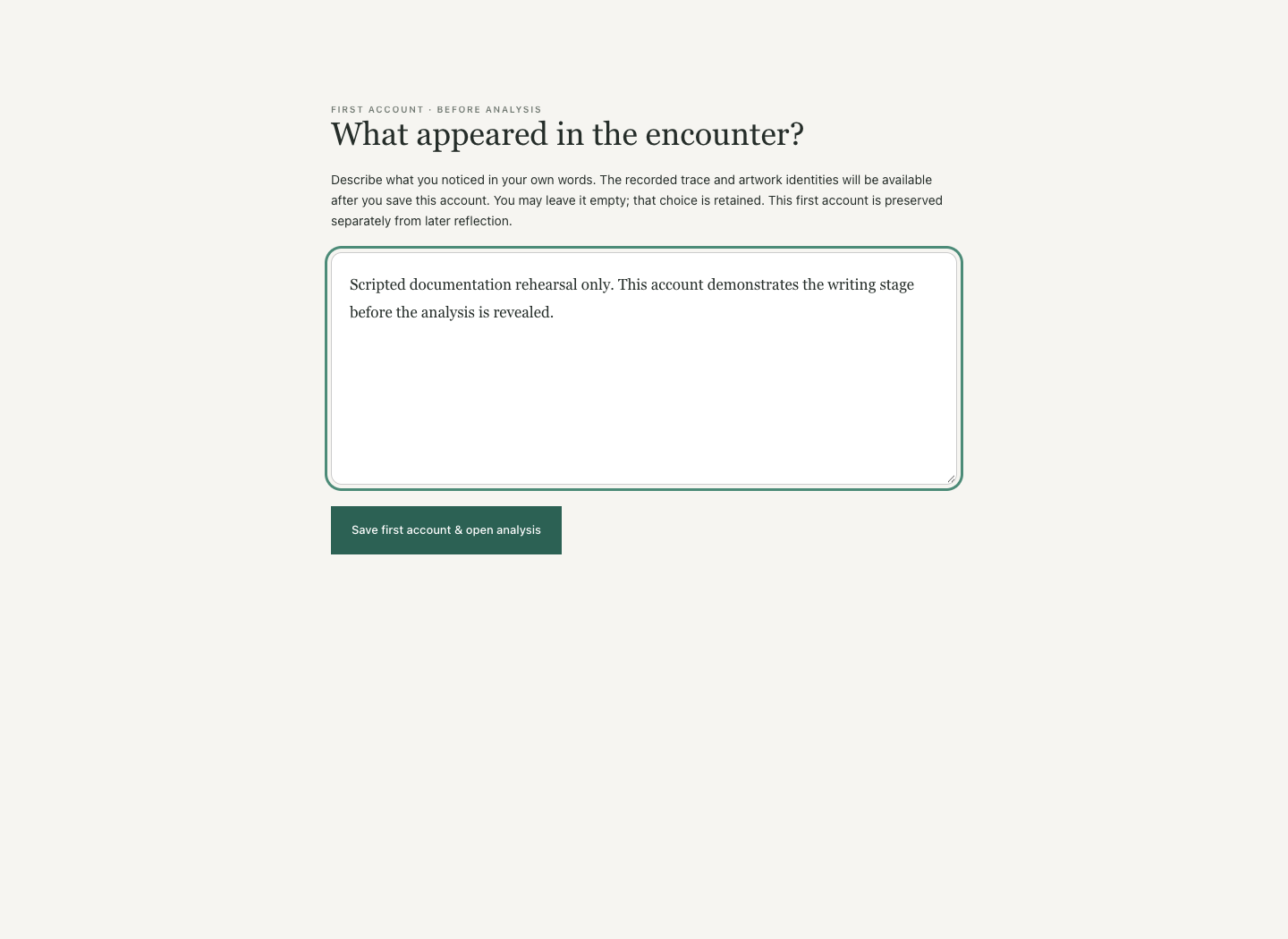
Collect first accounts before showing an analysis, compare declared conditions, and retain observations, disagreements and exclusions for qualitative or mixed-method work.
Bring a real curatorial question.
Start with one decision your team is already discussing. These are proposed museum uses, illustrated with the working interface and constructed demonstration records.
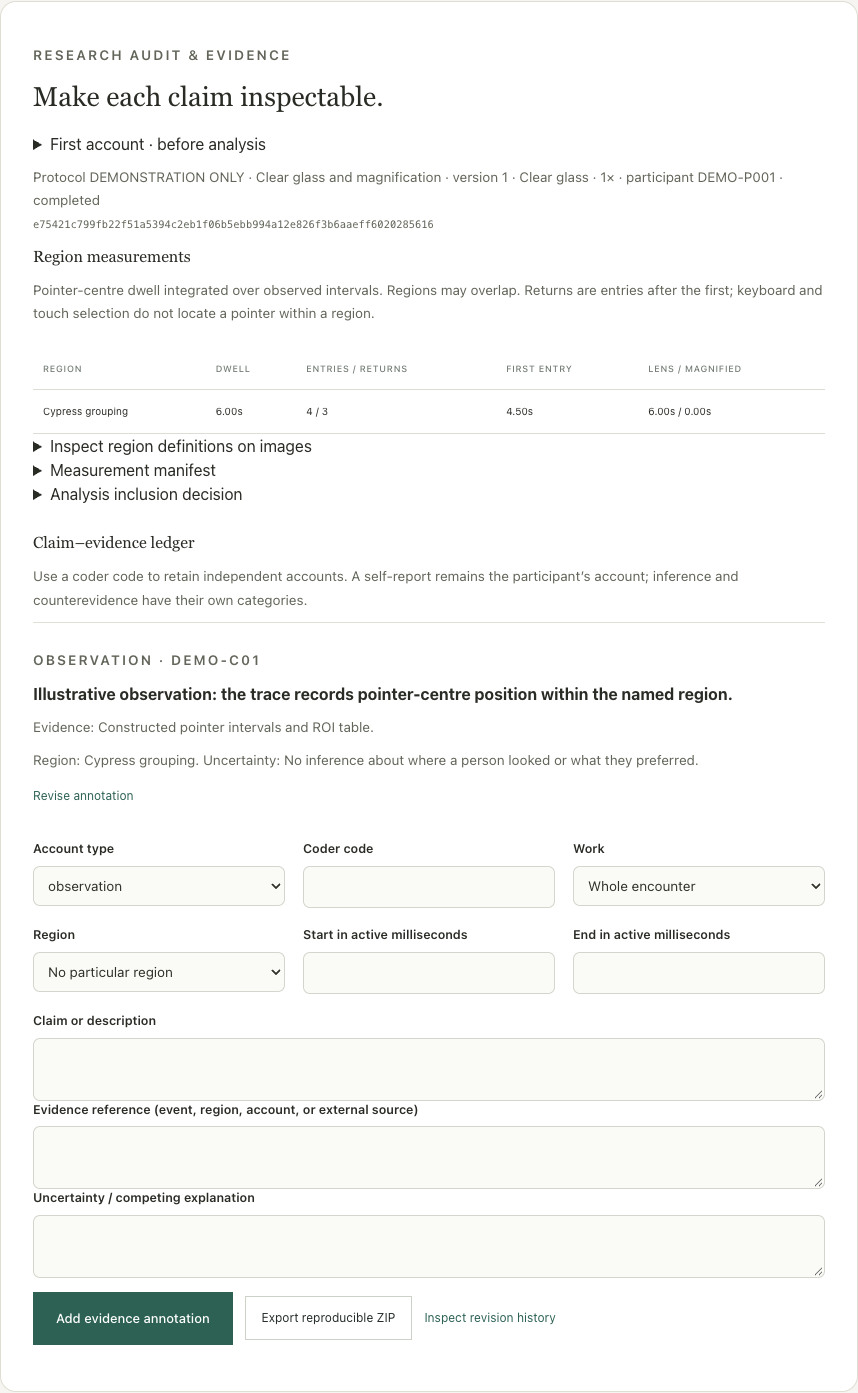
Actual first-account writing screen before the analysis is revealed, with a scripted demonstration account. — image at source
Proposed museum workflow · interface illustration
Examine a label or curatorial framing
What changes when the same works are introduced differently?
A traceable comparison to bring into an interpretation review, with the texts, accounts and uncertainty retained.
How a museum team can use it
Retain two exact introductory texts as separate protocol conditions. Keep the works and presentation settings fixed. Collect first accounts before revealing the trace, then compare recorded interaction and code the written accounts.
When prior knowledge would defeat identity withholding, use a justified design with fresh participant groups. The app does not undo exposure to a label or automatically establish comprehension.
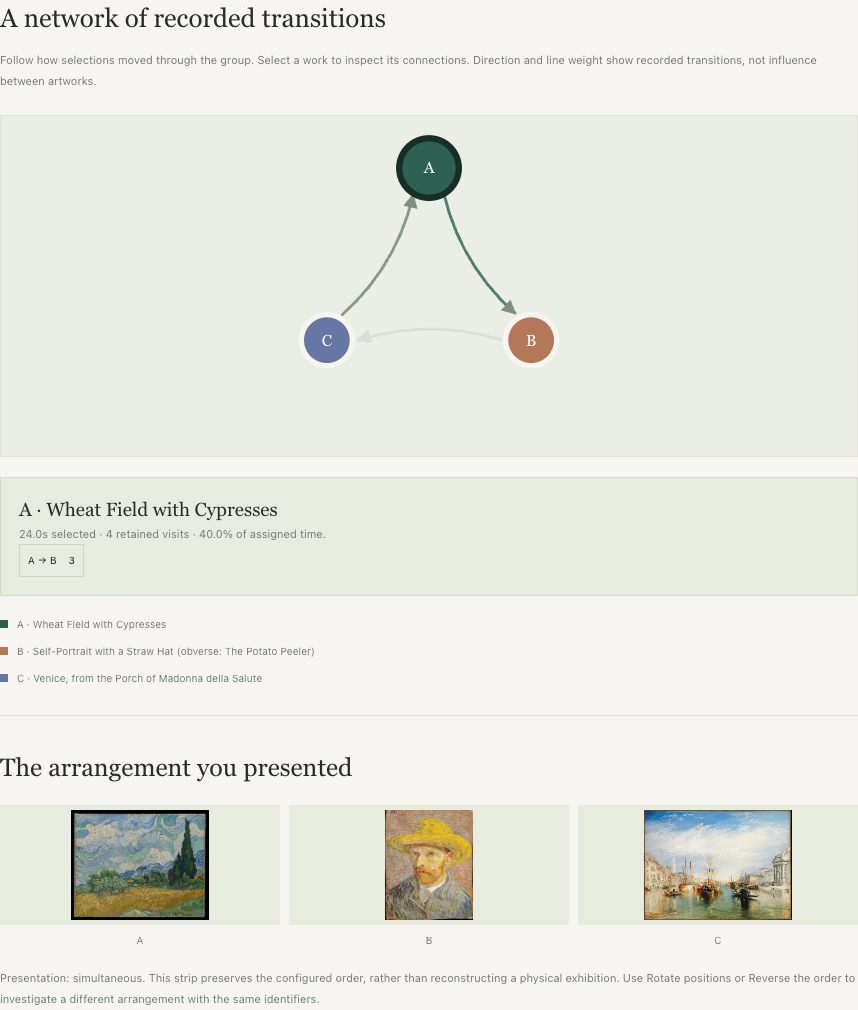
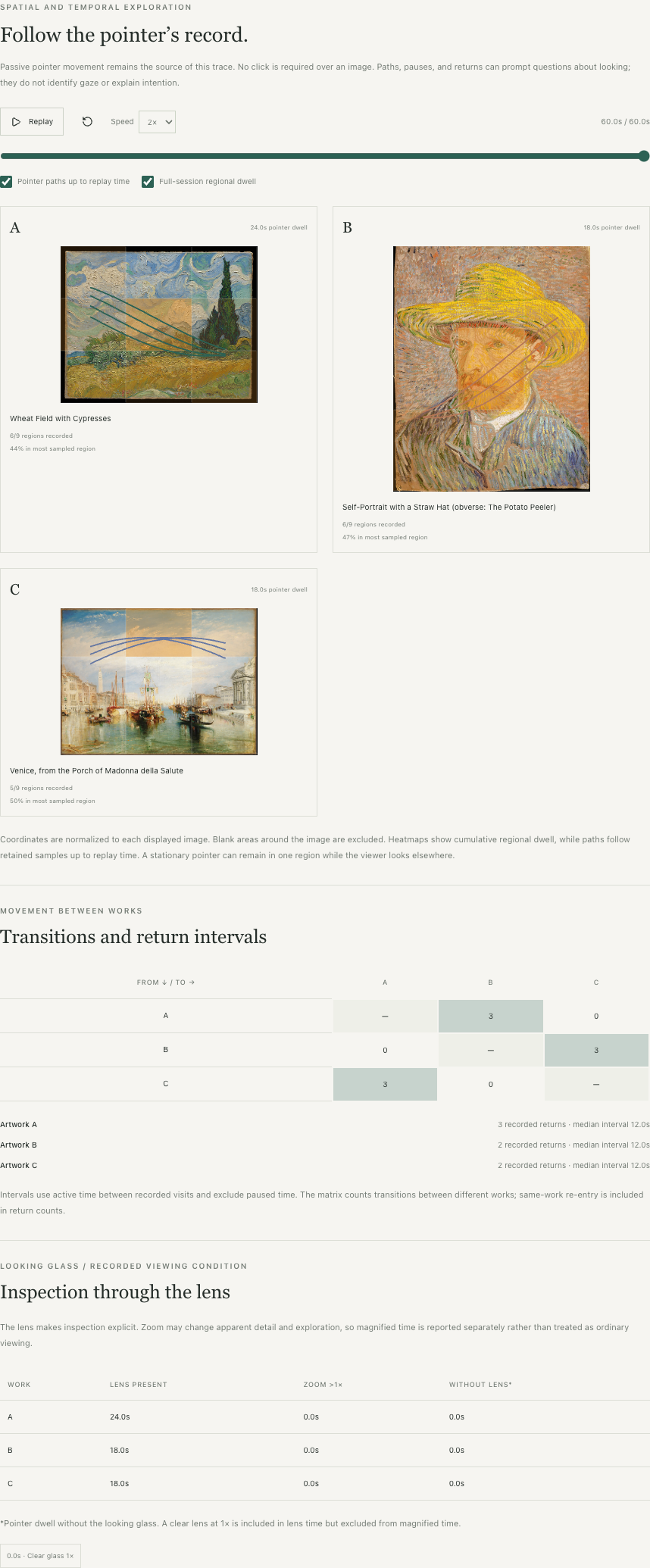
Directional transition network with a selected artwork node and recorded outgoing connections. — image at source
Proposed museum workflow · interface illustration
Test a pairing or display order
What does a different arrangement make available for comparison?
An inspectable basis for discussing a proposed pairing or sequence, including accounts that resist the curatorial premise.
How a museum team can use it
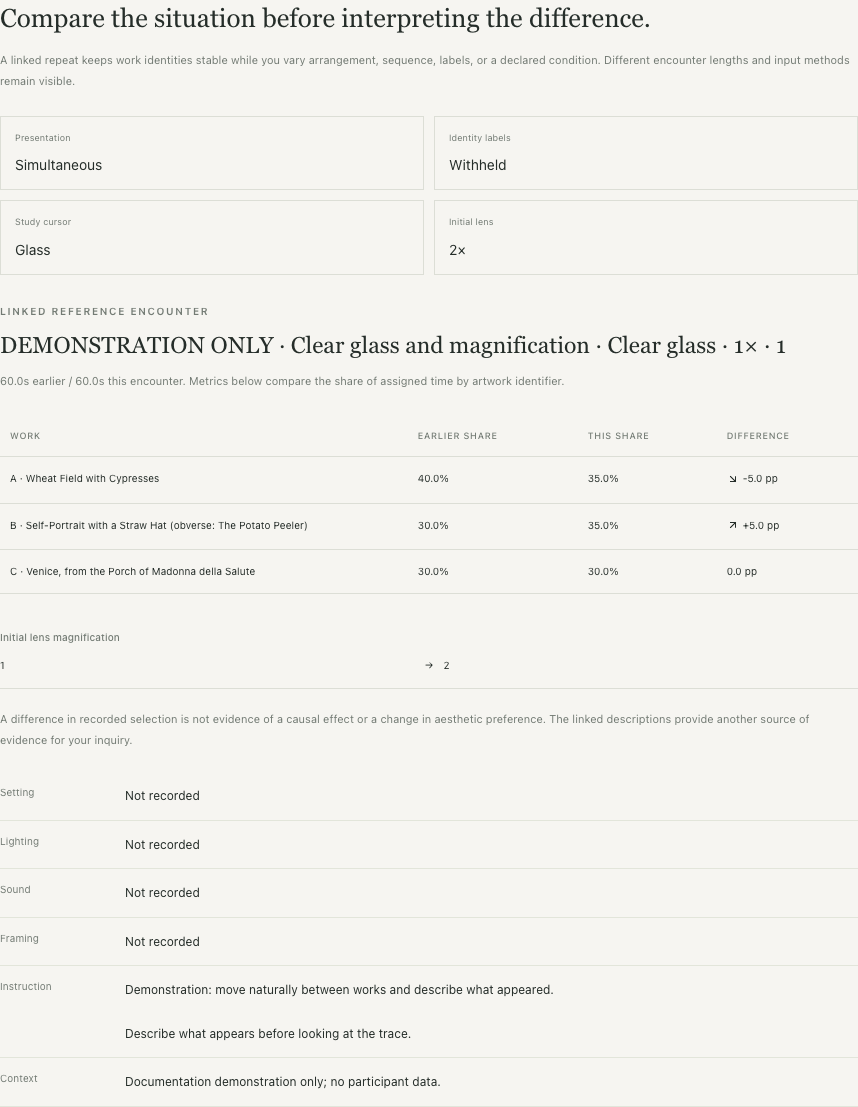
Keep the same artworks and use a linked reverse or rotation, or define the alternatives in a locked protocol. Review transitions, returns and first accounts by stable artwork identifier.
This is a digital comparison. Confirm decisions in the physical display; the tool does not reproduce gallery distance, lighting or visitor movement.
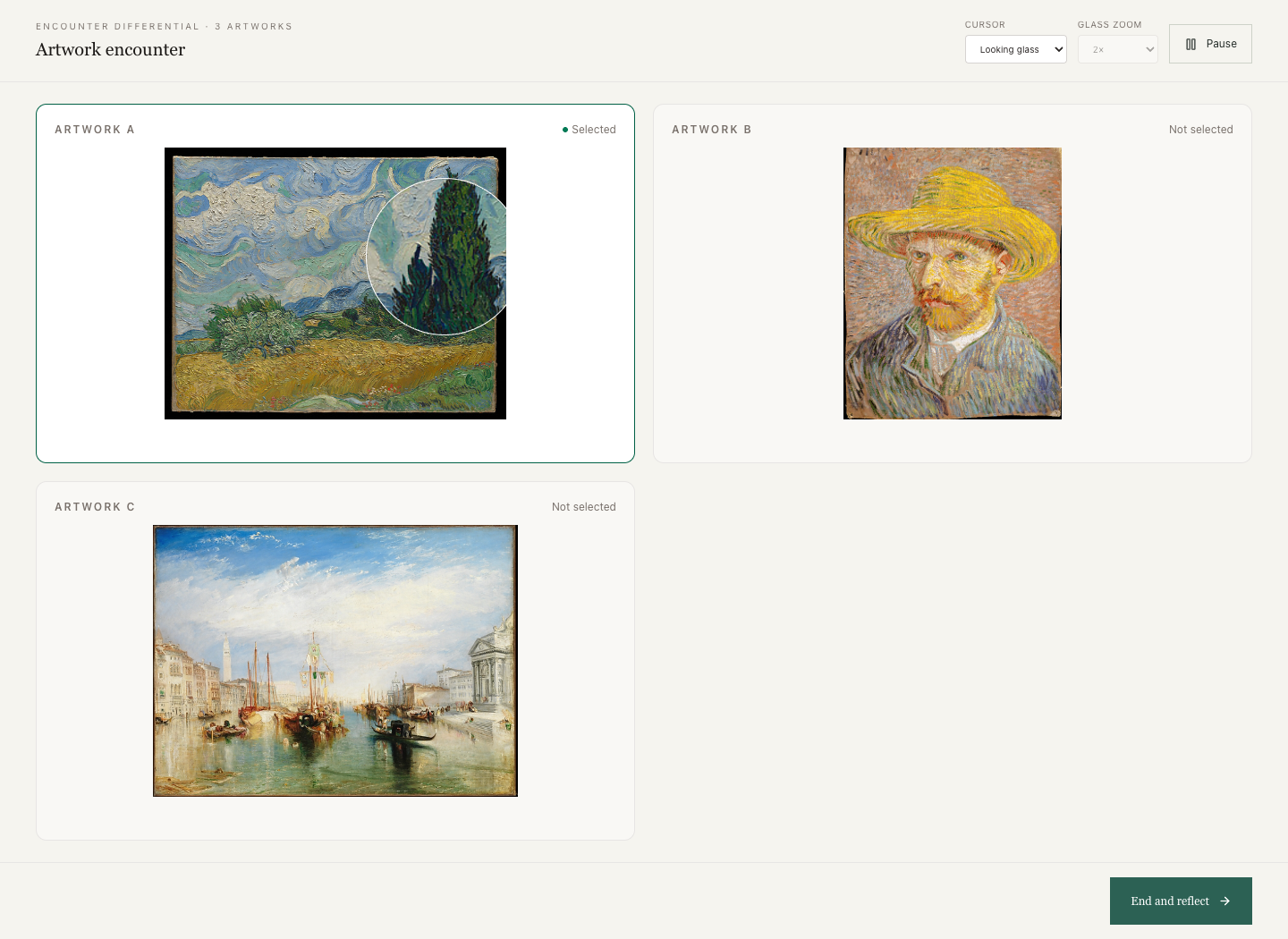
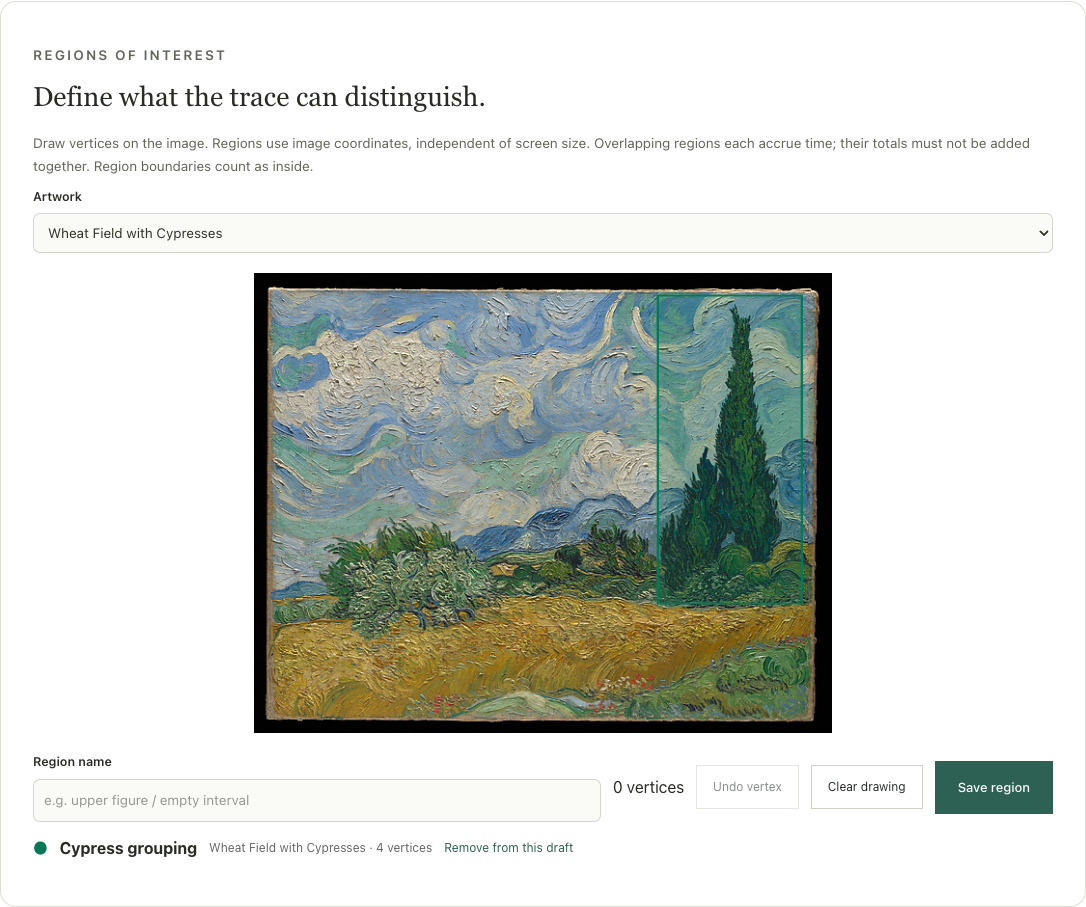
A named polygon region drawn over the cypress grouping in Wheat Field with Cypresses. — image at source
Proposed museum workflow · interface illustration
Study the role of detail and magnification
Does a looking glass change recorded exploration and description?
A reproducible record for discussing detail access and close-looking exercises, with region definitions retained.
How a museum team can use it
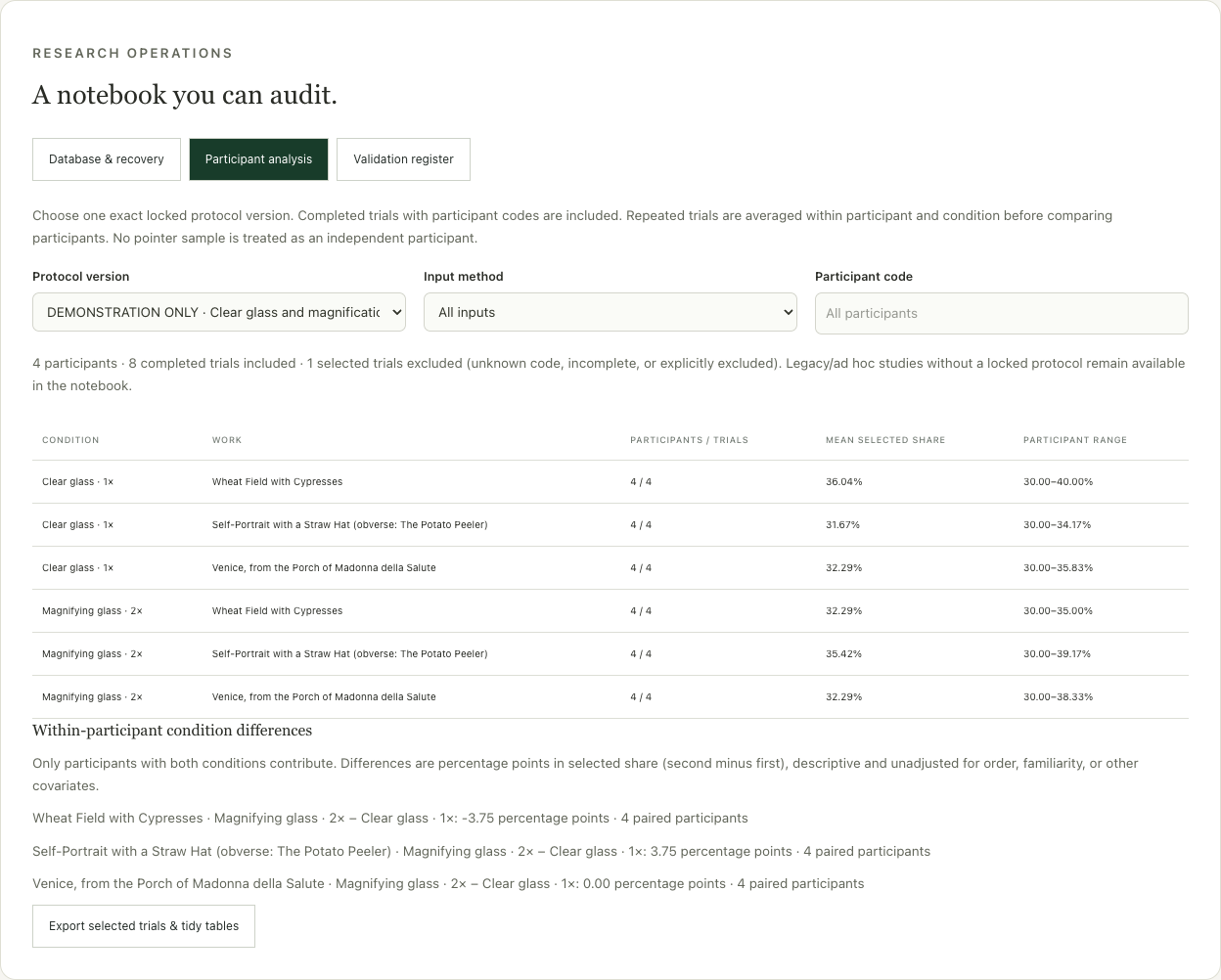
Name image regions before collection. Compare clear and magnifying conditions using the same works, display and instructions. Review regional pointer dwell, entries and accounts alongside the lens settings.
Region membership follows the pointer centre. It is not eye tracking, and the lens itself changes the encounter.
Explore all six museum workflows and the pilot plan →
A record to bring into the curatorial meeting.
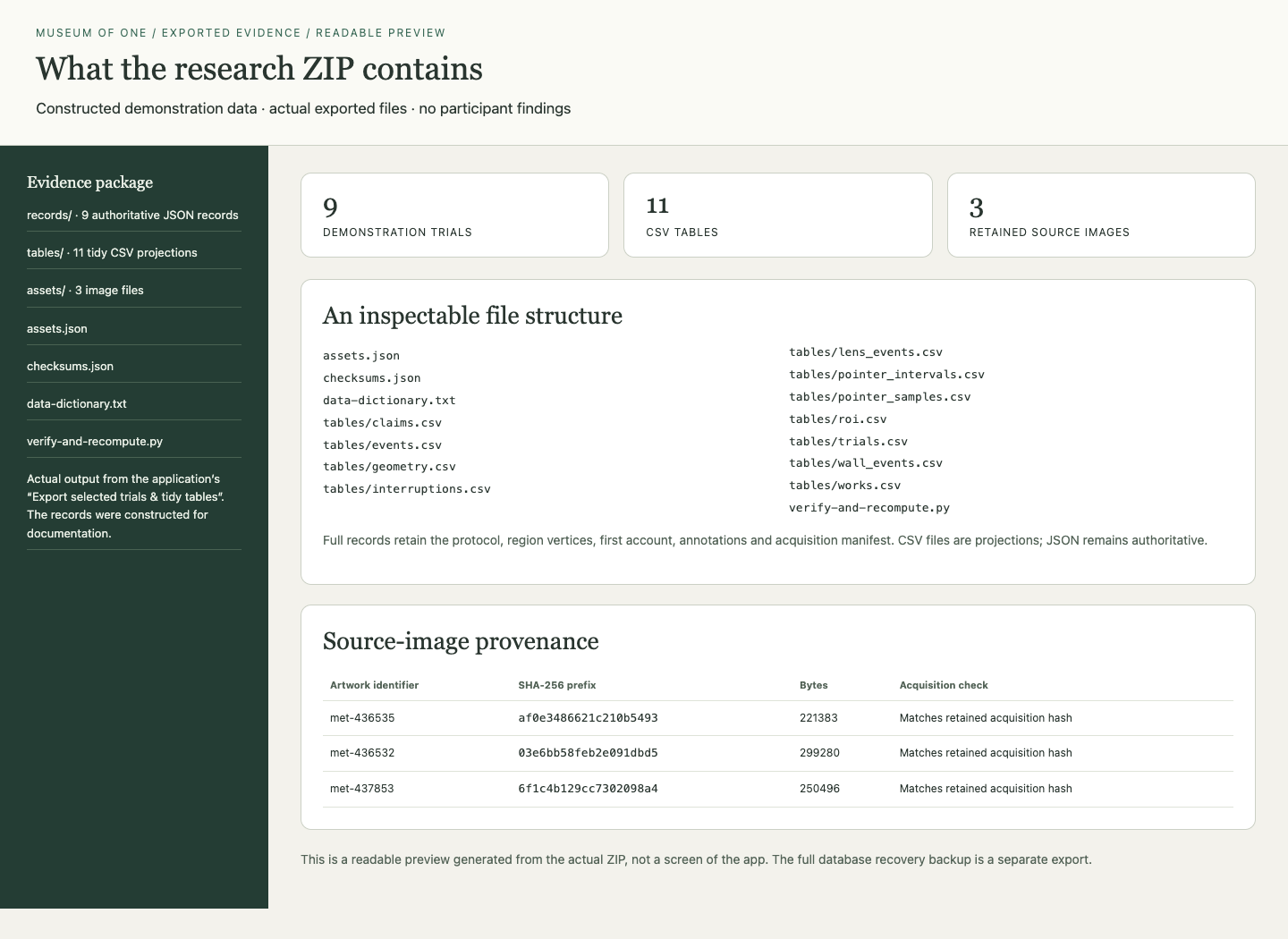
Keep the question and alternatives, a locked protocol, region definitions, participant accounts, recorded interaction, reasoned exclusions and claim–evidence annotations together. Export the records, tidy tables, source images and verification material so another colleague can inspect the reasoning.
Request it for your museum →Run the worked study →Read the research programme →Tell Museum of One your institution or practice, the curatorial question and the intended setting. On request, I can send the GitHub repository or a copy of the tool itself.
Use it as a documented digital pilot. The current working prototype supports facilitated comparative studies with images. Pair it with appropriate recruitment, consent and an analysis plan, and check the transfer of any conclusion to a physical exhibition. Pointer interaction is not gaze, preference or proof of understanding.
Research is part of the museum role described in ICOM’s museum definition. Encounter Differential offers one practical way to make the investigation of a curatorial choice explicit and inspectable.
Encounter Differential / Working prototype / Visual tour
See the research workflow.
Fifteen views of study design, recorded encounters, analysis and exported evidence. Select any image to inspect it at full size.
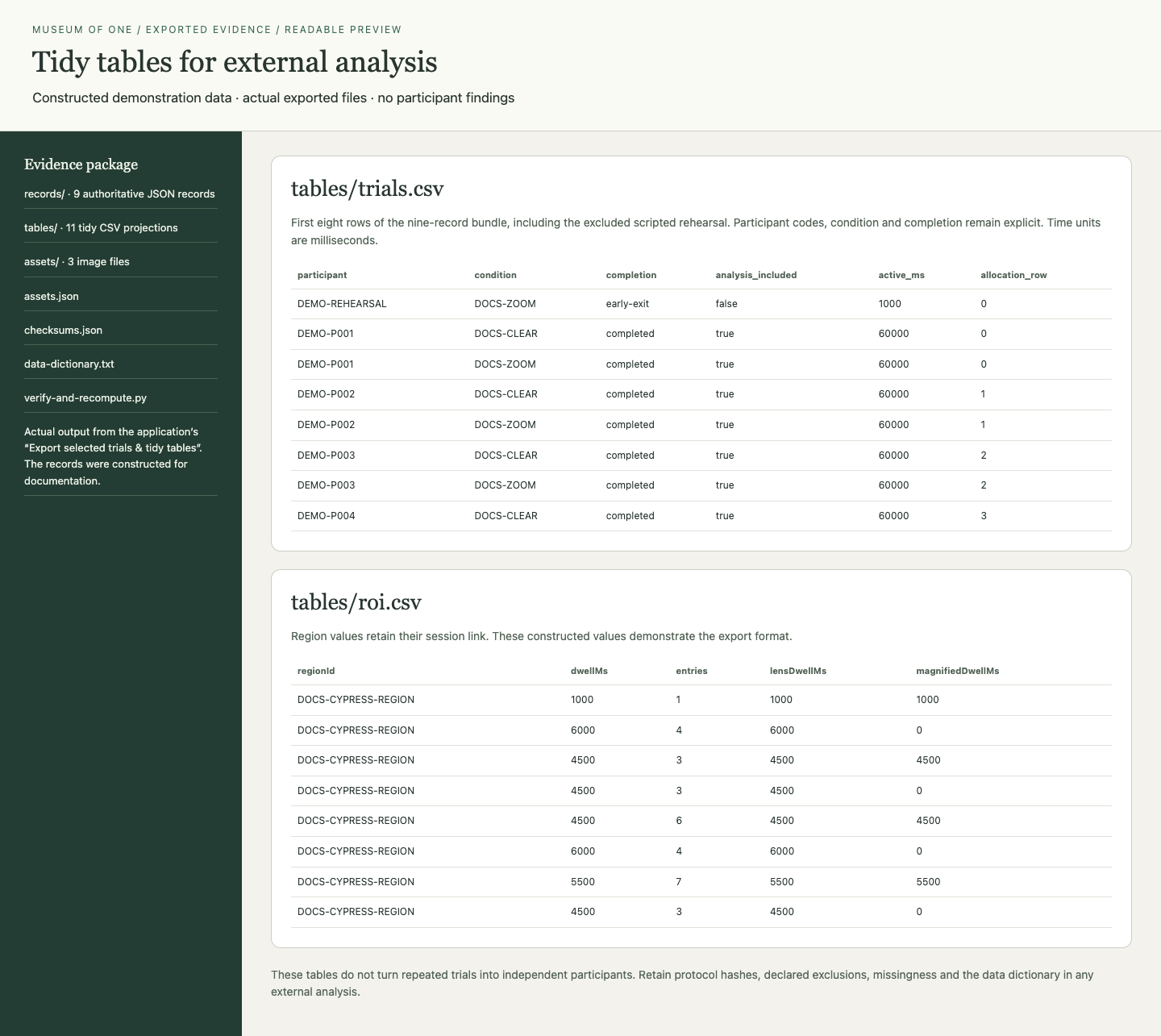
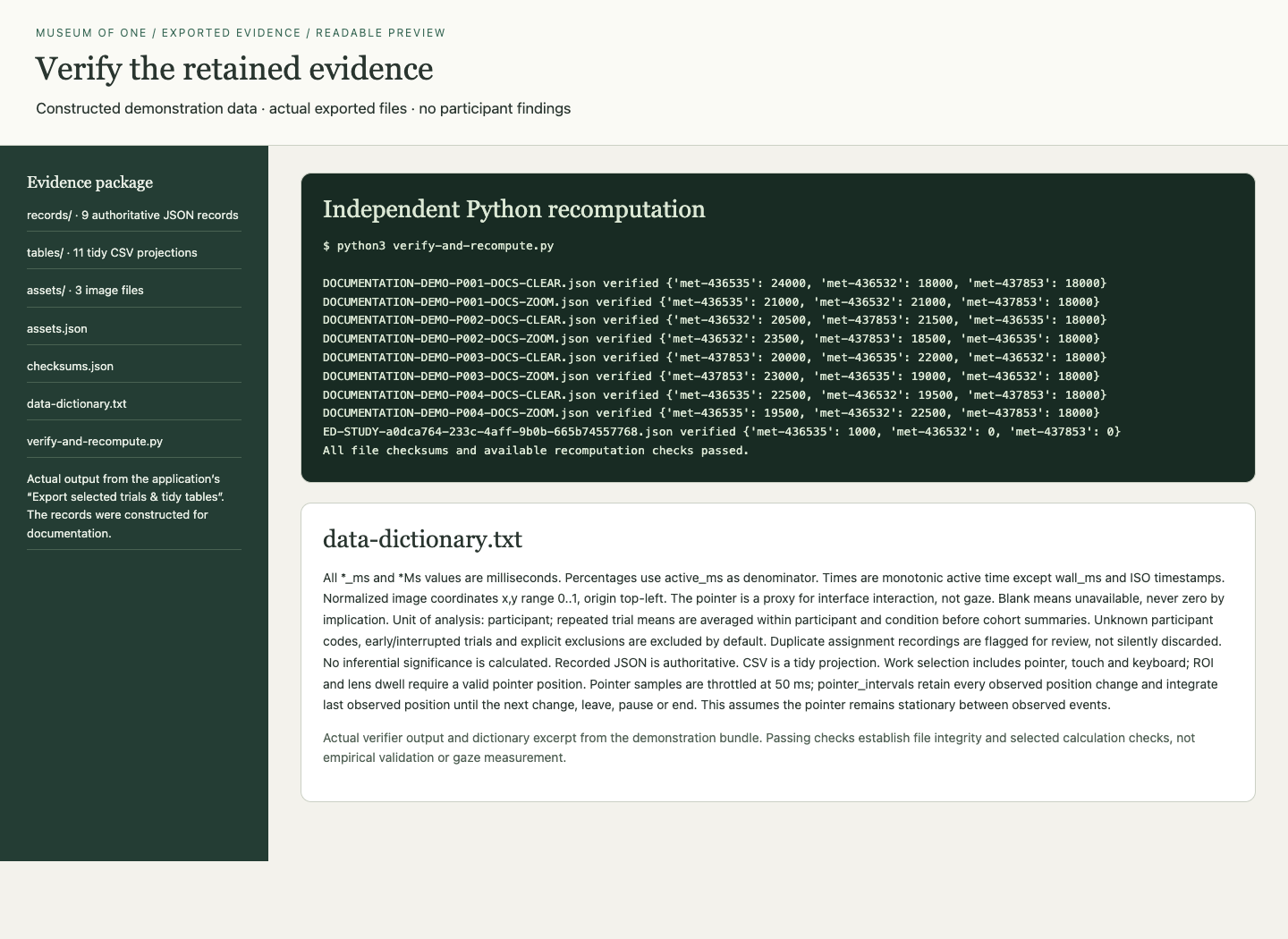
Actual interface screenshots and three readable previews generated from an actual export. All records are constructed demonstrations; no participant findings are shown.
01 / 3 views
Design the situation
Choose the works, draw the regions and retain an exact protocol.
02 / 3 views
Record the encounter
A looking glass, a first account and the conditions of acquisition.
03 / 6 views
Inspect and compare the evidence
Read patterns alongside accounts, uncertainty and declared conditions.
04 / 3 views
Take the evidence with you
Actual exported files, readable tables and independent verification.
Run a study of your own.
Open the complete study guide & FAQ →
Individuals and institutions can request the GitHub repository or the tool itself. The website presents documentation and static images.
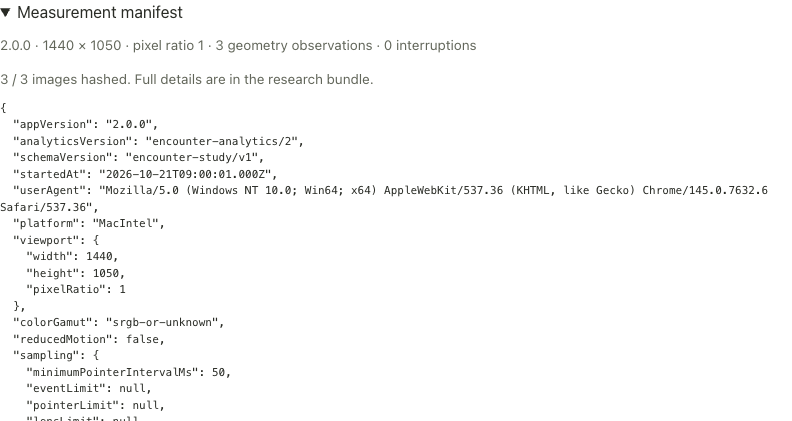
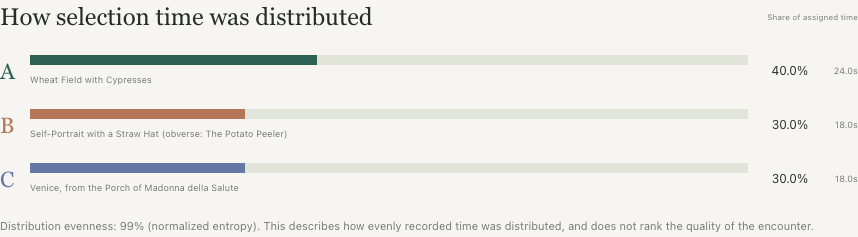
The export example retains eight completed demonstration trials plus one explicitly excluded scripted rehearsal. The participant comparison uses the eight completed trials. Integrity checks do not establish empirical validity.
Compare methods, browse all eight tool records and open the research worksheet
Research / Infrastructure / Tools and experiments
Documentation only. The interactive applications are not embedded. Each record presents the method and its limits; none of these pages accepts material for analysis.
Compare tools ↓ · Browse records ↓ · Research worksheet ↓
+Choose a starting question, then consult the full record before using a method. These are documentation pages; the comparison does not run an analysis.
Compare the documented designs. Open a record for its procedure and limits. On narrow screens, scroll the comparison horizontally.| Question and tool | Starting material | Documented output | Main limit |
|---|
| Phenomenological Indices →How does a text move between description and interpretation? | A critical passage and its coding record. | A provisional reading across five proposed indices. | Coding judgments and thresholds require scrutiny. |
|---|
| Linguistic Diagnostics →Where does critical prose assign meaning or speak for viewers? | Critical prose and the applicable coding rules. | A traceable account of rhetorical decisions. | A profile cannot establish motives or moral worth. |
|---|
| Theory Prism →How do different critical approaches construct their claims? | A common object, stated approaches, and source texts. | A comparison of attention, premises, and inference. | Assisted accounts need source checking. |
|---|
| Encounter Differential →How do documented viewing conditions shape recorded interaction and first accounts? | 2–8 artworks, locked protocols, image regions and participant accounts. | Versioned records, participant comparisons and reproducible evidence exports. | Pointer traces and selected time are not gaze or preference. |
|---|
| Curatorial Space →What changes when one display condition changes? | A reference arrangement and one controlled change. | A documented comparison of presentation conditions. | Simulation does not reproduce a gallery encounter. |
|---|
| Spatiotemporal Comparison →Which conditions can be compared across places and periods? | Dated source records from specified contexts. | A bounded account of similarities, differences, and gaps. | Juxtaposition does not prove influence or causation. |
|---|
| Adjacency Mapper →What assumptions does a proposed pairing impose? | Declared attributes, relational parameters, and rules. | A model profile with an inspectable calculation log. | Model consistency is not a measured viewer effect. |
|---|
How can a curatorial account remain answerable to its evidence?
Observatory · Curatorial/Museum Research | Works, artifacts, sources, exact fragments and situated accounts. | Linked claims, sourced assertions, decisions and reviewed research outputs. | A complete record does not establish truth, consent, legal rights or empirical validity. |
Curatorial research and evidence
08 →
A local workbench connecting studies, artworks, artifacts, documentary evidence, material situations and curatorial decisions.
Research use: inspect exact passages, retain competing assertions, compare readings and prepare a traceable account.
Status: Working prototype, Research Desk v2. Demonstrations are constructed; no completed empirical validation is claimed.
Research programme → · Study guide →
Critical language
01 →
Five proposed indices for examining description, presupposition, phase, residue, agency, and movement within critical writing.
Experimental instrument · Tool v.1 · Worked example → · Citation →
02 →
A diagnostic reading of rhetorical density, interpretive load, viewer displacement, and ethical proximity in art-critical language.
Experimental instrument · Tool v.2 · Worked example → · Citation → · Diagnostic Reading guide →
03 →
A comparative teaching instrument for examining what different critical frameworks notice, assume, overlook, and authorize.
Experimental teaching instrument · Worked example → · Citation →
Research worksheet
An editable, three-page worksheet for Linguistic Diagnostics. Retain the source passage, coding decisions, exclusions, uncertainty, and review notes alongside the method you use.
Version 1.0 · 17 October 2026. The worksheet is a manual documentation aid. It introduces no new coding rules or validated results. Read the Linguistic Diagnostics record →
Encounter and attention
04 →
A working prototype for comparative artwork research: 2–8 works, locked protocols, image regions, a clear or magnifying looking glass, first accounts, participant comparisons and reproducible evidence exports.
Working prototype · Encounter Differential 2.0 · Worked example → · Citation →
Spatial and curatorial experiments
05 →
A curatorial experiment in how light, scale, distance, framing, adjacency, and sequence condition an encounter with art.
Experimental curatorial environment · Worked example → · Citation →
06 →
Comparative inquiry into the historical, geographical, institutional, and material conditions surrounding artistic production.
Comparative research framework · Worked example → · Citation →
07 →
A rule-based modelling experiment in dominance, amplification, flattening, narrative pressure, and relations between adjacent works.
Experimental rule-based model · Worked example → · Citation →
Explore the record
+Instruments, viewing protocols, and modelling experiments within Museum of One’s research infrastructure. These seven records explain the purpose and procedure of each tool, its connection to Post-Interpretive Criticism, and the limits of its claims. They support the Phenomenological Methods and Diagnostic Reading programme.
The records explain each tool’s purpose, method, limits and citation. Encounter Differential also includes a complete study guide, FAQ and screenshots of its working prototype. Examples and demonstration records report no participant findings or empirical validation.
The research position
+The shared question is how critical language, viewing arrangements, and curatorial decisions condition an encounter with art. PIC supplies the demand for restraint and answerability. These tools give selected questions a procedural form so that assumptions, observations, and inferences can be inspected separately. They do not establish a measurement of aesthetic truth.
Methodological publications
+The tools belong beside the arguments and coding procedures that make their use open to scrutiny. A tool record describes a design; a published method supplies claims and evidence that require their own evaluation.
Research status and evidence
+A documented design specifies a procedure. An experimental instrument makes selected assumptions available for testing. Neither label is a claim of independent validation.
Quantifying Critical Posture reports a related single-coder pilot, not independent validation of these tools. Diagnostics Without Possession sets out coding and reliability procedures; a procedure for testing agreement is not a completed reliability result. Each record states the limits of the evidence it presents.
Return to the Methods programme → · All Research Programmes →
Transcribed declarations retain their source scope. Identifiers are not promoted to independently verified edition assignments.