Documentary Evidence and Source Comparisons: Supplement 1 to Relational Archival Investigation
The published supplement records the matched descriptive features, preserved differences, open explanations and rejection of a third-date extension. These selected pages document the author’s reasoning; source quotations remain attributed to the institutions cited in the publication.
Selected PDF file pages 4 and 6 of 11 (printed pages 3 and 5). The complete published PDF retains the continuation of section C.3.
PDF page 4 · printed page 3
Documentary Evidence and Source Comparisons: Supplement 1 to Relational Archival Investigation, version 1.0, PDF file page 4 of 11; printed page 3.
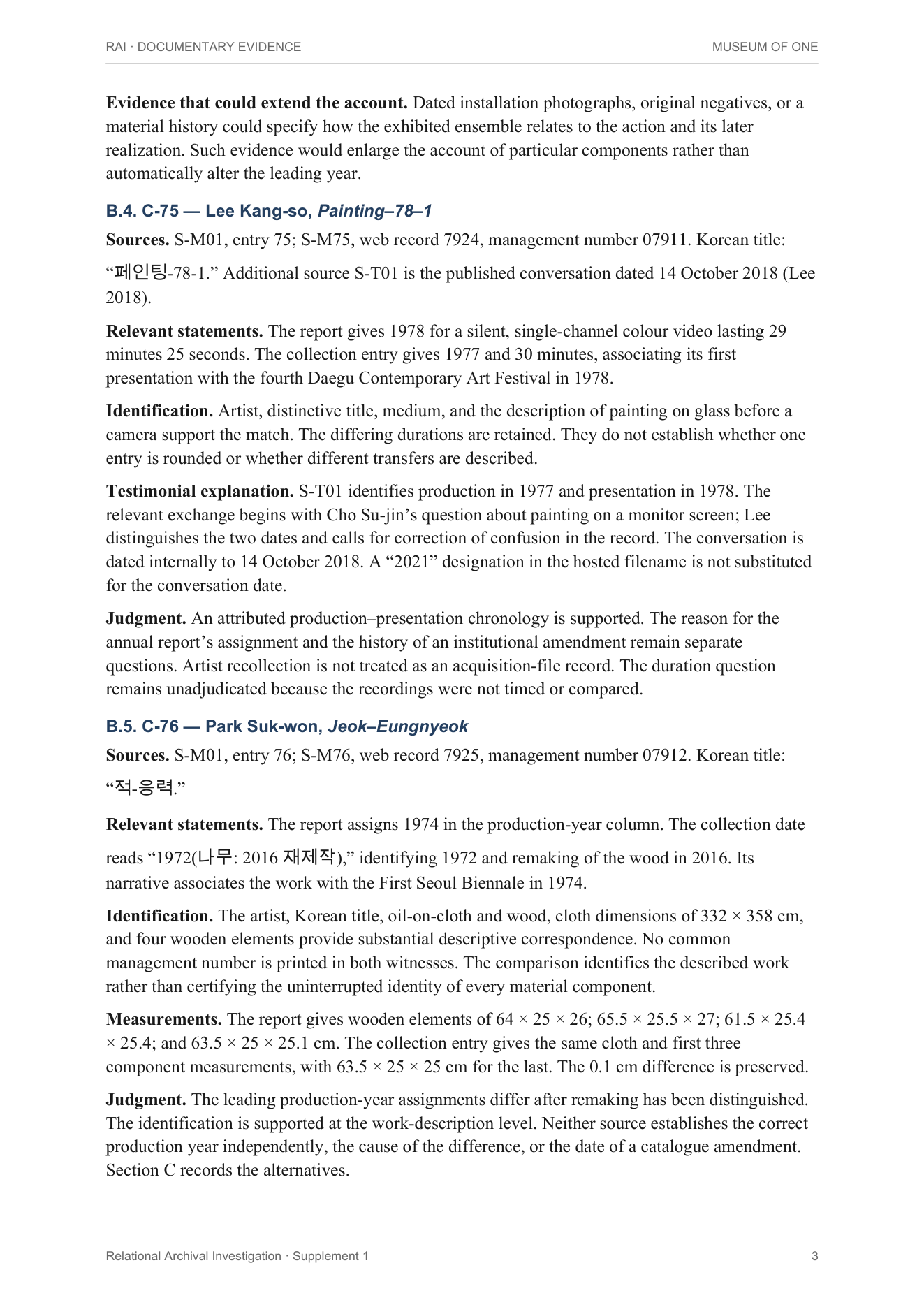
Open this page in the published PDF ↗ · Permanent page link
Published text / transcription
PDF text extraction, checked against the rendered published page · 2026-11-10 · Reviewed extraction; original language retained
This is an extracted text layer of the published research page, not a new transcription of an institutional manuscript. Line breaks and text-layer ordering may differ from the visual page. No new translation has been supplied.
RAI · DOCUMENTARY EVIDENCE
MUSEUM OF ONE
Relational Archival Investigation · Supplement 1
3
Evidence that could extend the account. Dated installation photographs, original negatives, or a
material history could specify how the exhibited ensemble relates to the action and its later
realization. Such evidence would enlarge the account of particular components rather than
automatically alter the leading year.
B.4. C-75 — Lee Kang-so, Painting–78–1
Sources. S-M01, entry 75; S-M75, web record 7924, management number 07911. Korean title:
“페인팅-78-1.” Additional source S-T01 is the published conversation dated 14 October 2018 (Lee
2018).
Relevant statements. The report gives 1978 for a silent, single-channel colour video lasting 29
minutes 25 seconds. The collection entry gives 1977 and 30 minutes, associating its first
presentation with the fourth Daegu Contemporary Art Festival in 1978.
Identification. Artist, distinctive title, medium, and the description of painting on glass before a
camera support the match. The differing durations are retained. They do not establish whether one
entry is rounded or whether different transfers are described.
Testimonial explanation. S-T01 identifies production in 1977 and presentation in 1978. The
relevant exchange begins with Cho Su-jin’s question about painting on a monitor screen; Lee
distinguishes the two dates and calls for correction of confusion in the record. The conversation is
dated internally to 14 October 2018. A “2021” designation in the hosted filename is not substituted
for the conversation date.
Judgment. An attributed production–presentation chronology is supported. The reason for the
annual report’s assignment and the history of an institutional amendment remain separate
questions. Artist recollection is not treated as an acquisition-file record. The duration question
remains unadjudicated because the recordings were not timed or compared.
B.5. C-76 — Park Suk-won, Jeok–Eungnyeok
Sources. S-M01, entry 76; S-M76, web record 7925, management number 07912. Korean title:
“적-응력.”
Relevant statements. The report assigns 1974 in the production-year column. The collection date
reads “1972(나무: 2016 재제작),” identifying 1972 and remaking of the wood in 2016. Its
narrative associates the work with the First Seoul Biennale in 1974.
Identification. The artist, Korean title, oil-on-cloth and wood, cloth dimensions of 332 × 358 cm,
and four wooden elements provide substantial descriptive correspondence. No common
management number is printed in both witnesses. The comparison identifies the described work
rather than certifying the uninterrupted identity of every material component.
Measurements. The report gives wooden elements of 64 × 25 × 26; 65.5 × 25.5 × 27; 61.5 × 25.4
× 25.4; and 63.5 × 25 × 25.1 cm. The collection entry gives the same cloth and first three
component measurements, with 63.5 × 25 × 25 cm for the last. The 0.1 cm difference is preserved.
Judgment. The leading production-year assignments differ after remaking has been distinguished.
The identification is supported at the work-description level. Neither source establishes the correct
production year independently, the cause of the difference, or the date of a catalogue amendment.
Section C records the alternatives.
Relevant statements. The report assigns 1974
Relevant statements. The report assigns 1974 in the production-year column. The collection date reads “1972(나무: 2016 재제작),” identifying 1972 and remaking of the wood in 2016. Its narrative associates the work with the First Seoul Biennale in 1974.
PDF page 6 · printed page 5
Documentary Evidence and Source Comparisons: Supplement 1 to Relational Archival Investigation, version 1.0, PDF file page 6 of 11; printed page 5.
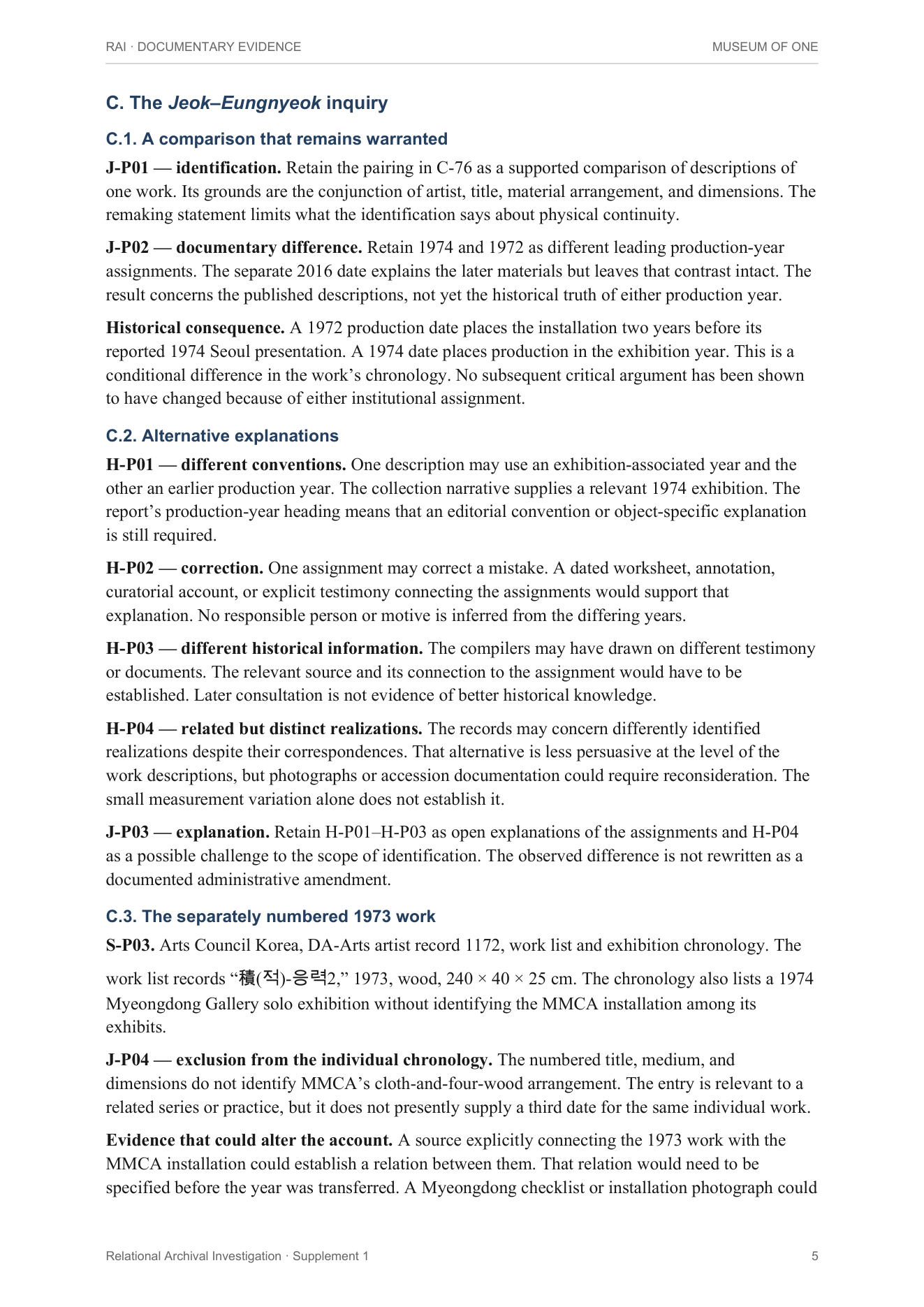
Open this page in the published PDF ↗ · Permanent page link
Published text / transcription
PDF text extraction, checked against the rendered published page · 2026-11-10 · Reviewed extraction; original language retained
This is an extracted text layer of the published research page, not a new transcription of an institutional manuscript. Line breaks and text-layer ordering may differ from the visual page. No new translation has been supplied.
RAI · DOCUMENTARY EVIDENCE
MUSEUM OF ONE
Relational Archival Investigation · Supplement 1
5
C. The Jeok–Eungnyeok inquiry
C.1. A comparison that remains warranted
J-P01 — identification. Retain the pairing in C-76 as a supported comparison of descriptions of
one work. Its grounds are the conjunction of artist, title, material arrangement, and dimensions. The
remaking statement limits what the identification says about physical continuity.
J-P02 — documentary difference. Retain 1974 and 1972 as different leading production-year
assignments. The separate 2016 date explains the later materials but leaves that contrast intact. The
result concerns the published descriptions, not yet the historical truth of either production year.
Historical consequence. A 1972 production date places the installation two years before its
reported 1974 Seoul presentation. A 1974 date places production in the exhibition year. This is a
conditional difference in the work’s chronology. No subsequent critical argument has been shown
to have changed because of either institutional assignment.
C.2. Alternative explanations
H-P01 — different conventions. One description may use an exhibition-associated year and the
other an earlier production year. The collection narrative supplies a relevant 1974 exhibition. The
report’s production-year heading means that an editorial convention or object-specific explanation
is still required.
H-P02 — correction. One assignment may correct a mistake. A dated worksheet, annotation,
curatorial account, or explicit testimony connecting the assignments would support that
explanation. No responsible person or motive is inferred from the differing years.
H-P03 — different historical information. The compilers may have drawn on different testimony
or documents. The relevant source and its connection to the assignment would have to be
established. Later consultation is not evidence of better historical knowledge.
H-P04 — related but distinct realizations. The records may concern differently identified
realizations despite their correspondences. That alternative is less persuasive at the level of the
work descriptions, but photographs or accession documentation could require reconsideration. The
small measurement variation alone does not establish it.
J-P03 — explanation. Retain H-P01–H-P03 as open explanations of the assignments and H-P04
as a possible challenge to the scope of identification. The observed difference is not rewritten as a
documented administrative amendment.
C.3. The separately numbered 1973 work
S-P03. Arts Council Korea, DA-Arts artist record 1172, work list and exhibition chronology. The
work list records “積(적)-응력2,” 1973, wood, 240 × 40 × 25 cm. The chronology also lists a 1974
Myeongdong Gallery solo exhibition without identifying the MMCA installation among its
exhibits.
J-P04 — exclusion from the individual chronology. The numbered title, medium, and
dimensions do not identify MMCA’s cloth-and-four-wood arrangement. The entry is relevant to a
related series or practice, but it does not presently supply a third date for the same individual work.
Evidence that could alter the account. A source explicitly connecting the 1973 work with the
MMCA installation could establish a relation between them. That relation would need to be
specified before the year was transferred. A Myeongdong checklist or installation photograph could
J-P02 — documentary difference
J-P02 — documentary difference. Retain 1974 and 1972 as different leading production-year assignments. The separate 2016 date explains the later materials but leaves that contrast intact. The result concerns the published descriptions, not yet the historical truth of either production year.
S-P03. Arts Council Korea
S-P03. Arts Council Korea, DA-Arts artist record 1172, work list and exhibition chronology. The work list records “積(적)-응력2,” 1973, wood, 240 × 40 × 25 cm. The chronology also lists a 1974 Myeongdong Gallery solo exhibition without identifying the MMCA installation among its exhibits.
J-P04 — exclusion
J-P04 — exclusion from the individual chronology. The numbered title, medium, and dimensions do not identify MMCA’s cloth-and-four-wood arrangement. The entry is relevant to a related series or practice, but it does not presently supply a third date for the same individual work.
Provenance and verification
IIIF Presentation manifest ↗ · Selected published pages; no image API service.
Cite this research document
Dorian Vale. Documentary Evidence and Source Comparisons: Supplement 1 to Relational Archival Investigation. 9 November 2026 · version 1.0. Museum of One. 10.5281/zenodo.24088574. https://archive.museumofone.art/evidence/rai-documentary-supplement-v1.html.
Source, rights and selection
Author-owned published research pages reproduced under the account holder’s explicit publication instruction. Existing copyright is preserved. Third-party passages retain their attributed sources; this permission does not authorize redistribution of institutional images, manuscripts or private correspondence.
© 2026 Dorian Vale · Museum of One. In Copyright.
Record history
First release of this research presentation: 2026-11-10
2026-11-10 · Museum of One · First public dossier selection from the already published version 1.0 PDF. Original page images, PDF page numbers and publication identity retained; no change to the deposited edition.