MOO-CAT-022ITEM / Digital record
MUSEUM OF ONE
ARCHIVAL LIBRARYWhen Interpretation Becomes AuthorityDorian Vale
2026 · Catalogue display
MOO-CAT-022 ↗
When Interpretation Becomes Authority
Dorian Vale’s editorial account of correspondence with Alexander V. Markov examines how critical language acquires authority through museum labels, catalogues and institutional procedures. The exchange connects Post-Interpretive Criticism with the Semiotics of Non-intentional Ephemerality while preserving the attribution of proposals, disagreement and limits of documentary evidence.
Dorian Vale · 2026
Research dialogue
MOO-CAT-020ITEM / Digital record
MUSEUM OF ONE
ARCHIVAL LIBRARYWhen Documentation Becomes the WorkDorian Vale
2026 · Catalogue display
MOO-CAT-020 ↗
When Documentation Becomes the Work
Examines how photographs, later interventions and reperformance shape the documentary histories of works by Sung Neung Kyung, Rim Dong Sik and Kim Kulim.
Dorian Vale · 2026
Working paper
MOO-CAT-021ITEM / Digital record
MUSEUM OF ONE
ARCHIVAL LIBRARYTitles, Dates, and Reconstructed WorksDorian Vale
2026 · Catalogue display
MOO-CAT-021 ↗
Titles, Dates, and Reconstructed Works
Four studies of Kim Yong-Ik, Park Suk-won, Lee Kang-so and Kim Kulim compare how collection dates, titles and reconstructions bear on artwork identity and historical claims.
Dorian Vale · 2026
Working paper
Research tool or guide · Dorian Vale · 2026-11-09
A source-led protocol for discovering and testing historical problems through relations among documentary assertions.
Research tool or guide · Dorian Vale · 2026-11-09
Research methods and instruments for art, archives and aesthetic encounters, including Relational Archival Investigation and its published evidence.
MOO-CAT-017ITEM / Digital record
MUSEUM OF ONE
ARCHIVAL LIBRARYRelational Archival InvestigationDorian Vale
2026 · Catalogue display
MOO-CAT-017 ↗
Relational Archival Investigation
A documentary study of Korean experimental art: how collection records, artist testimony and archives support claims about artwork identity, chronology, naming, performance and display. Main paper with two separately citable supplements.
Dorian Vale · 2026
Working paper
MOO-CAT-018ITEM / Digital record
MUSEUM OF ONE
ARCHIVAL LIBRARYRAI: Documentary Evidence and Source ComparisonsDorian Vale
2026 · Catalogue display
MOO-CAT-018 ↗
RAI: Documentary Evidence and Source Comparisons
The documentary record supporting RAI: seven MMCA acquisition entries compared with collection records, with SeMA sources, artist testimony, institutional identifiers and the limits of each comparison.
Dorian Vale · 2026
Technical note
MOO-CAT-019ITEM / Digital record
MUSEUM OF ONE
ARCHIVAL LIBRARYRAI: Extended Case StudiesDorian Vale
2026 · Catalogue display
MOO-CAT-019 ↗
RAI: Extended Case Studies
Four studies of Kim Yong-Ik, Rim Dong Sik, Sung Neung Kyung and Kim Youngjin distinguish the work from the histories of its title, photographs, performance and display.
Dorian Vale · 2026
Technical note
Research tool or guide · Dorian Vale · 2026-10-21
A local research workbench for artworks, artifacts, evidence and curatorial decisions. Explore eight research tools, a constructed worked study, a visual tour and practical guidance for varied museum inquiries.
MOO-CAT-005ITEM / PDF
MUSEUM OF ONE
ARCHIVAL LIBRARYAfter the Interpretation ChangesDorian Vale
2026 · Catalogue display
MOO-CAT-005 ↗
After the Interpretation Changes
Research Working Paper No. 2 distinguishes title correction, later identification, and the circulation of catalogue descriptions through a study of Simon Maris’s portrait Isabella and its repository records.
Dorian Vale · 2026
Working paper
MOO-CAT-006ITEM / PDF
MUSEUM OF ONE
ARCHIVAL LIBRARYAnswerabilityDorian Vale
2026 · Catalogue display
MOO-CAT-006 ↗
Answerability
Research Working Paper No. 1 examines when exhibition and documentary evidence requires an art-historical account to limit or revise its claims, with particular attention to postwar Japanese art and Shiraga Kazuo.
Dorian Vale · 2026
Working paper
Website description · Dorian Vale · 2026-10-11
The second volume brings together essays from the field and educational texts extending Post-Interpretive Criticism. It develops the practice of witnessing, restraint and moral proximity through critical and pedagogical writing.
Website description · Dorian Vale · 2026-10-11
The first volume collects the doctrines, theories and applications of Post-Interpretive Criticism. Its contents include Stillmark Theory, Absential Aesthetics, Hauntmark Theory, aesthetic displacement and the ethics of critical language.
Website publication · Dorian Vale · 2026-09-22
Published English and Japanese dialogue between Dorian Vale and Tomoki Akimaru, preserved by Museum of One.
Website publication · Dorian Vale · 2026-09-18
An ongoing exchange originally hosted by Dong-Yeon Koh, with direct links to her published conversation and its responses.
MOO-CAT-007ITEM / PDF
MUSEUM OF ONE
ARCHIVAL LIBRARYArt That Falls ApartDorian Vale
2026 · Catalogue display
MOO-CAT-007 ↗
Art That Falls Apart
An essay considering unstable materials, deterioration, and the tension between conservation and artistic impermanence. It reads material fatigue through the ethics of witnessing.
Dorian Vale · 2026
Journal article
MOO-CAT-008ITEM / PDF
MUSEUM OF ONE
ARCHIVAL LIBRARYHassan Sharif’s ObjectsDorian Vale
2026 · Catalogue display
MOO-CAT-008 ↗
Hassan Sharif’s Objects
An essay on Hassan Sharif’s handmade accumulations of ordinary materials, examining repetition, labour, consumption, and the ethical implications of material fragility.
Dorian Vale · 2026
Journal article
MOO-CAT-009ITEM / PDF
MUSEUM OF ONE
ARCHIVAL LIBRARYEl Anatsui’s Man’s Cloth SeriesDorian Vale
2026 · Catalogue display
MOO-CAT-009 ↗
El Anatsui’s Man’s Cloth Series
An essay on El Anatsui’s bottle-cap assemblages, linking discarded materials and collaborative labour with historical memory, installation practices, and the author’s account of reparation.
Dorian Vale · 2026
Journal article
MOO-CAT-003ITEM / PDF
MOO-CAT-003 ↗
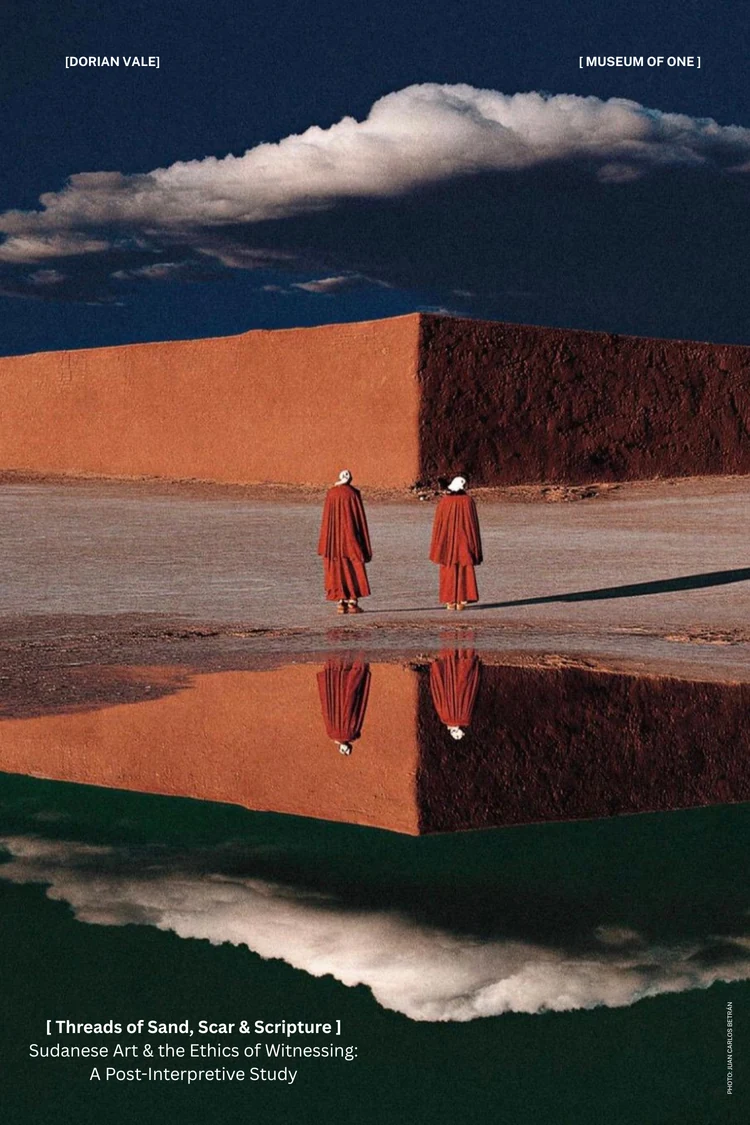
Threads of Sand, Scar & Scripture
A study of Sudanese art in relation to war, displacement, and historical fragmentation. The author approaches critical writing as an ethical practice of proximity and restraint.
Dorian Vale · 2026
Book
MOO-CAT-004ITEM / PDF
MOO-CAT-004 ↗
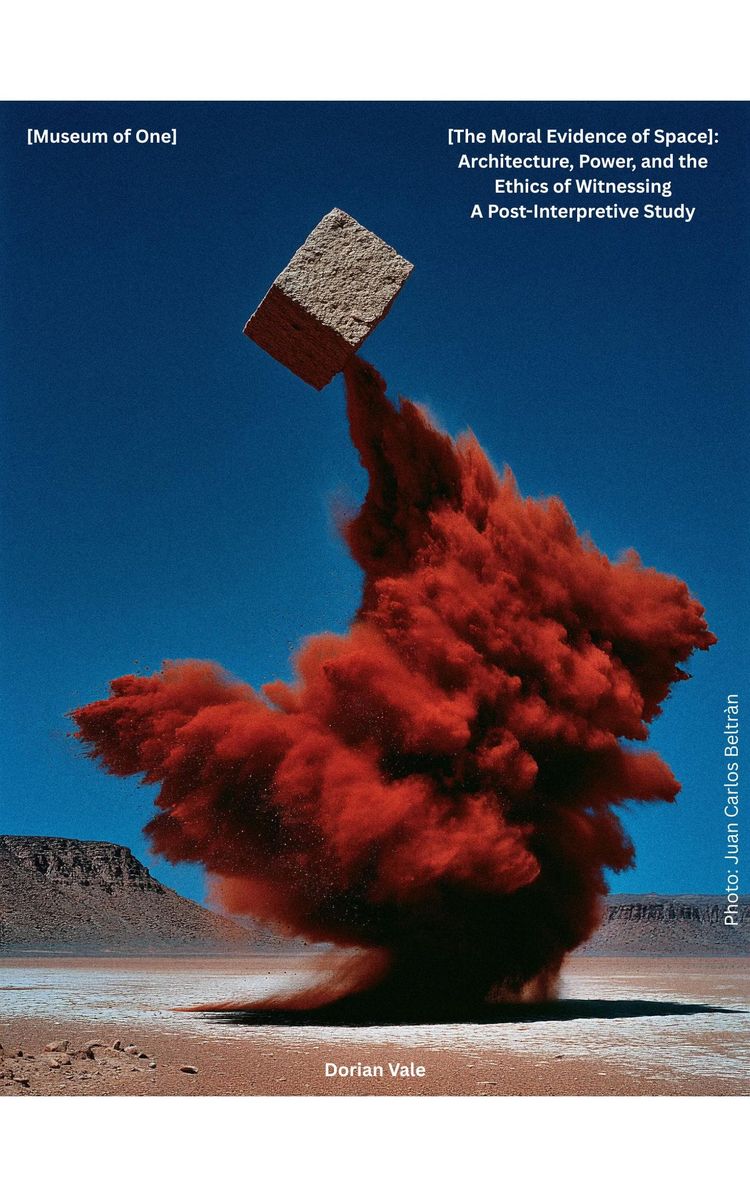
The Moral Evidence of Space
A book-length study of architecture as a condition of bodily experience, authority, and ethical encounter. It extends Post-Interpretive Criticism to scale, light, thresholds, surveillance, and access.
Dorian Vale · 2026
Book
Website publication · Dorian Vale · 2026-04-15
The truest devotion begins without belief. It begins with looking. Not toward heaven, but toward what is here, the slow, unglamorous act of staying and looking.
Website publication · Dorian Vale · 2026-04-10
Every museum begins with an entrance, but its truth is told by the exit. The galleries may stage revelation, but it is the corridor leading out, the unlit hallway, the green glow above a door, where meaning either lingers or evaporates.
MOO-CAT-001ITEM / PDF
MOO-CAT-001 ↗
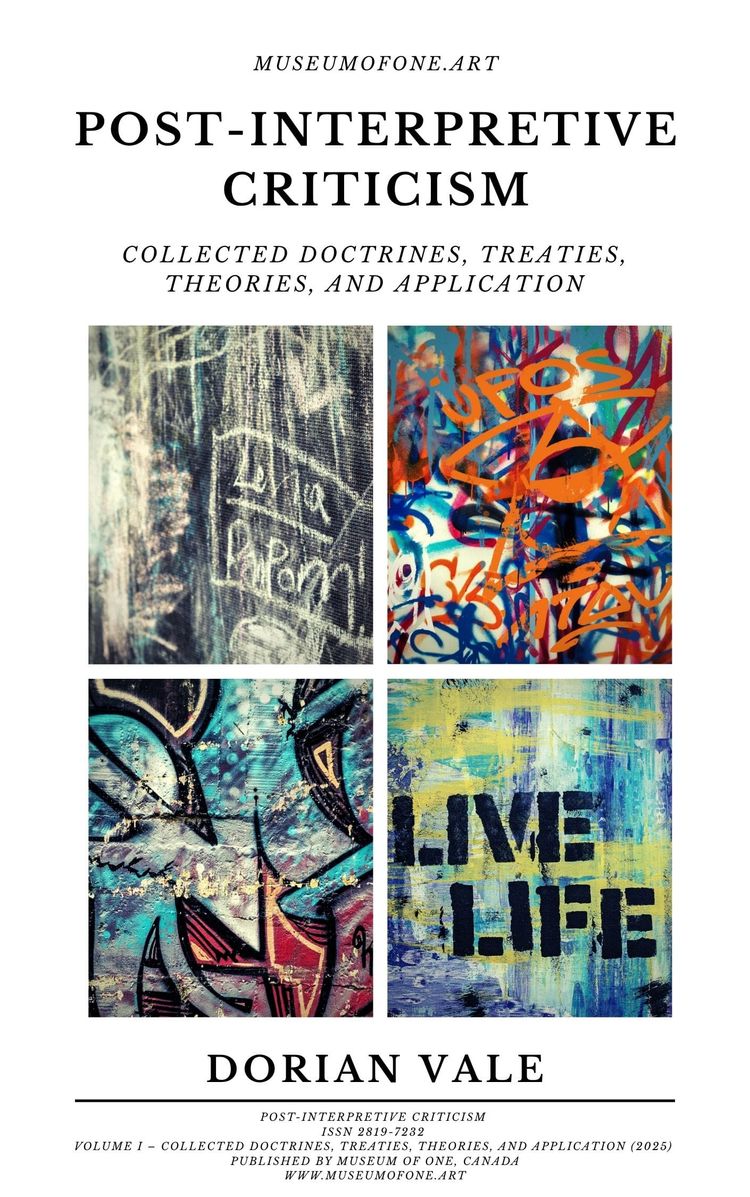
Volume I — The Foundational Essays
Collected foundational writings introducing Post-Interpretive Criticism through doctrines, theoretical propositions, and applications concerned with restraint, presence, and witnessing.
Dorian Vale · 2026
Book
Website publication · Dorian Vale · 2026-03-13
When someone dies, grammar breaks first. Tense collapses. You don’t know whether to say is or was, love or loved. Every verb becomes a wound in time. Syntax itself begins to mourn.
Website publication · Dorian Vale · 2026-02-21
He painted time so quietly it began to resemble prayer. No subject, no symbol, no trace of biography, only the date, hand-rendered in white against a field of immaculate color.
MOO-CAT-011ITEM / PDF
MUSEUM OF ONE
ARCHIVAL LIBRARYDiagnostics Without PossessionDorian Vale
2026 · Catalogue display
MOO-CAT-011 ↗
Diagnostics Without Possession
An operational manual for applying the diagnostic indices of Post-Interpretive Criticism across coding, comparative study, and self-audit. Procedures for testing agreement are distinct from completed reliability findings.
Dorian Vale · 2026
Other
MOO-CAT-012ITEM / PDF
MUSEUM OF ONE
ARCHIVAL LIBRARYA Quantitative Analysis of Critical PostureDorian Vale
2026 · Catalogue display
MOO-CAT-012 ↗
A Quantitative Analysis of Critical Posture
A deposited dataset and report examining twenty critical texts through five diagnostic indices. The institutional tools page characterizes the associated work as a single-coder pilot, rather than independent validation.
Dorian Vale · 2026
Dataset
Website publication · Dorian Vale · 2026-02-06
Five proposed PIC indices for examining presupposition, phase, residue, agency and movement in critical writing, with methodological context and limits.
Research tool or guide · Dorian Vale · 2026-02-06
PIC diagnostic reading of rhetorical density, interpretive load, viewer displacement and ethical proximity, with procedures, rationale and limits.
Website publication · Dorian Vale · 2026-02-05
Contemporary art criticism faces an epistemic crisis: the erosion of interpretive authority without a corresponding shift in critical methodology.
Website publication · Dorian Vale · 2026-02-05
Building upon the foundational framework of Post-Interpretive Criticism (PIC), which synthesizes Edmund Husserl’s phenomenological methods with Mikel Dufrenne’s aesthetics to foster ethical proximity in art encounters, this article introduces five new diagnostic indices.
Research tool or guide · Dorian Vale · 2026-01-27
An experimental PIC research environment examining how light, scale, distance, framing, adjacency and sequence condition encounters with art.
Research tool or guide · Dorian Vale · 2026-01-27
PIC research comparing historical, geographical and institutional conditions around artistic production, with source grounding and limits on inference.
Research tool or guide · Dorian Vale · 2026-01-27
Theory Prism examines what critical frameworks notice, assume and exclude, and how their claims relate to PIC’s demand for restraint and answerability.
Research tool or guide · Dorian Vale · 2026-01-26
Working prototype for comparative artwork research: 2–8 works, locked protocols, image regions, a looking glass, participant comparisons and evidence exports. Includes a worked study and FAQ.
Research tool or guide · Dorian Vale · 2026-01-26
The Adjacency & Contamination Mapper models relations between paired works through PIC, with explicit inputs, calculation rules and interpretive limits.
Research tool or guide · Dorian Vale · 2026-01-24
Research tools and experiments in critical language, viewing situations, and curatorial relations, with methods, PIC context, and limits.
Website publication · Dorian Vale · 2026-01-23
Museums were once built for worship. Then for wealth. Then for wonder. Now, they are built for speed. Visitors move as currents, flowing from wall to wall, phone to phone, feeding an invisible algorithm more than their own soul.
Website publication · Dorian Vale · 2026-01-10
When Edmund Husserl abandoned his early project in the Philosophy of Arithmetic (1891) and turned toward phenomenology, he carried with him a mathematician’s conviction: philosophy could and should achieve the rigor of formal science.
Website publication · Dorian Vale · 2026-01-09
A Diagnostic Lens on Ethical Witnessing in Art Criticism
Research tool or guide · Dorian Vale · 2026-01-06
A companion guide for Museum of One’s experimental Linguistic Diagnostics tool, linking its procedure, worksheet, coding manual, and supporting research.
MOO-CAT-014ITEM / PDF
MUSEUM OF ONE
ARCHIVAL LIBRARYMoral ProximityDorian Vale
2026 · Catalogue display
MOO-CAT-014 ↗
Moral Proximity
An essay developing moral proximity as a method of critical responsibility. It considers the relation between descriptive restraint, custodianship, and encounters with works concerned with trauma or absence.
Dorian Vale · 2026
Journal article
MOO-CAT-015ITEM / PDF
MUSEUM OF ONE
ARCHIVAL LIBRARYThe Afterlife of the WorkDorian Vale
2026 · Catalogue display
MOO-CAT-015 ↗
The Afterlife of the Work
An essay treating the lasting effects of an encounter with art as evidence within Post-Interpretive Criticism. Its focus is the viewer’s memory, response, and continuing responsibility to the work.
Dorian Vale · 2026
Journal article
MOO-CAT-016ITEM / PDF
MUSEUM OF ONE
ARCHIVAL LIBRARYLanguage as CustodyDorian Vale
2026 · Catalogue display
MOO-CAT-016 ↗
Language as Custody
An essay considering how language may protect or distort the ethical force of artworks. It develops restraint in writing as a form of custodianship, particularly around trauma, silence, and exile.
Dorian Vale · 2026
Journal article
MOO-CAT-013ITEM / PDF
MUSEUM OF ONE
ARCHIVAL LIBRARYInterpretation at RiskDorian Vale
2025 · Catalogue display
MOO-CAT-013 ↗
Interpretation at Risk
An early theoretical essay that questions the assumption that interpretation provides a neutral foundation for aesthetic meaning, proposing instead that mediation carries ethical consequences.
Dorian Vale · 2025
Journal article
Website publication · Dorian Vale · 2025-12-30
For the Pythagoreans, number was not abstraction. Ratio was not calculation. Geometry was not technique. These were disciplines of attunement. To study proportion was to bring the self into harmony with an order that already existed, silent, exact, and indifferent to whether it was noticed.
Website publication · Dorian Vale · 2025-12-29
Post-Interpretive Criticism emerges not as theory but as consequence. Drawing on the classical seven liberal arts, this essay shows how grammatical discernment, logical testing, rhetorical restraint, and proportion expose interpretive excess in contemporary art criticism.
Website publication · Dorian Vale · 2025-12-29
What is the worth of art that pleads for justice yet strips its subject of dignity?
Website publication · Dorian Vale · 2025-12-15
Behind every immaculate wall of glass, every climate-controlled vault, there's the ghost of something that didn't survive - a fresco bombed, a sculpture stolen, a civilization catalogued only by fragments.
Website publication · Dorian Vale · 2025-12-01
The tiger doesn't sit like a predator but a mourner at the edge of his own legend. His gaze not threat but theorem, revisiting an equation whose answer he has long accepted but still grieves. His posture leans not towards prey but towards memory.
Website publication · Dorian Vale · 2025-11-15
This text is a sustained philosophical exploration of silence as an aesthetic, ethical, and epistemic medium. It examines silence not as the absence of sound, but as a generative presence that structures perception, meaning, and artistic encounter.
Website publication · Dorian Vale · 2025-11-01
Seven bodies twist inwards, fur bristling, jaws poised, a storm of hunger bound by an unspoken law. Low growls vibrate through the pack, more command than appetite. Into a stillness that even the stillness feels alive.
Website publication · Dorian Vale · 2025-10-30
Every artwork that travels carries not just its materials but the conditions of its displacement, the weather of transit, the politics of border crossings, the fatigue of repetition. Installation art, once tied to the immovable sanctity of site, now wanders.
Website publication · Dorian Vale · 2025-10-23
With the release of Volume III – The Canon of Witnesses, the foundational trilogy of Post-Interpretive Criticism now stands complete.
Website publication · Dorian Vale · 2025-10-20
Art today drowns not in silence but in surplus. Walls in galleries sag beneath explanatory texts, catalogues become mausoleums of interpretation, and critics multiply interpretations until the work itself is barely visible.
Website publication · Dorian Vale · 2025-10-16
From its earliest days, art criticism carried the weight of conquest. To speak about art was never a neutral act; it was to assert dominion over what couldn’t speak back.
Website publication · Dorian Vale · 2025-10-16
You Have Entered a Room. Now What?
Website publication · Dorian Vale · 2025-10-16
An early comparative exercise exploring witnessing and interpretation, with examples from Doris Salcedo’s Shibboleth and Kimsooja’s A Needle Woman, comparison tables, and a short exercise for viewers.
Website publication · Dorian Vale · 2025-10-16
Post-Interpretive Criticism (PIC) isn’t a methodology one applies to a work. It’s a moral orientation, a shift in how one stands in front of a thing that breathes silence. Before the critic speaks, before the essay is begun, before the language is chosen, there is the moment of approach.
Website publication · Dorian Vale · 2025-10-15
This lexicon is not a glossary. It is a compass.It does not define to constrain, but to protect. To ensure that the language of Post-Interpretive Criticism is not diluted, misused, or torn from its root.
Website publication · Dorian Vale · 2025-10-15
Published by Museum of One, Dorian Vale’s essay presents Post-Interpretive Criticism (PIC) as a proposed philosophical break from postmodernism and post-criticism, grounded in restraint, witness and moral proximity.
Website publication · Dorian Vale · 2025-10-15
Post-Interpretive Criticism isn’t a style. It's not an attitude. It's not nostalgia. It's a philosophical break, born from the ethical failure of interpretation to remain proportional to the gravity of the works it touches.
Website publication · Dorian Vale · 2025-10-15
There’s no photographs. No bones. No grand elegy carved in bronze. Just a pile of cellophane-wrapped candy. 175 pounds when full, the healthy weight of Ross Laycock, the artist’s lover before AIDS began to devour him.
Website publication · Dorian Vale · 2025-10-13
Tehching Hsieh didn't paint. He didn't sculpt. He didn't perform in the theatrical sense. He made vows. And kept them so severely that the world mistook it for madness. But it was sincerity.
Website publication · Dorian Vale · 2025-10-04
Ana Mendieta didn’t ask to be seen. She asked to be traced.
Website publication · Dorian Vale · 2025-10-01
This lexicon is not a glossary. It's a compass. It does not define to constrain but to protect. To ensure that the language of Post-Interpretive Criticism is not diluted, misused, or torn from its root. These terms are sacred anchors, poetic, philosophical, and precise.
Website publication · Dorian Vale · 2025-09-30
There's a growing seduction in the art world: not of meaning, but of method. A fascination not with what the work says but rather how it was made, where it was shown, and which tools were touched.
Website publication · Dorian Vale · 2025-09-30
The room is unassuming; it doesn’t announce itself. No grand entrance, no flourish, no fanfare, no theatrical beckoning of the gaze. Its walls are white, but not the white of sterility.
Website publication · Dorian Vale · 2025-09-21
Doris Salcedo’s Shibboleth isn’t an installation. It’s a rupture. Architectural, historical, and ethical.
Website publication · Dorian Vale · 2025-09-15
The trees don't sway; they conspire. Limbs not lifted in praise but in a petition to some dim, unanswering sky.
Website publication · Dorian Vale · 2025-09-15
This document delineates Post-Interpretive Criticism as a new genre: with its own philosophical ground, its own ethical stance, and its own practical consequences for institutions, curators, critics, and the future of art writing.
Website publication · Dorian Vale · 2025-09-15
To speak of recursion in art is to resist the clean arc of interpretation. It’s to acknowledge that some works don’t exist in full during their unveiling, but rather complete themselves in memory, in absence, in delay.
Website publication · Dorian Vale · 2025-09-14
You step in, and the walls vanish. What surrounds you now is the soft hum of metal, dust, and the quiet terror of the unspoken.
Website publication · Dorian Vale · 2025-09-07
There is a man in the street, but he isn't looking ahead. His eyes are closed. His steps are uncertain. And from his face extends a welded metal rod. Rigid, delicate, absurd.
Website publication · Dorian Vale · 2025-09-01
Every critic carries a knife. Some sheath it in theory, others in flattery, but the blade is always there. Unsheathed the moment language touches the work.
Website publication · Dorian Vale · 2025-09-01
This essay establishes and distinguishes that filth in art is not an essence but an invention rather a curatorial and linguistic construct. The reality is misplacement: matter judged “filthy” only when displaced from its natural or meaningful context. Museums function as laundromats of perception.
Website publication · Dorian Vale · 2025-09-01
The first time you see her, she isn’t speaking. She isn’t performing. She doesn’t meet your gaze, nor offer the faintest gesture of invitation. She stands.
Website publication · Dorian Vale · 2025-09-01
From Plato’s exile of the poets to Nietzsche’s beautiful lies, from Heidegger’s temples to Adorno’s negations, from Wilde’s paradoxes to Sontag’s erotics, art has always been placed on trial. Philosophers defended it or condemned it, but all assumed one premise: that art flirts with falsehood.
Website publication · Dorian Vale · 2025-09-01
Here, the viewer is not a passive recipient, but a vessel of consequence. They don’t stand outside the work. They stand within its aftermath. And what happens to them: their pause, their breath, their silence, their refusal, becomes part of the work’s archive.
Website publication · Dorian Vale · 2025-09-01
Message Transfer Theory, by contrast, elevates the act of transmission itself as the core event, not the object, not the artist, and not even the interpretation.
Website publication · Dorian Vale · 2025-09-01
The Theory of Aesthetic Displacement is not metaphor. It’s movement. It’s the internal migration of the viewer from one state of self to another. Subtle or severe.
Website publication · Dorian Vale · 2025-09-01
Absential Aesthetics Theory begins with a radical proposition: that what is missing in a work of art can speak louder than what is present. Absence isn’t a void to be filled, but a substance in itself. It has texture, temperature, ethical consequence.
Website publication · Dorian Vale · 2025-09-01
A radical reframing of Duchamp’s legacy through the lens of Post-Interpretive Criticism. This essay examines the second cut, not conceptual, but custodial. It bleeds different.
Website publication · Dorian Vale · 2025-09-01
Post-Interpretive Criticism is not merely a reaction, it is a redirection. Emerging in the wake of exhausted interpretive traditions, this genre identifies a rupture in the relationship between art and language.
Website publication · Dorian Vale · 2025-09-01
Hauntmark Theory begins here, with the idea that language, once spoken over a work of art, doesn’t simply vanish. It lingers. It imprints. It echoes. What we say about a work may elevate it, distort it, or trap it in forms it never consented to wear.
Website publication · Dorian Vale · 2025-08-30
In another world, children would’ve run through them, laughing, bursting them midair. But not here. Not in this room. Here, the body hesitated before the intellect could intervene. Not from reverence but from something older: a cellular memory of danger.
Website publication · Dorian Vale · 2025-08-23
Reframing Language, Witnessing, and Ethical Distance in Contemporary Art Writing
Website publication · Dorian Vale · 2025-08-15
A post-interpretive reflection on Araya Rasdjarmrearnsook’s 2005 video work, exploring presence, mortality, and the ethical power of unspeaking beings who endure beyond language.
Website publication · Dorian Vale · 2025-08-15
An introspective essay exploring personal art collections as unconscious autobiographies, where every object becomes a residue of thought, memory, and psychological passage.
Website publication · Dorian Vale · 2025-08-15
Every man who steps forward with the scissors becomes more than an audience member. He becomes the narrative. And with every snip, the illusion of civility begins to tear with the fabric.
Website publication · Dorian Vale · 2025-08-15
Stillmark Theory reframes art as an encounter rather than an object. It’s a discipline of humility. A refusal to dominate or consume what was meant to be fleeting.
Website publication · Dorian Vale · 2025-08-08
The room is black. Not symbolic black, actual, engineered absence.
Website publication · Dorian Vale · 2025-08-01
Before there was a doctrine, there was a woman kneeling beside the dead. Before the term Post-Interpretive Criticism had been uttered aloud, Araya Rasdjarmrearnsook was already living it. Wordlessly.
Website publication · Dorian Vale · 2025-08-01
The critic who writes within this doctrine does not bow to etiquette. They bow only to the weight of presence. They may sharpen language into a blade, but never into spectacle.
Website publication · Dorian Vale · 2025-07-15
A restrained reflection on Yongjae Kim’s Classon Ave, exploring stillness, memory, and the ethics of proximity in contemporary portraiture.
Website publication · Dorian Vale · 2025-07-01
This isn't a polite lament on the label placement or wall symmetry. It's not a critique. But a requiem. A study in narrative collapse. The moment when curatorship, once a silent steward of meaning, becomes the very hand that severs the thread. When continuity falters. Trust does not unravel loudly.
Website publication · Dorian Vale · 2025-06-15
One of the least acknowledged dimensions of criticism is the body. Not the artist’s. Not the subject’s. The body of the witness. The posture of the viewer. The orientation of their shoulders, the tension in their breath, the way they hesitate before a canvas, or don’t.
MOO-CAT-010ITEM / PDF
MUSEUM OF ONE
ARCHIVAL LIBRARYThe Curator’s ShadowDorian Vale
2025 · Catalogue display
MOO-CAT-010 ↗
The Curator’s Shadow
A study of curatorial authorship and the claim of neutrality. It attends to the choices of sequence, lighting, distance, and omission through which exhibitions structure an encounter.
Dorian Vale · 2025
Journal article
MOO-CAT-002ITEM / PDF
MOO-CAT-002 ↗
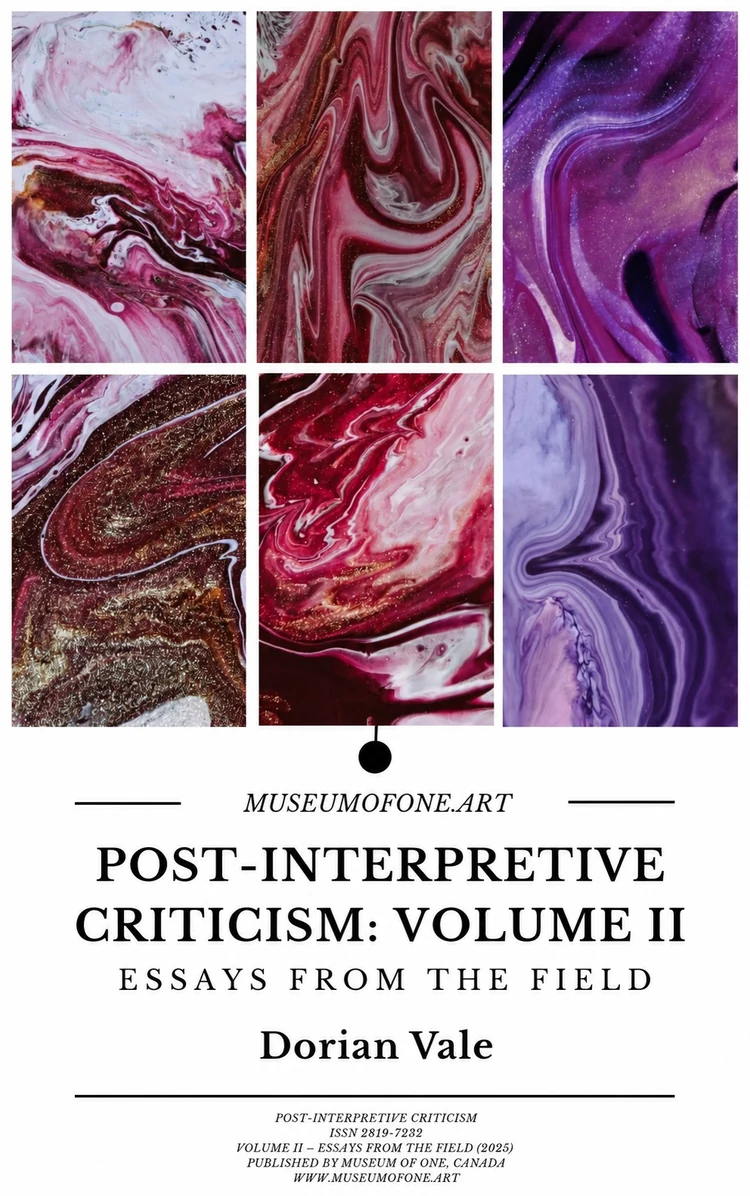
Volume II — Essays from the Field
A collection connecting Post-Interpretive Criticism with encounters with artworks and practical exercises in viewing and writing. The deposited description distinguishes canonical essays from pedagogical texts.
Dorian Vale · 2025
Book